The Duke of Beef

The title of this post is a 50:50 pun on the old-fashioned dish Beef Wellington and a restaurant that operated in the Dandenong Range to the east of Melbourne a few decades ago. The restaurant, called The Baron of Beef, offered a fixed menu bookended by soup and steamed pudding, with a main course of roasted whole sirloin of beef and all the trimmings, served in a music-hall manner by staff dressed in costumes from England’s Robin Hood era. (A magnificent natural park called Sherbrooke Forest is one of the Dandenong’s most famous features.) Maggie and I had several family meals at The Baron of Beef during the three years of our first relationship (1969-1972).

Anyway, back to the Duke and the retro dish named in his honour. There was a time when Beef Wellington was a must-have dish at dinner parties prepared in well-to-do Melbourne households and it is still widely available as a heat-and-eat item at butchers frequented by families of the same ilk. During a previous life, Maggie often prepared this dish from scratch, and went to the extent of decorating the tailor-made servings with the relevant initials of their recipients. I, on the other hand, had only attempted this feat once, with limited success, so I was quite impressed the first time Maggie prepared it in our kitchen. And the second and third times.

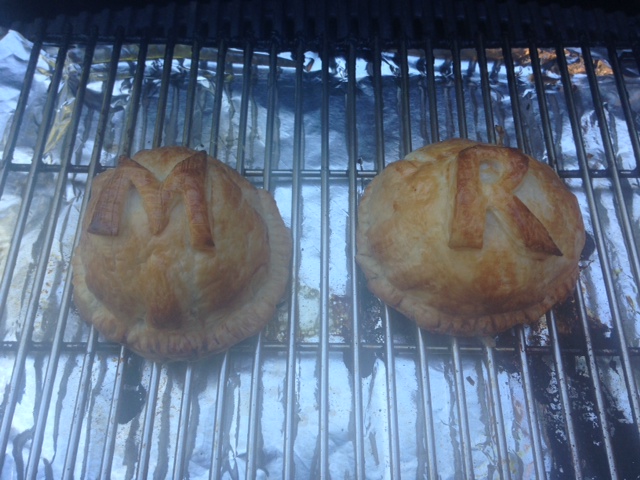
So, when our Christmas Day entree of beef carpaccio left us with a sizeable piece of mostly-rare beef eye fillet, I proposed that we convert it to a meal of Beef Wellington. Here is a (poor-quaility) photo of how it turned out …

photo 5-2… and here is how we did it.

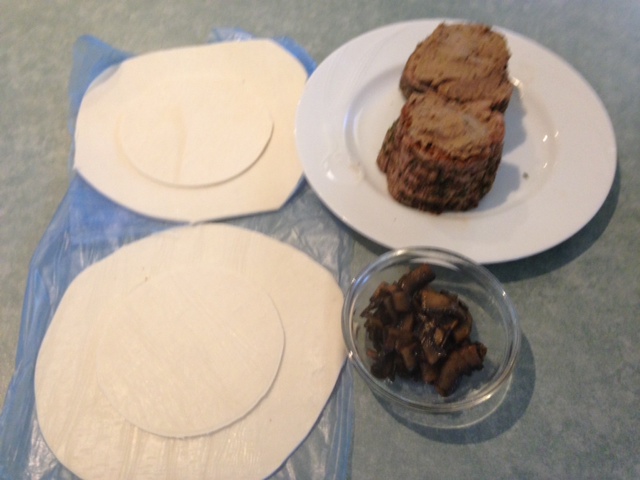
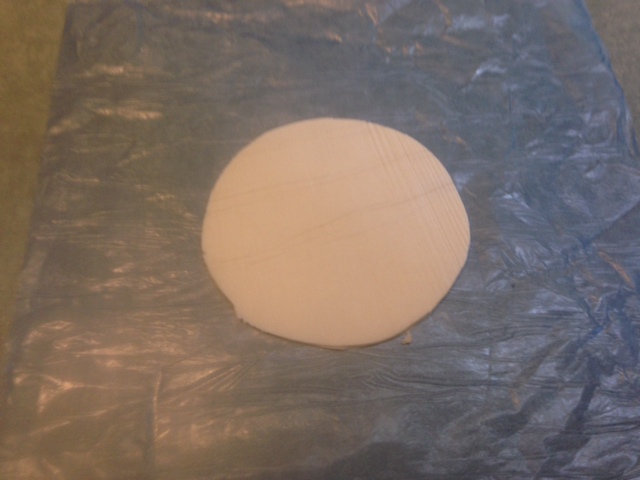
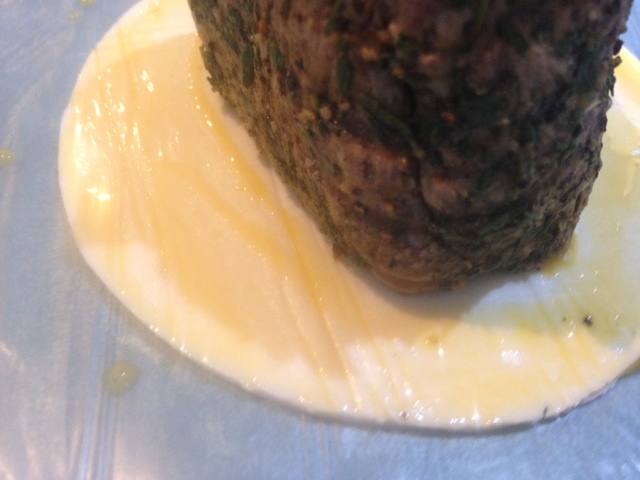
Firstly, Maggie cut the beef into two portions and briefly seared the rare surfaces in a non-stick pan. 100g of Swiss Brown mushrooms were sliced then sauteed in butter in the same pan until quite soft. Meanwhile, Maggie cut out four discs of puff pastry, two smaller ones for the bases and two for the caps.

photo 1   photo 2
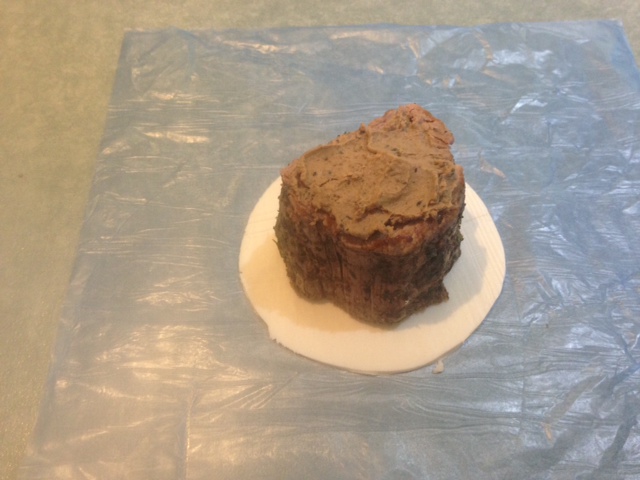
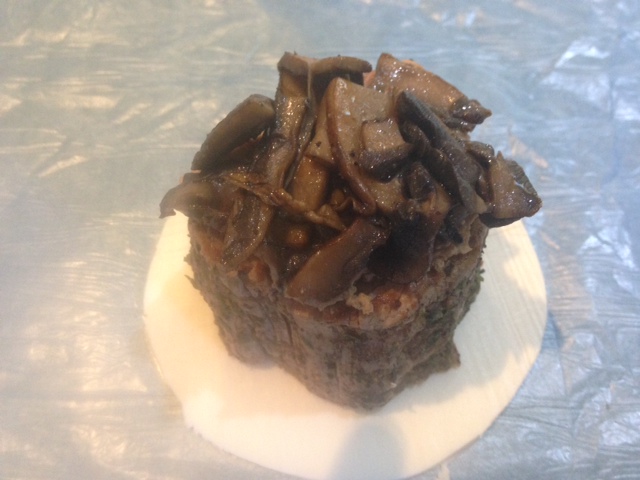
Each piece of beef was placed on a base and topped with a generous amount of pate infused with black pepper then about 1/3 of the mushrooms.

photo 3   photo 4
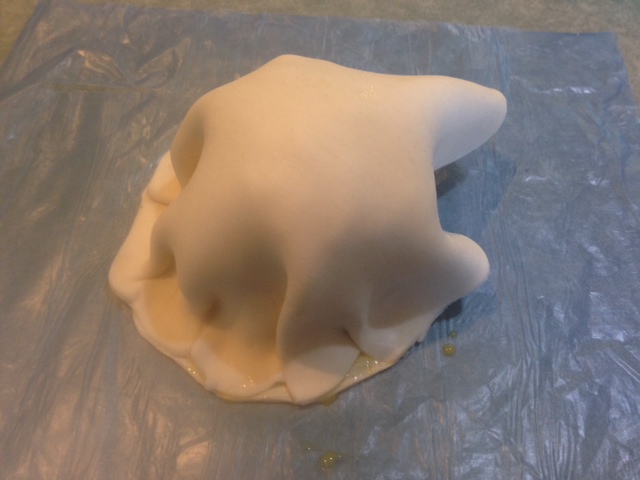
A beaten egg, or eggwash, is brushed over the exposed surface of each base, the cap is added and, using a fork and more eggwash, is sealed to the base

photo 5   photo 1-1

photo 2-1   photo 3-1

photo 4-1   photo 5-1
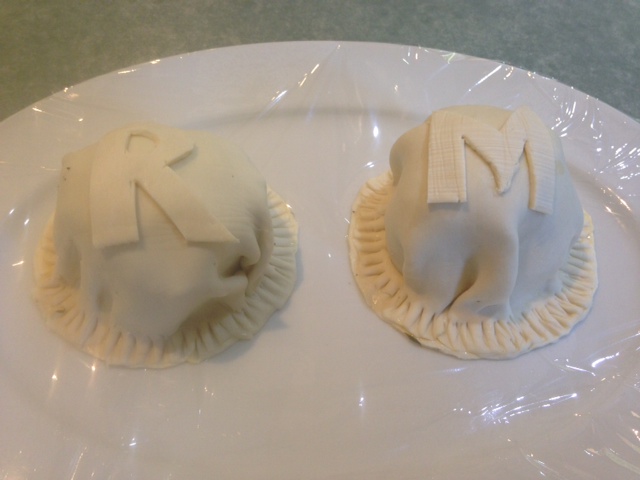
Maggie then added puff pastry initials to each piece and brushed the finished product with the egg wash.

photo 1-2   photo 2-2
We baked the dish for about 25 minutes in our Weber Q at about 180C. Meanwhile, I made a jus by simmering the leftover mushrooms in 1/2 a cup of dry red wine and 1/4 cup of tawny port for about 10 minutes. After the jus had been strained, Maggie blended it with a small amount of commercial gravy powder to complete the sauce.

photo 3-2   photo 4-2


Posted in Cooking | Tagged , | 1 Comment

Festive food: Christmas Day in pictures


Table set for four

Table set for four

Entree of salmon, Japanese noodles and wasabi

Entree of salmon, Japanese noodles and wasabi

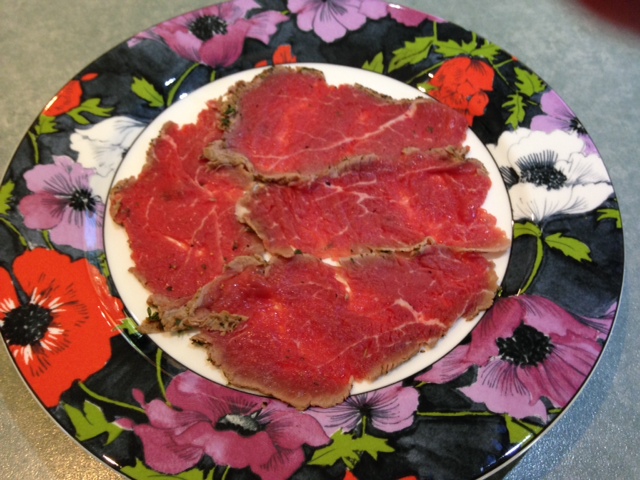
Carpaccio 1   Carpaccio 2

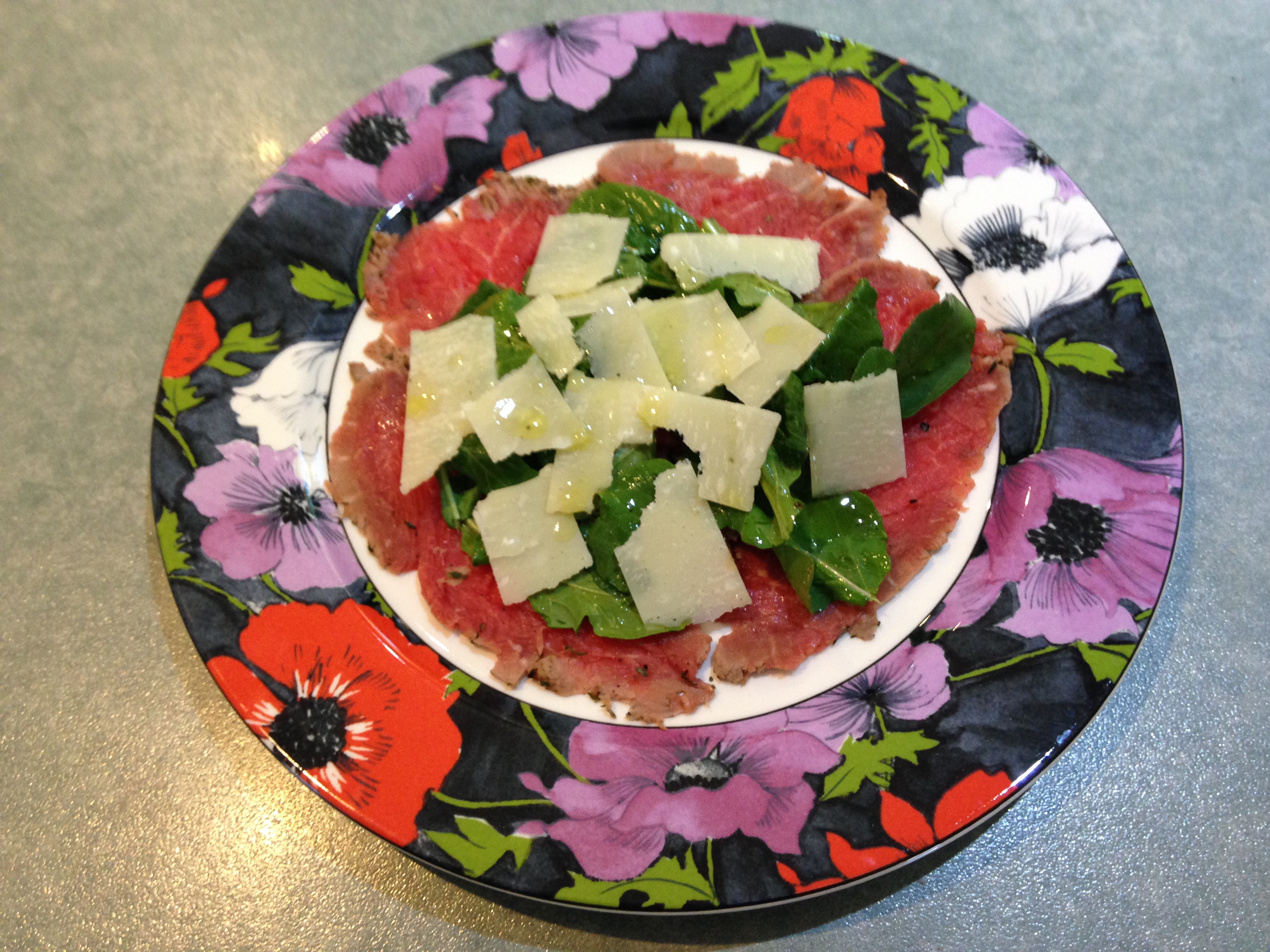
Beef carpaccio with rocket and shaved Italian parmesan

Beef carpaccio with rocket and shaved Italian parmesan

Platter of chargrilled spatchcock & peaches

Platter of chargrilled spatchcock & peaches

Lemon & raspberry tart with lime & coconut ice cream

Lemon & raspberry tart with lime & coconut ice cream

Words to follow later this week.

Posted in Cooking, Home life | Tagged , , | Leave a comment

Not dreaming of a white Christmas …

… but we are remembering one

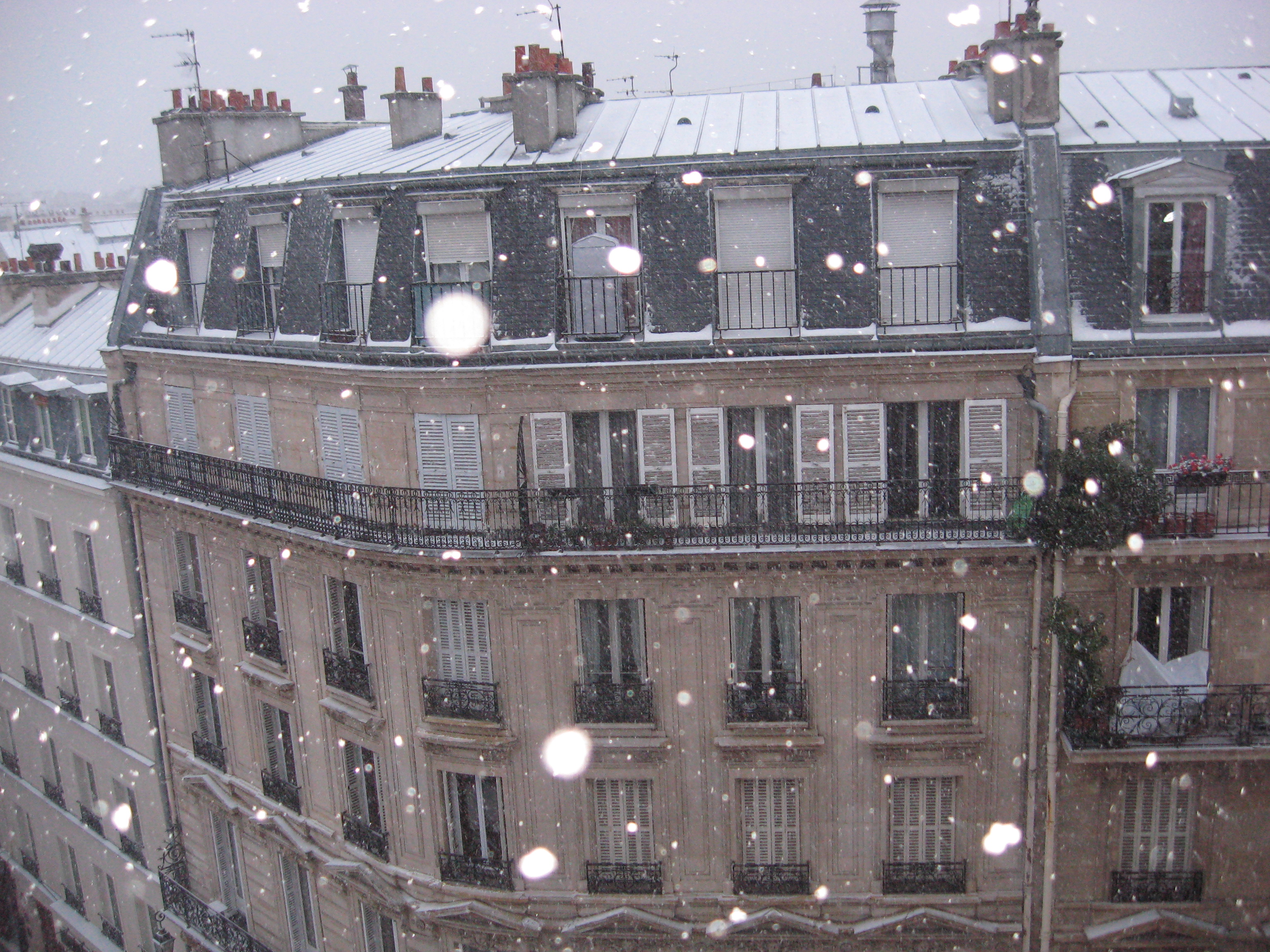
Our first visit to France was in 2009 and we arrived in Paris in the second week of December. The first three days were sunny but more and more chilly. Then, on our fourth morning, we woke to find snow falling outside our hotel window.

Morning snow from our hotel window

Morning snow from our hotel window

As you might imagine, we Aussies were quite excited. After breakfast – orange juice, croissants, coffee, you know how it goes in France – we made our way to Musee Rodin. The garden scenes were breathtaking.

Thinking of a white Christmas?

Thinking of a white Christmas?

From the Musee Rodin

From the Musee Rodin towards Montparnasse

At the end of that week, we joined a coach tour of France. Our first day took across the snow-laden countryside of Burgundy towards the foothills of the Alps.

Ice wine on the vine

Ice wine on the vine

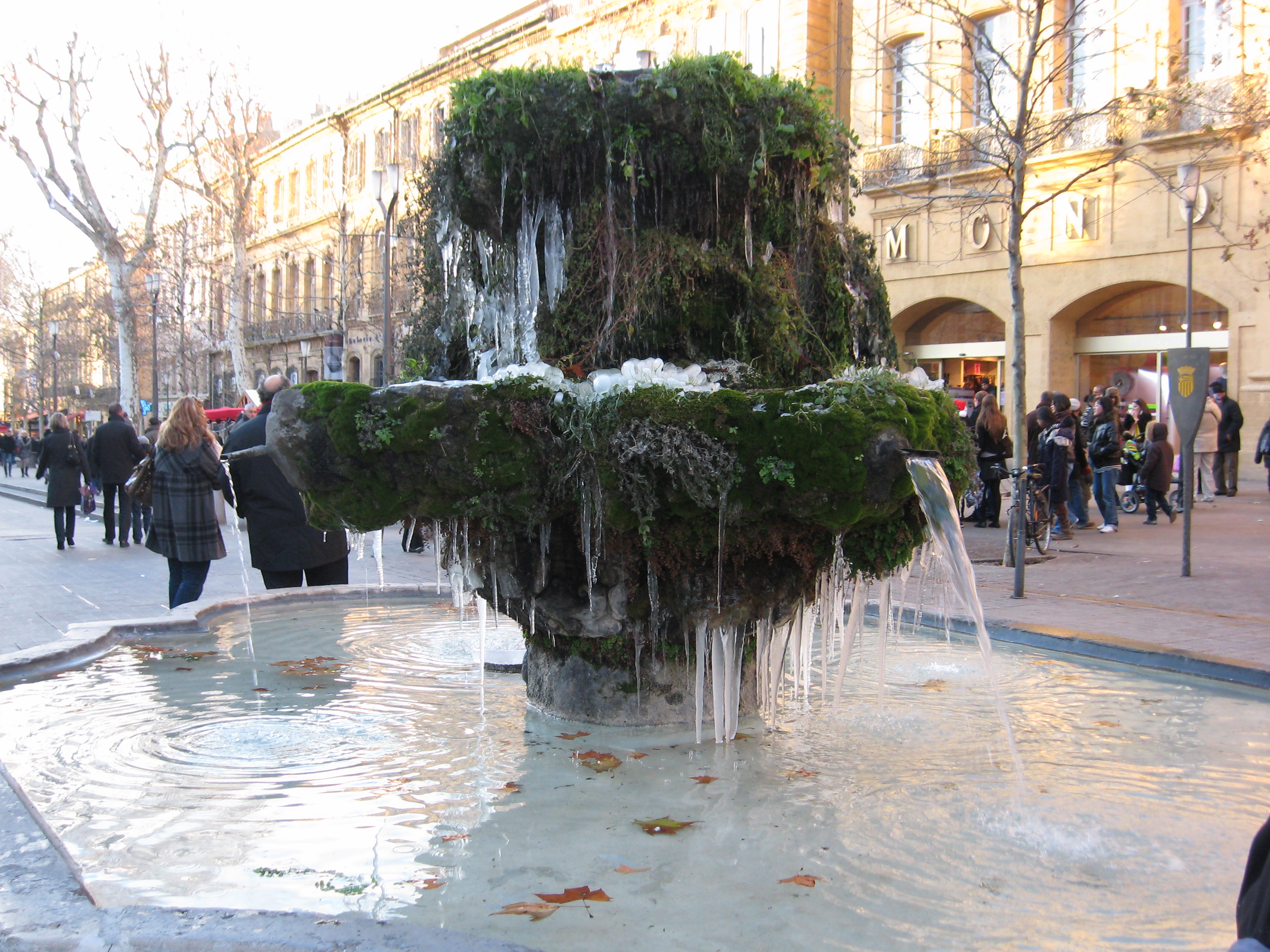
The second day of the tour took us further south, arriving at Aix-en-Provence in the afternoon. In the main street, we found a frozen fountain cascade. Seriously cold!

Fountain frozen in time, Aix-en-Provence

Fountain frozen in time, Aix-en-Provence

The tour then took us to the Mediterranean coast, with two nights in each of Nice and Marseilles. (We even saw some snow in shaded gullies on the outskirts of Nice!) Then we made our way to Avignon, where we spent Christmas Eve. The night market at Avignon was the prettiest we saw in France.

Market, Christmas Eve, Avignon

Market, Christmas Eve, Avignon

In the local Hotel de Ville (town hall) there was a display of santons, the traditional nativity figurines. Visit http://en.wikipedia.org/wiki/Santon_(figurine) for more information.

Display of Santons, Avignon

Display of Santons, Avignon

Our kitchen santon

Our kitchen santon

It is also traditional for each town hall to feature a table set for a Christmas meal and laden with various treats.

French Christmas dinner table, Hotel de Ville, Avignon

French Christmas dinner table, Hotel de Ville, Avignon

Posted in Travel | Tagged , , , , , | Leave a comment

Festive food: delicious retro lunch

My mother and father have resided in a nursing home since early 2012. Mum has severe Alzheimer’s disease and can no longer be taken out of the home. Dad has some physical issues but is strong mentally and his appetite for fine food is undiminished.

So, knowing that we had other plans for Christmas Day, Maggie and I offered to prepare and share a festive meal with him on the Sunday before Christmas. I’m not sure whether or not it was a sub-conscious response to Dad’s age, but the menu we hit upon was decidedly retro.

We began with an entree of prawn cocktail, a combination of prawn flesh and thick cream flavoured with Worcestershire and tomato sauces, lemon juice, salt and pepper, served atop a bed of shredded lettuce. For better or for worse, this has been served as part of countless thousands of Australian festive meals for as long as we can remember. Today’s version was up there with the best we’ve had – top quality South Australian prawns, a well-balanced sauce and fresh cos lettuce that Maggie had shredded with our bread knife.

No photo available – we were too busy getting started!

The main course comprised roast chicken (plus herb, bread and prosciutto stuffing), potato roasted in olive oil with whole cloves of local garlic and chopped sage and rosemary, and a beetroot and carrot parcel, all cooked in the Weber Q; fresh green beans that Maggie had topped, tailed and put through a slicer; gravy; and a slice or two of the ham we had prepared on Friday.

Plate of roast chicken fit for a father or, should he be so lucky, a king

Festive plate of roast chicken fit for a father or, should he be so lucky, a king

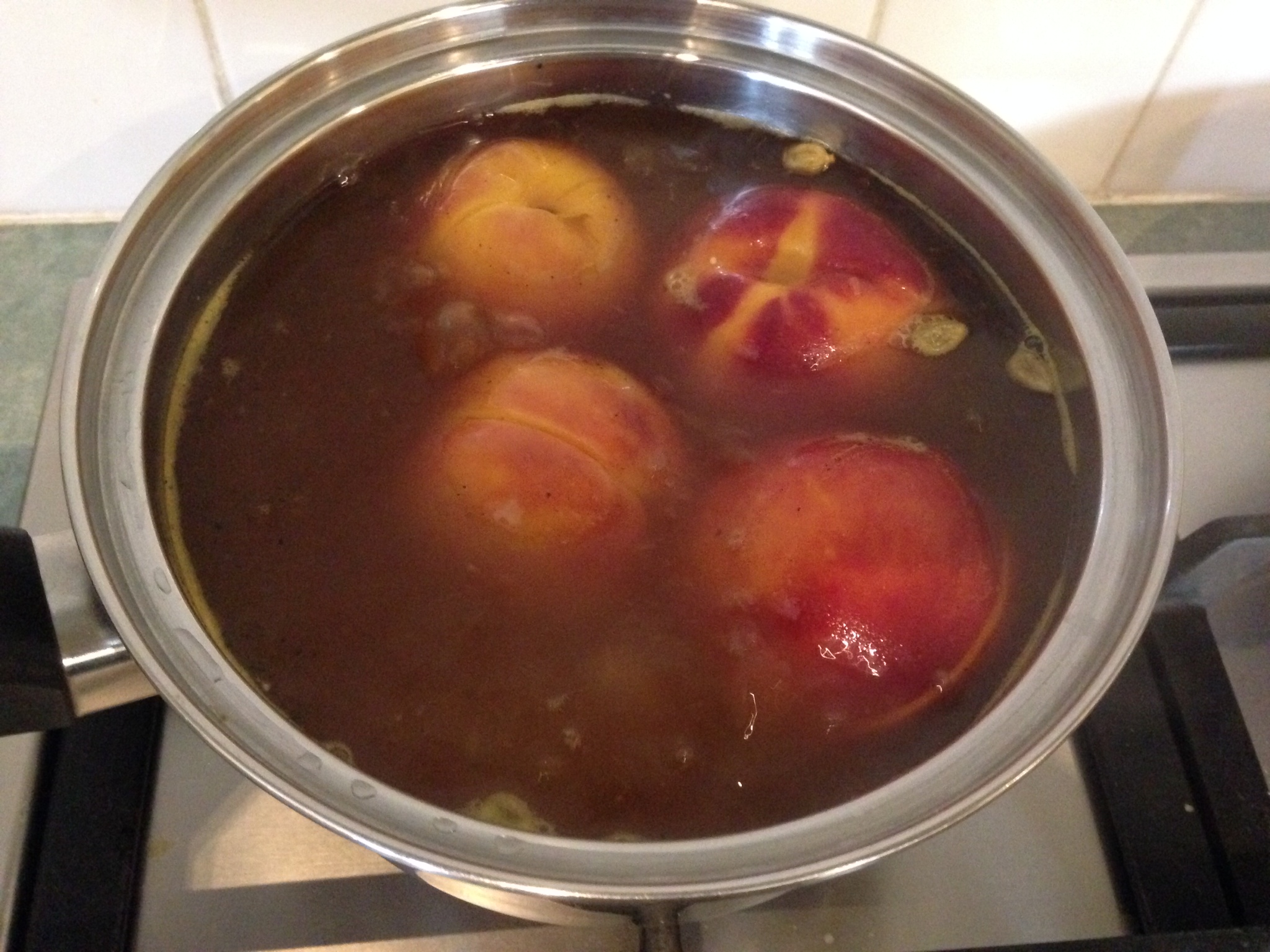
For dessert, we made a peach and raspberry trifle. A trifle can be prepared using a cooked custard or one that is not cooked. We prefer the latter, as we only make a trifle in summer, using fresh seasonal fruit. The peaches are poached as indicated in the recipe for poached pears.

Ingredients

3 eggs, separated
70g caster sugar
¼ tsp vanilla essence
150g mascarpone cheese
1/3 cup each of medium-dry and sweet sherry
6-8 sponge finger biscuits (savoiardi)
2 poached peaches
1 punnet (185g) of raspberries
toasted almond flakes

Method

  1. Place the egg yolks, sugar and vanilla essence in a large bowl and beat until pale and creamy (about 5 minutes). Add the mascarpone and beat until smooth.
  2. Combine the sherries in a wide, shallow bowl. Dip one of the biscuits in the sherry and, when it is well soaked, place it on the base of a straight-sided dish that will hold all the biscuits snugly (we use 6 or 7 biscuits and a glass dish that is 20cm in diameter). Repeat with the remaining biscuits. Drizzle ¼ cup of the poaching liquid over the biscuits.
  3. Cut each peach in half, remove the stone and slice the flesh finely
  4. Beat the egg whites until soft peaks are formed. In two batches, fold the whites into the yolk and mascarpone mixture.
  5. Spoon 1/3 of the mascarpone mixture over the biscuits. Arrange half of the peach slices and 1/3 of the raspberries as the next layer. Repeat once. Add the last of the mascarpone mixture, distribute the remaining berries and scatter with toasted almond flakes.
  6. Cover with cling wrap and refrigerate for several hours so the trifle can steep in all the flavours.

Peaches 1   Peaches 2

Trifle 1   Trifle 3

Posted in Cooking | Tagged , , , , | Leave a comment

Beaune-inspired-and-infused chicken dinner

This is the second-to-last of the many dishes that we enjoyed during our travels in Europe earlier this year and have since added to our repertoire. (Tafelspitz will be the last but that is a project for winter 2015.)

We both had a lovely main course of this traditional Burgundian dish on the second night that we dined at La Grilladine restaurant in Beaune. A couple of months after we returned home, we found a recipe online and used it once to prepare an acceptable dish.  However, we both felt that we could do better.

The dish that inspired us

The dish that inspired us

Last week, we made it again, applying several changes we had decided to make to the original recipe. It is now ready to share. We are still using the jars of mustard we bought at Edmond Fallot moutarderie in Beaune. These mustards are stronger than the Dijon mustard we buy at supermarkets for general domestic use.  For this dish, we used the one that contains some honey, to accentuate the sweet notes of the sauce.

Ingredients

20g butter
2 shallots, finely chopped
3 tsp strong Dijon mustard or 1 tbsp (20ml) regular
80ml dry white wine
150ml chicken stock
100ml cooking cream
olive oil, for frying
3-4 chicken breast fillets, trimmed

Method

  1. Melt the butter in a saucepan over low heat. Add the chopped shallots and sauté for about 10 minutes.
  2. Add the mustard and wine, bring to the boil and simmer for 3 minutes. Add the stock, return to the boil and simmer for about 8 minutes.
  3. Strain the sauce to remove the pieces of shallot, pressing down with the back of a spoon to extract as much sauce as possible.
  4. Heat some olive oil in a non-stick pan over medium-high heat. Fry chicken 4-6 minutes on each side, depending on thickness, or until browned and cooked through.
  5. While the chicken is cooking, add the cream to the sauce and gently simmer it for 3 to 5 minutes to thicken the sauce.
  6. Slice pieces of chicken, transfer to each dinner plate and drizzle sauce over the meat.
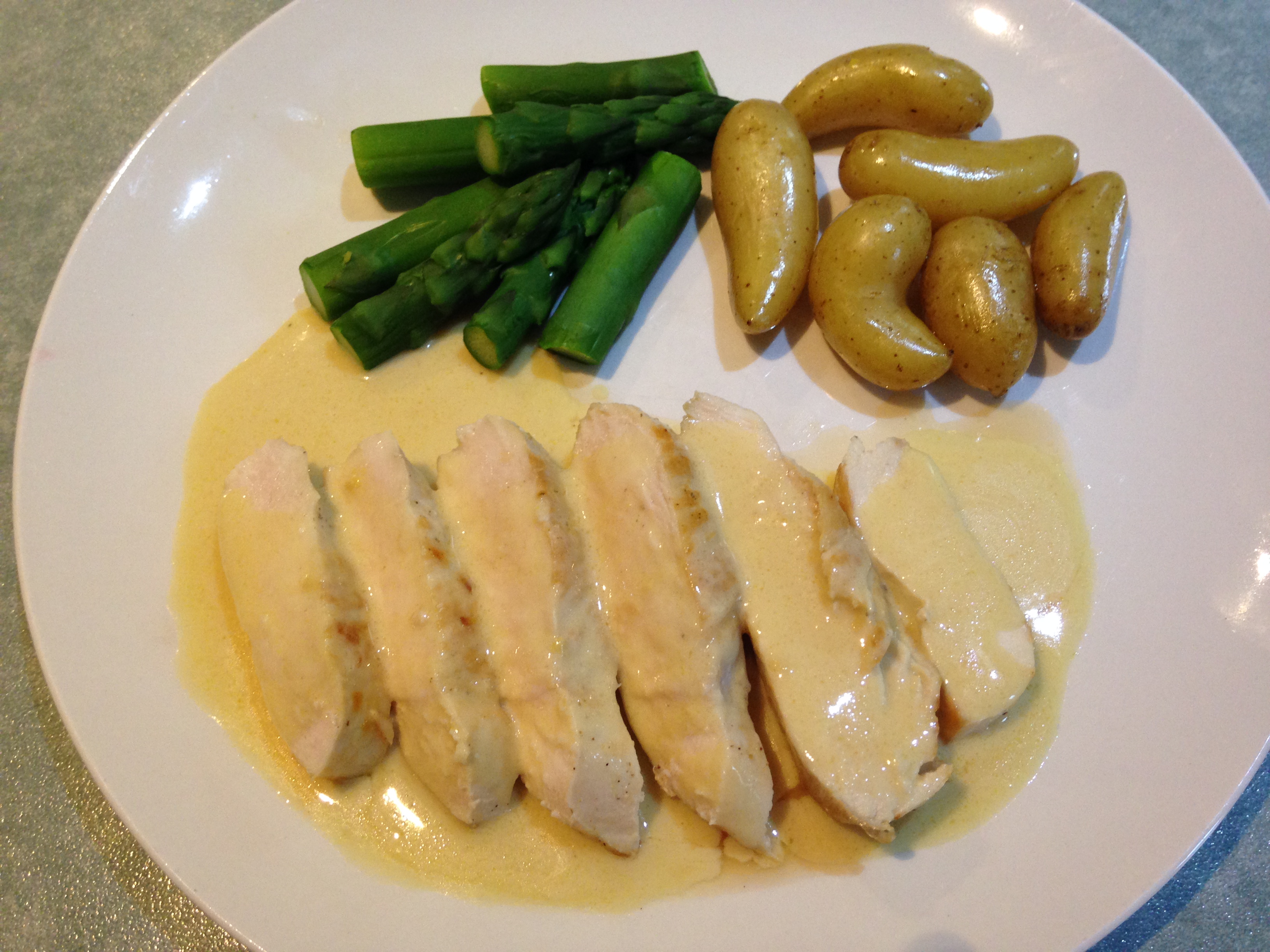
  7. We serve the chicken with gently boiled kipfler potatoes and a green vegetable, eg wilted spinach, beans or, in season, asparagus.
Our interpretation

Our interpretation

PS. Of the 106 posts that are now on my blog, this is the 100th written in 2014. Happy anniversary to me, or something like that.

Posted in Cooking, Eating out, Travel | Tagged , , , | Leave a comment

Festive food: the ham

Maggie and I both enjoy ham. Through much of the year, we buy two types of sliced ham – one lightly smoked, branded as Grandmother Ham, with a lovely texture that is perfect for sandwiches; the other, a triple-smoked ham that goes well in such things as omelettes and savoury scones, where the ham has to compete with the flavour of other ingredients. Numerous other Australians do likewise.

Come Christmas time, the business of buying ham becomes much more earnest in our part of the world. Yes, there is strong demand for turkey, prawns, oysters, chicken and roasting pork, not forgetting crayfish/lobster which is fetching more than $120 per kg, thanks to the burgeoning middle-class in China! But it’s ham that is the headline item on the menu in hundreds of  thousands of households across the country. Consequently, there are scores of different hams produced just for the festive season and, as well as what the supermarkets offer at lower price points, every butcher and delicatessen of any substance will offer ‘gourmet’ legs of ham on the bone to their customers, ranging in price from $15/kg to upwards of $40/kg.

We can’t always justify having a whole ham in the house for the festive season but, this year, we have organised Maggie’s 18-day break from work so that we will have plenty of time to enjoy some premium ham. So, Maggie proposed that we see what the team at Ashburton Meats could supply and, yesterday, we collected the ham we had ordered, which came from Otway Free-range Pork via their preferred smoker, at a reasonable price.

Here’s how we glazed and baked the ham to finish it off to our liking.

Ham 6

Firstly, Maggie removed the skin and used a sharp knife to score the fat in a diamond pattern.

Ham 1   Ham 2

The glaze began with 1/2 cup of orange marmalade, 1 tbsp dark brown sugar and 2 tbsp Dijon mustard. These were mixed together well in a saucepan, then we added 1/4 cup of fresh orange juice and brought the glaze to the boil and let it simmer for 3 minutes. 

Ham 3   Ham 4

Meanwhile, we pre-heated the oven to 180C (fan-forced). You should vary the temperature according to how your own oven behaves, as it is important to avoid cooking the ham too quickly and burning the sugar component of the glaze. Sit the ham on a rack over a baking dish and add water to the dish to a depth of 2cm. Brush the glaze generously over the fat and bake for up to 40 minutes, brushing more glaze over the ham every 10 minutes.

The ham was superb. Maggie says “it’s what we’ve been looking for”!

Posted in Cooking | Tagged , , , , , | Leave a comment

I spy, with my little eye …

… something beginning with ‘k”. Ketchup? No, it’s known as tomato sauce in my part of the world. Not kangaroo either; that said, I’ve eaten it willingly enough in restaurants or Aboriginal communities, but we haven’t cooked any at home. No, ‘k’ is for ‘kitchen’, specifically, our kitchen; and that is the subject of this post.

Each Tuesday of the year, our preferred newspaper, The Age includes a liftout section devoted to food and beverages, under the banner Good Food. Most of the content is built around well-traversed subjects: restaurants, recipes, food producers, wine, bars, cafes, food ethics, kitchen equipment, chefs, cookbooks and so on.

Our interest in the content varies from week to week, but there are two items that we enjoy consistently. One, known as Brain Food, provides witty and informative responses to questions from readers about ingredients and cooking methods. You know the type: Where do I go to buy this obscure ingredient in a recipe I want to try? Why do recipes specify unsalted butter? What is the benefit of resting a steak?

The other is called Kitchen Spy and is a whole page about the domestic kitchen and cooking and eating habits of a specific person. Usually that person is involved in the food industry in some way; sometimes it is a ‘personality’ from another sphere. On the whole, it is a good read and, often enough, we find it educative or thought-provoking.

So, given that cooking is a central pillar of how Maggie and I have constructed our shared life, I thought it might be fun to imagine what Kitchen Spy would look like if our kitchen was the one featured. Here is how it unfolds:

The Staples

Our pantry
Cobram Estate olive oil, Murray River pink salt flakes, Campbell’s salt-reduced stocks and five different vinegars, including the one that we infuse with cumquat and spices ourselves. Several different pastas and rices, flour for pasta and baking, and homemade muesli (toasted and raw). Numerous spices, both seeds and ground, dried oregano, saffron brought home from Dubai and the spice mixes we prepare ourselves – berbere, baharat and an Indian-style mix for fish curry. There is always plenty of garlic – Maggie gets edgy otherwise – and, at present, our home-grown kipfler potatoes. There’s a ‘k’!

Kitchen spy 2

Our fridge
Two fridges actually. The one in our garage is used to store raw nuts and oily seeds, frozen meats, frozen soups – some for our 11-month old grand-daughter Iris – and sauces, a little bit of wine, any overflow of fruit and vegetables from the kitchen fridge, and numerous jars of homemade goodies – green tomato pickle, red tomato relish, pear and ginger chutney, spicy peach and apple relish, orange marmalade, preserved lemons, limoncello, dark berry jam, fig and ginger jam, pickled cherries. We also use this fridge to thaw meat out slowly – it is opened less often, so its temperature is more constant.

The main fridge has a wide range of fresh fruit and vegetables, meat ready to cook, numerous condiments including mustards brought home from Dijon, Norganic Golden Soya Mayonnaise, Jalna yoghurt to have with my muesli, light sour cream, homemade breadcrumbs, Irrewarra sour dough for toasting, Western Star unsalted butter, South Gippsland free-range eggs, Santa Vittoria mineral water and minced horseradish – one of Maggie’s lifelong pleasures.

Inspiration

Palate memories – from travels, eating out in Melbourne and our childhoods. We were both fortunate to have parents who could afford to buy premium ingredients and to have mothers who knew how to use them. Recipes written by chefs and cooks; My Umbrian Kitchen by Patrizia Simone has been by far the strongest source in recent years. And food producers and retailers – we have many conversations about food with our suppliers.
Look at all the tags on recipes we have used!

Look at all the tags on recipes we have used!

Most memorable meal

Hands down, it was our lunch at Hotel de Centre in Meursault, south of Beaune in Burgundy. I have written a post about this, so I won’t repeat it. Suffice to say that it kick-started three giddy days of dining, wining and falling in love with Cote d’Or.

Secret vice

Well, it’s not wine. But only because that is no secret! No, it’s a combo of mid-evening crumpets with Vegemite in the cooler months and Arnott’s Savoy crackers all-year round.

We’re cooking …

The last meal we cooked at home was char-grilled spatchcock and peaches, accompanied by a rice salad made with arborio (risotto) rice. This will be the main course for lunch on Christmas Day. We hadn’t made it since April, when the peach season ended, and we decided to have a practice run to tighten up the method. It was delicious! I will share the rice salad recipe after Christmas.

Our toolkit

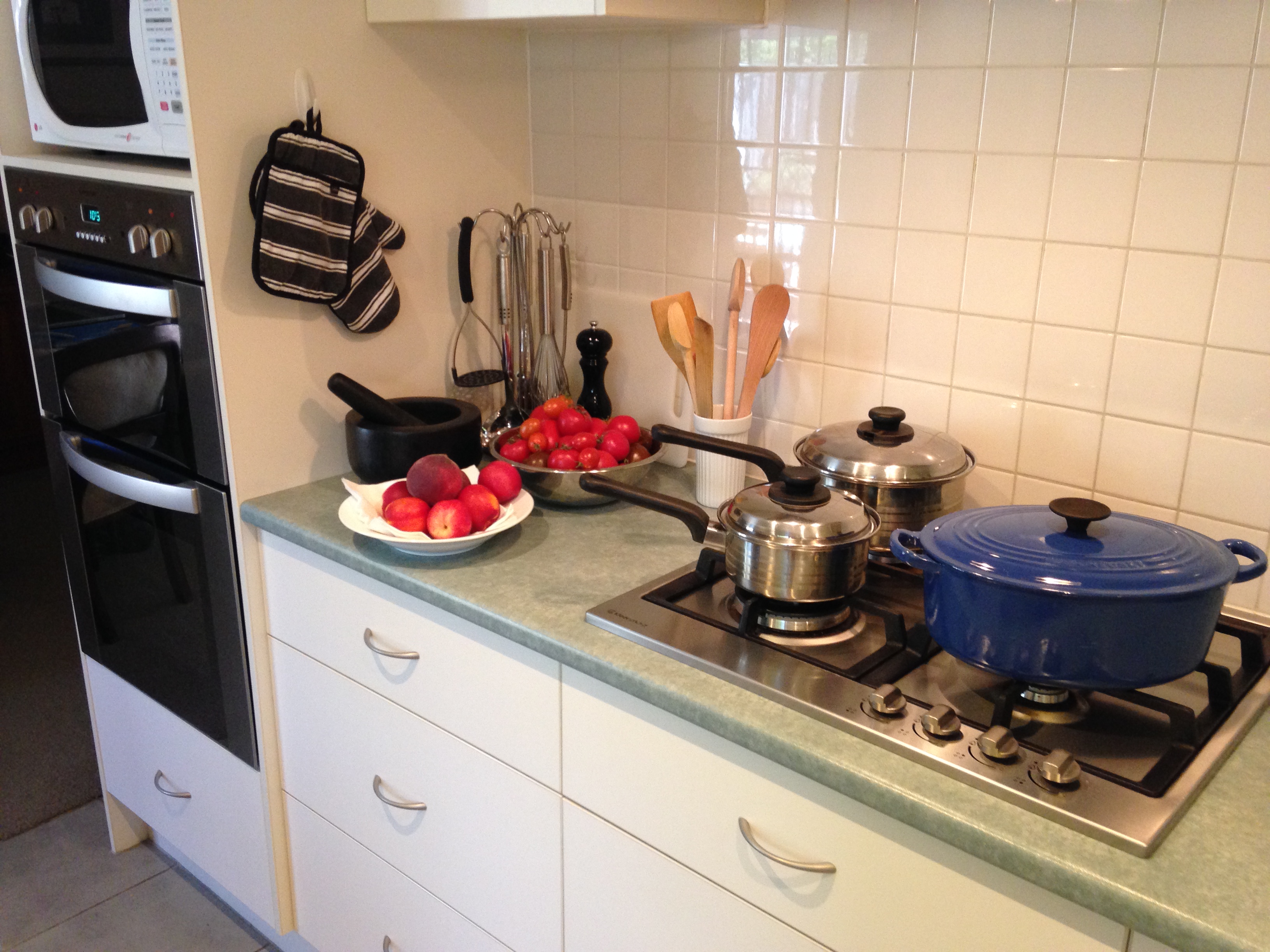
An assortment of sharps, including a knife Maggie bought in Toledo, Spain in 2010; serrated Victorinox knives for fine slicing of onions, etc; and a mezzaluna, for chopping fresh herbs without overusing your wrist. The Sunbeam mixmaster is a reliable workhorse for my baking repertoire; two different types  of Sunbeam blenders do a lot of work too. We have a variety of Scanpans, two Le Creuset pots and a set of Baccarat stainless steel saucepans that I chose as my farewell gift from a workplace in 2000. As well as a colander, we have four stainless steel sieves – they all come in handy and Maggie never misses an opportunity to remind me that she insisted on having the two smaller ones. And then there is our Weber Q, which has enabled us to take our outdoor cooking to a remarkable level.

We’re drinking …

We begin each day with black tea made in a pot with leaves – a blend of Irish Breakfast and whatever it is that Lan Choo puts in its packet. Just before Maggie leaves for work (Monday to Wednesday) or we begin our day’s program, we have some freshly-squeezed orange juice, followed by a Nespresso short black. We like wine but we have to buy at lowish price points – well, something has to give! At the beginning of our seventh decades, we rarely drink any of the full-bodied South Australian reds that set our generation apart from that of my son, Julian, who is a winemaker and pinot-phile. At home, our preferred varieties are Chardonnay, especially from Margaret River; Riesling, from the Eden and Clare Valleys; Rose, mainly from France; Prosecco for a festive occasion; and a grab-bag of medium-bodied blended reds.

Kitchen spy 3   Kitchen spy 1

I am way over the permissible word limit for Kitchen Spy but I hope you have enjoyed this post. My best wishes to you for the festive season.

Posted in Cooking, Home life | Tagged , | Leave a comment

Pig on a carpet ride?

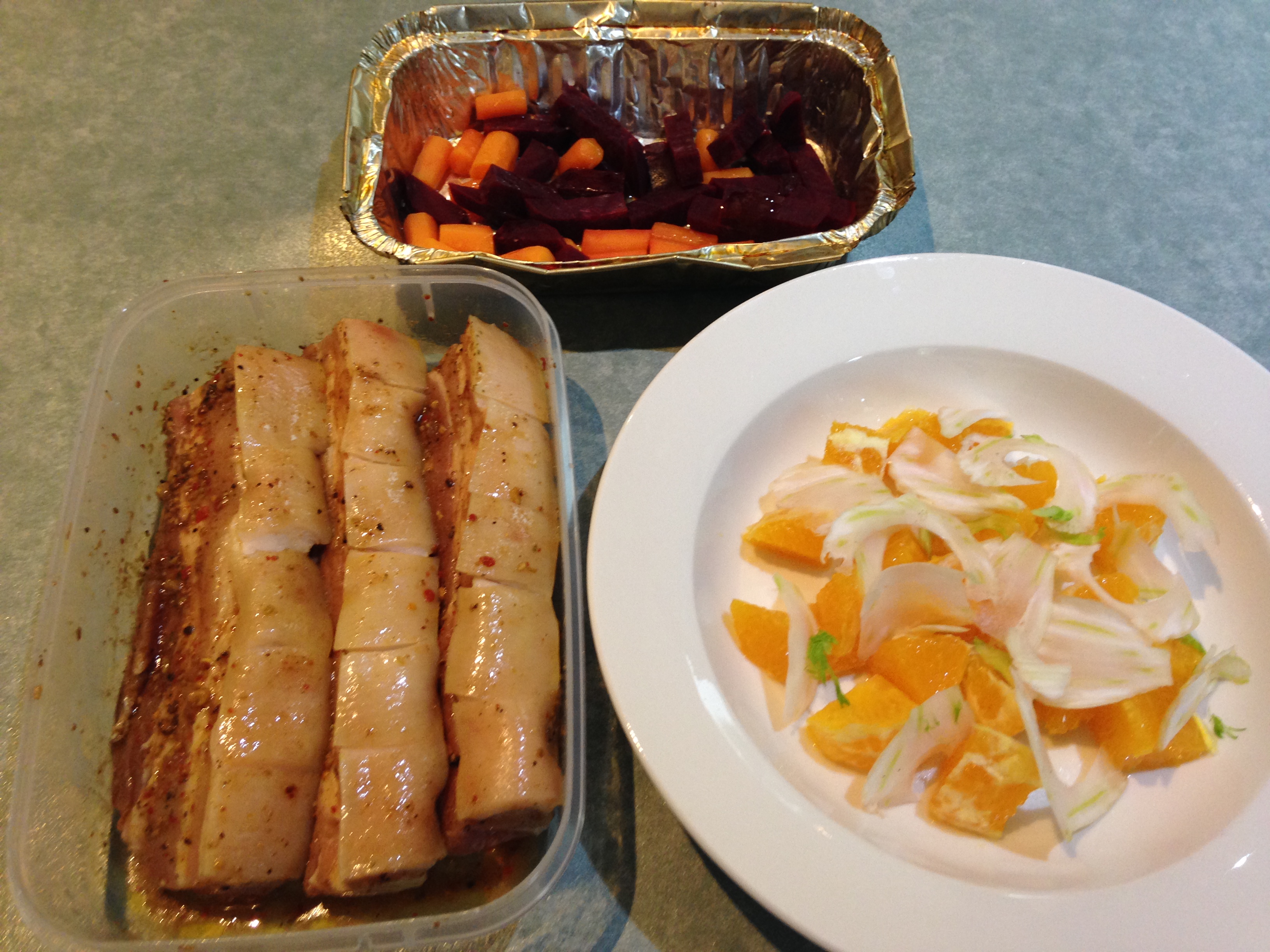
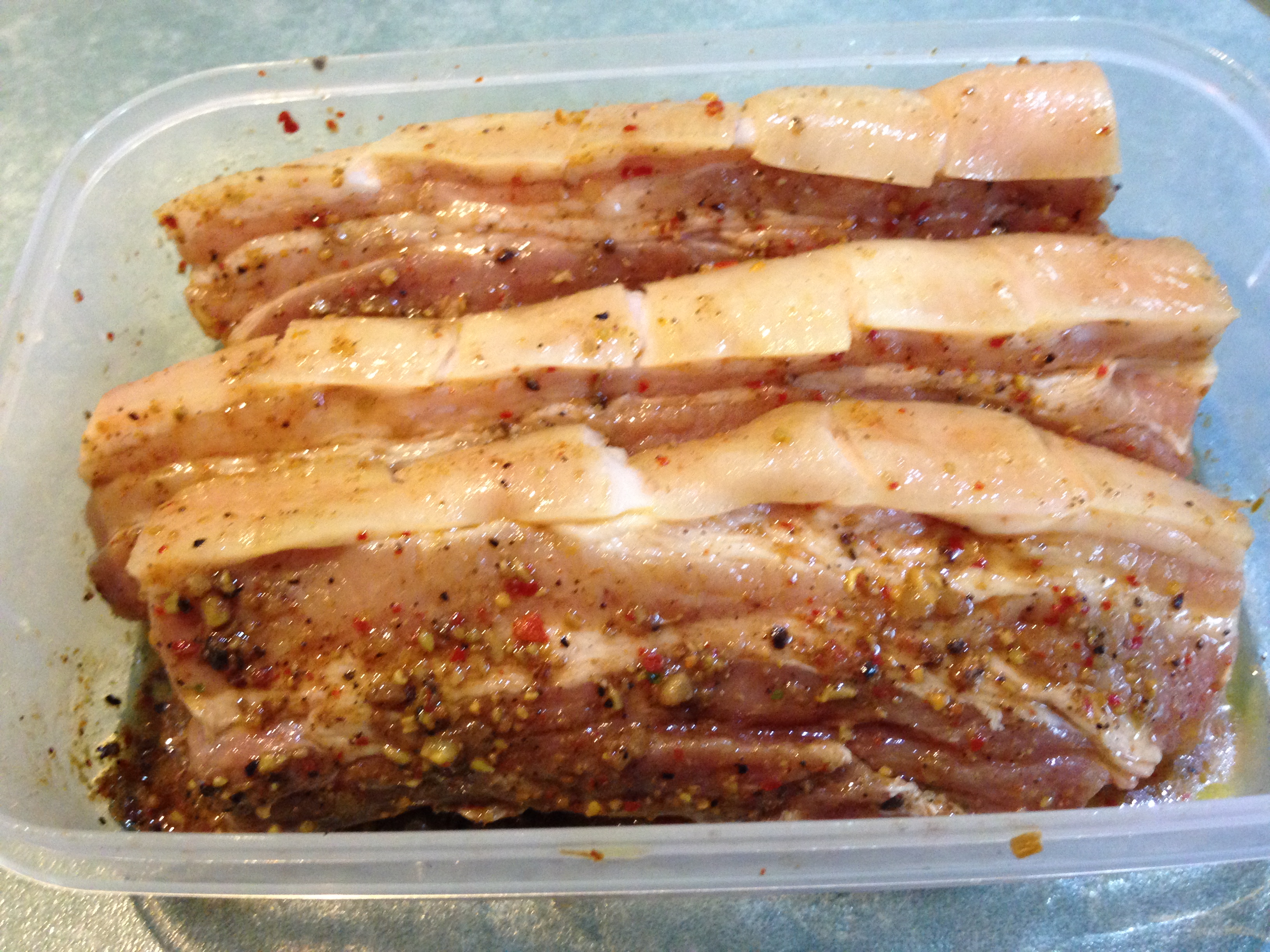
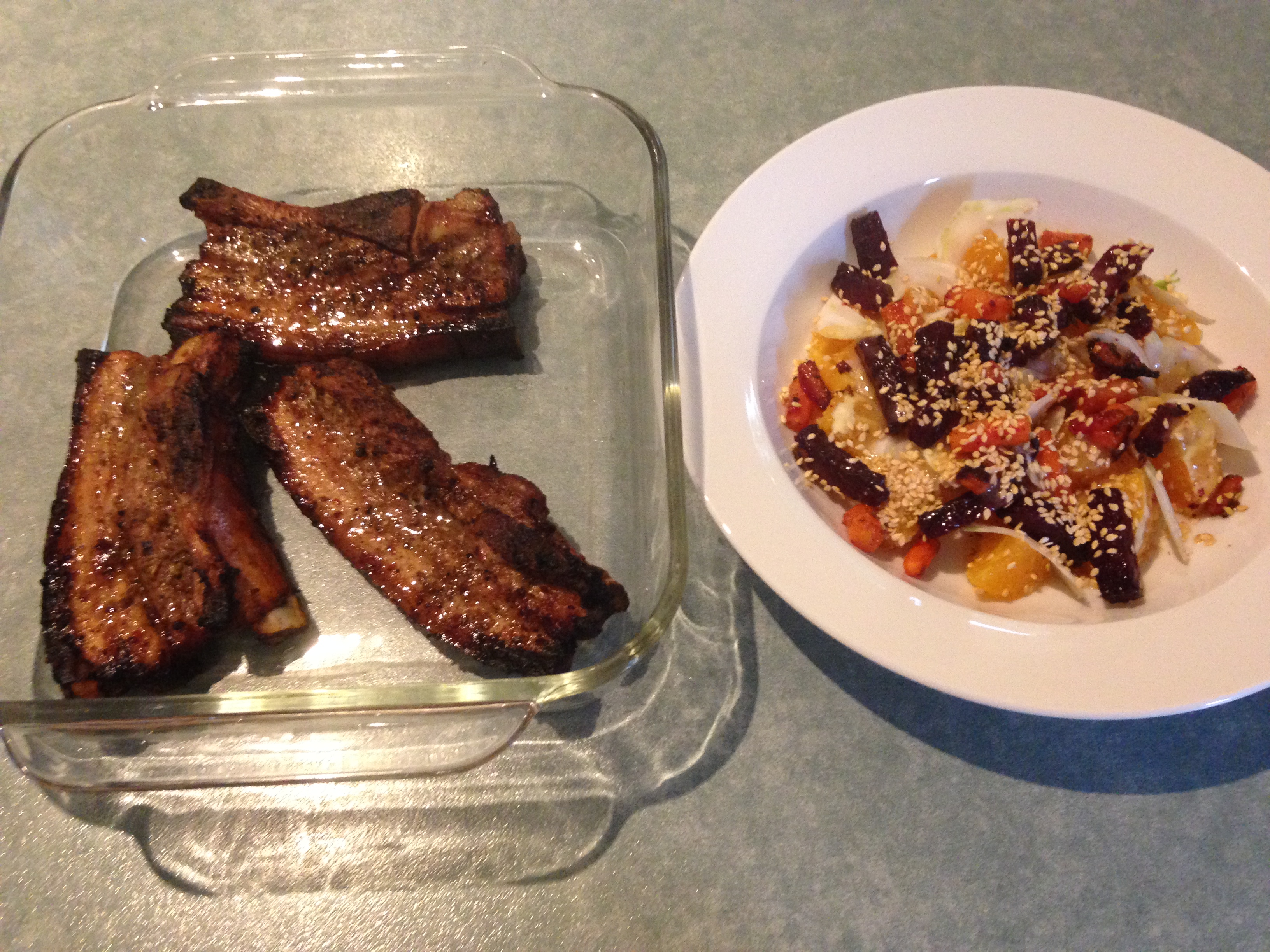
Last night’s dinner was tasty and refreshing – Weber-roasted pork ribs; a salad of orange, fennel, sesame seeds, carrot and beetroot; and some Basmati rice.

The pork had been marinated overnight in a wet paste of berbere spice mix, cumquat-infused vinegar, olive oil and about 1/2 a teaspoon of caster sugar. Then we roasted them for 35-40 minutes, which rendered most of the fat and gave the meat a dark golden brown hue.

I’ve posted our recipe for berbere spice mix previously. Our supply is running low and our stock of dried cayenne chillies is almost exhausted but there might be just enough to make a small batch of berbere to see us through until – fingers crossed – the cayenne chilli bush in our garden has delivered us some red fruit later in the summer.

While the ribs and root vegetables were roasting, it occurred to me that there could be a link between ‘berbere’ and the word ‘berber’, as in one of the indigenous peoples of northern Africa from whom we derived the name of a style of carpet. A brief search of Wikipedia suggested … probably not. Which was not so surprising. Berbere is a spice mix from the north-east of Africa, especially Ethiopia; the lands inhabited by the Berbers had their eastern extremity in the west of Egypt.

But I digress.

To make the salad, the carrot and beetroot were peeled, chopped into small chunks, boiled for 3 and 5 minutes, respectively, and then roasted in some olive oil and salt. Maggie peeled an orange with a knife, removed all the pith and the innermost edges of each segment of the orange flesh and then cut the segments in half, crossways. She added some shaved fennel, the roasted vegetables, a sprinkling of toasted sesame seeds and a drizzle of homemade vinaigrette dressing.

Ribs berbere 1   Ribs berbere 2

Ribs berbere 3

I haven’t posted our recipe for the vinaigrette dressing before. It’s not so amazing but I refer to it quite often, so here it is:

Ingredients

60ml olive oil (or vegetable oil if you prefer a lighter flavour)
1 clove garlic, peeled and crushed
1 tsp Dijon mustard
1 tbsp (20ml) red wine vinegar
½ tsp salt
¼ tsp white pepper
¼ tsp caster sugar
lemon juice and caster sugar, as necessary (see step 2, below)

Method

  1. Combine all ingredients, except the parsley, in a small jar, put the lid on and shake vigorously for about 10 seconds. (Alternatively, whisk the ingredients in a small bowl with a fork or similar.)
  2. Check the taste; add a little fresh lemon juice if it is too oily for your palate; add a little sugar if it is too astringent.
  3. Spoon over leaf-based salads before tossing salad gently.
  4. The dressing will keep in the fridge for about a week; raw garlic is the limiting factor. Bring to room temperature and shake briefly before re-using.
Posted in Cooking | Tagged , , , | Leave a comment

Not rushin’ this dessert

Most Australians are very fond of strawberries; Maggie and I are active members of this majority. We use them in several ways: with meringues, on a cheese and cream tart, in a fruit salad with banana and fresh pineapple, with passionfruit and ice cream and, for the last year or so, in a dessert known as Strawberries Romanoff.

The original version of this delicious dessert was created by the great French chef Escoffier. It was later popularised by a Los Angeles restaurateur of Lithuanian descent, who had given himself the surname Romanoff, as if he was a member of the family of the last Russian Tsar.

We have added a base of orange-infused sponge finger biscuits to the usual version, in the manner of tiramisu. If you would prefer to make this without alcohol, you could just use more orange juice but you will need to add a little bit – 1 to 2 teaspoons – of caster sugar to make the dish sweet enough. (And my apologies for lame pun in the title of this post.)

Ingredients

300g ripe strawberries, hulled
60ml Cointreau or Grand Marnier
80ml orange juice, freshly squeezed
2 tsp finely grated orange zest (optional, taste first, discard if lacking flavour)
4 sponge finger biscuits (savoiardi)
150mg mascarpone (or thick cream)
1 tbsp icing sugar
¼ tsp vanilla extract

Method

  1. Cut smaller strawberries in half lengthways; cut larger ones crossways into thick slices. Place strawberry pieces in a bowl, add 40ml of the liqueur, 30ml of the orange juice and the orange zest, stir to combine then cover with cling wrap and refrigerate for a couple hours, stirring gently once or twice.
  2. Remove the strawberry mix from the fridge. Arrange the four biscuits on the base of a flat-bottomed, straight-sided dish that will fit the biscuits snugly (break the biscuits into smaller pieces as necessary). Combine the remaining 20ml of liqueur and 50ml of orange juice and drizzle evenly over the biscuits.
  3. Next, gently beat the mascarpone (or cream), icing sugar and vanilla extract together.
  4. Gently fold the mascarpone into the strawberries then spoon the mixture onto the biscuits. Refrigerate for about one hour before serving.
  5. You can make this a day ahead of serving, giving the flavours more time to inter-mingle.

Strawb romanoff 1   Strawb romanoff 2

Posted in Cooking | Tagged , , | 1 Comment

Busy-ness but not as usual

Out for dinner, three times in nine evenings. Working for a political party for the first time in 25 years. No new recipes to share. Definitely not the usual program!

Not that we’ve suddenly come into some money and commenced a tour of Melbourne’s restaurants. Two of the times we went out for dinner were to the homes of friends. The first was just a few doors up our street, the home of Janet and Gary, both teachers. Janet has taken some accrued leave and finished the school year a month early. To celebrate, she invited us to share a meal of homemade Japanese-themed food. It was a perfect evening to dine on their shaded deck and the food was delicious. And pretty!

Janet meal 1

Janet meal 4   Janet meal 5

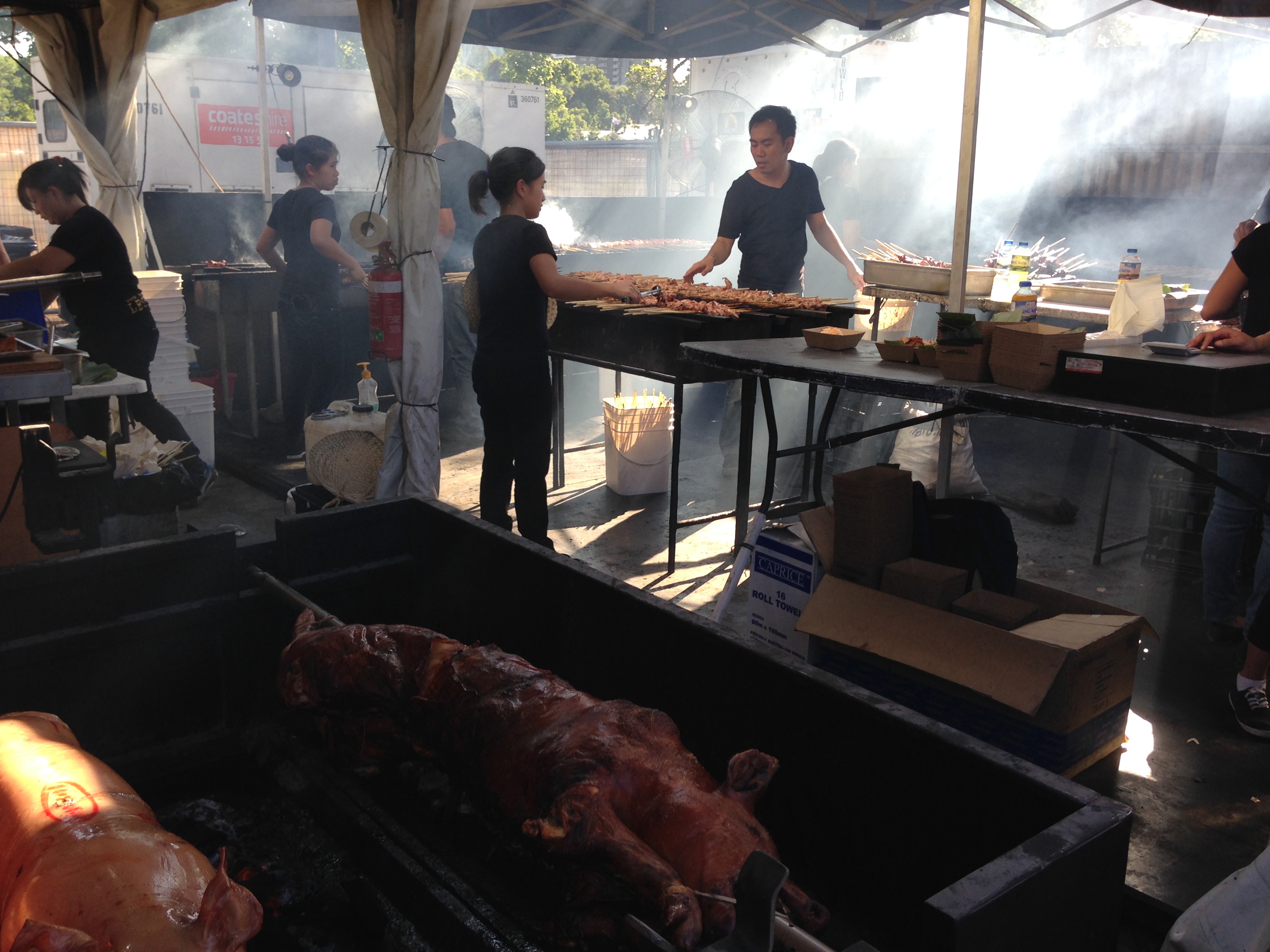
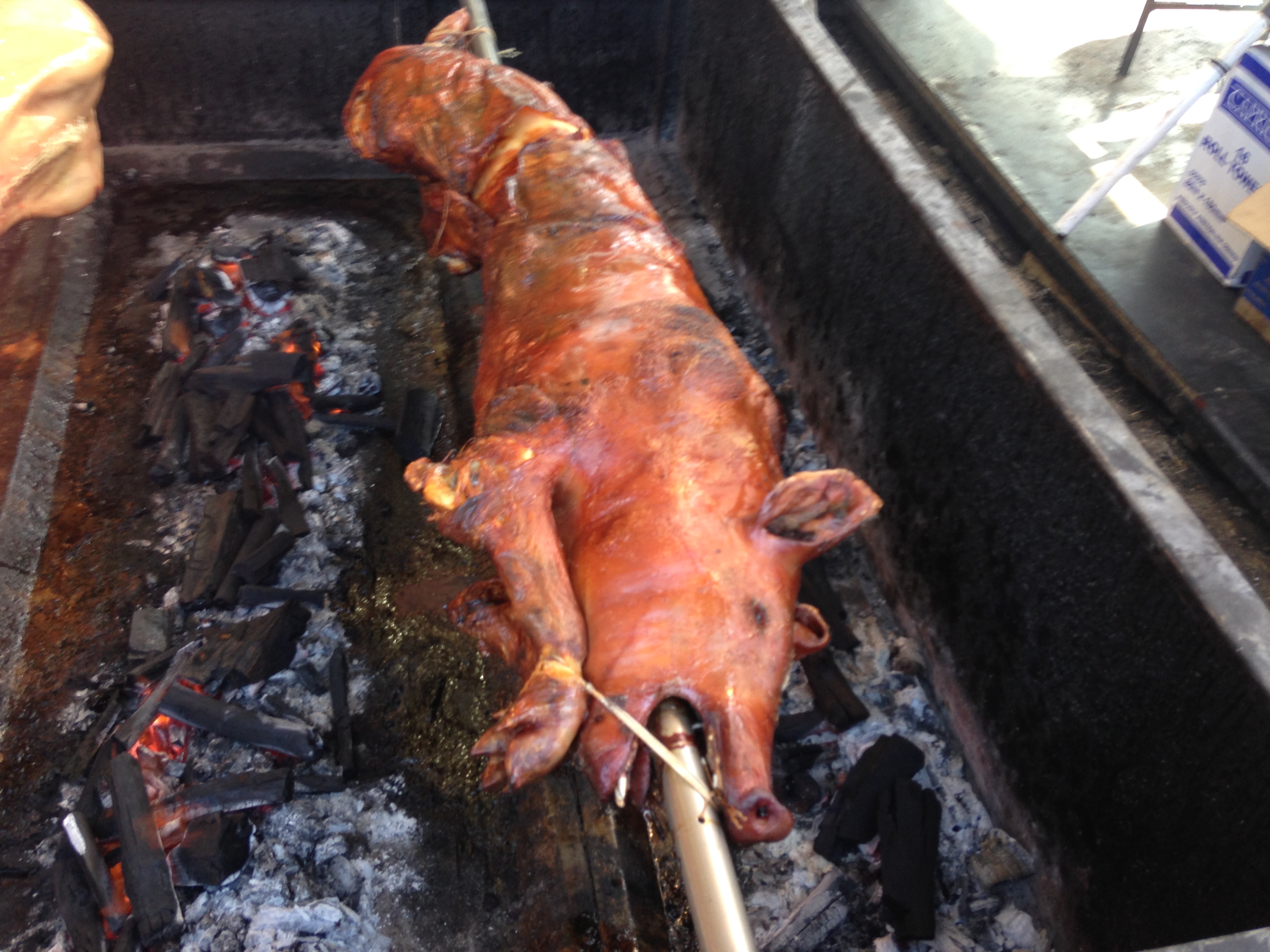
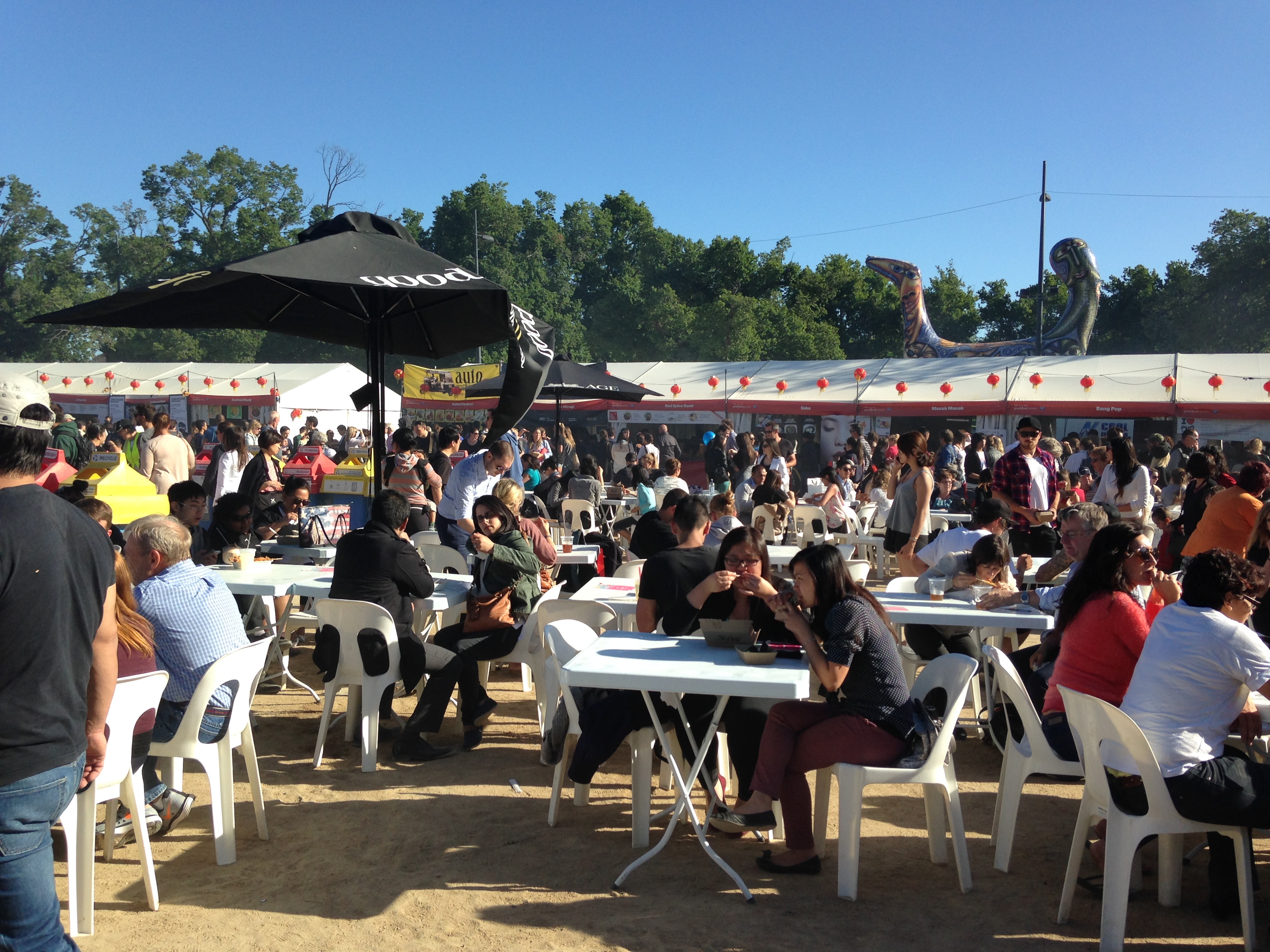
The next dinner out was a very Melbourne affair. Faux night noodle markets, set up close to the city centre beside the Yarra River. This event is staged annually over two weeks in the second half of November and we decided to go this year. We drove half way in, transferred to a tram and arrived late in the afternoon of a warm Spring day. Around forty businesses had set up stalls, with the range of cuisine inspired by at least 10 different countries, from India in the west to Indonesia in the east and north to Japan, Korea and various Chinese provinces. We chose three plates to share – a Thai green curry of pork, spicy soft-shell crab and skewers of pork barbecued in Filipino style with a banana glaze. The prices were very reasonable, there were plenty of spots to sit down and the customers were enthusiastic, of all shapes, sizes and styles from many of Melbourne’s numerous ethnic origins.

Noodle mkt 2   Noodle mkt 3

We are not night owls, so we weren’t there when the sun went down but, judging by the crowds streaming in as we departed, the place would have been jumping. We would happily go again, perhaps talk some friends into joining us.

Noodle mkt 4   Noodle mkt 6

A couple of days later was the date for the election of the Victorian State Parliament. This is held on the last Saturday of November, every four years.

I used to be actively involved in politics. On my father’s side, my family has been associated with the Australian Labor Party (ALP) for more than 70 years. Both of my father’s parents were Labor Members of Parliament in Tasmania and I was a candidate for the ALP three times in the first half of the 1980s. However, for personal reasons, eg a dislike of knives in my back, I ceased to be a member of this once-great party in 1989.

Over the last few years, a friend from my days as an environmental activist in Western Australia, has slowly been reviving my interest in politics. His efforts bore a modest amount of fruit when I decided to work as a volunteer for his party, The Greens, on election day. I enjoyed myself and I would do it again but I’m not sure that I will become an active member – I have a low tolerance threshold for meetings!

Greens badge

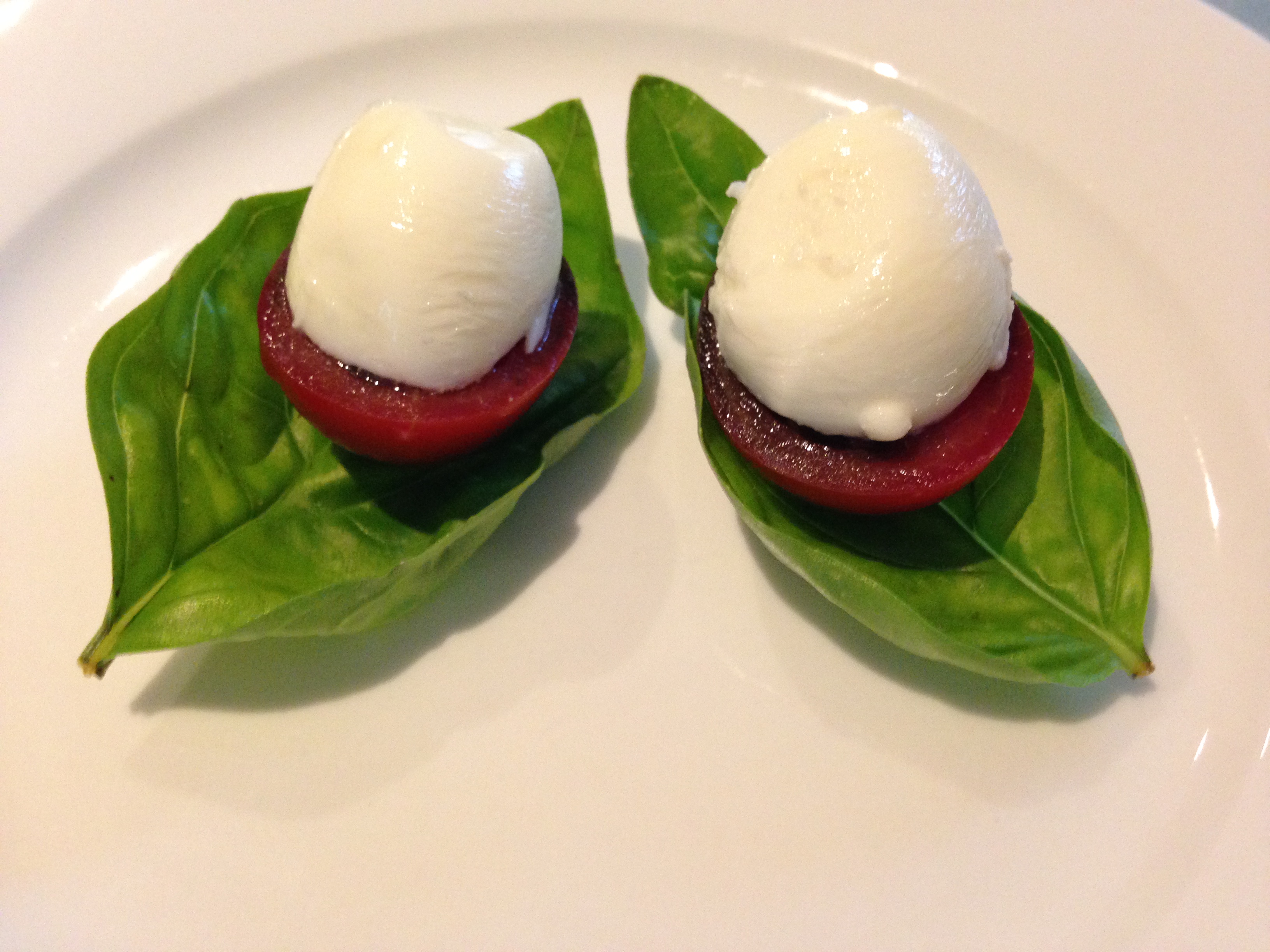
After the end of voting, we went out to have dinner at the home of a couple Maggie has known for more than forty years. Maggie’s offer to provide pre-dinner nibbles was taken up, so we were busy in our kitchen late on Saturday afternoon preparing two items. The first was that simple but classic combination of a fresh basil leaf, a thick slice of tomato and a slice of fresh mozzarella. Viva Italia!

Here's one we prepared later

Here’s one we prepared later

The other canape was more elaborate: wontons, bought as slices in a packet then baked to a crisp in our oven and later filled with a refreshing combination of poached chicken, seeded and diced Lebanese cucumber, plum sauce, fish sauce, chopped red chilli, thinly-sliced green (spring) onion and lime juice. We used a published recipe so, alas, not for sharing; well, not until we have made the changes we have in mind.

The meal was delicious from beginning to end but we were so busy enjoying our evening with our friends that I didn’t get around to taking any photos.

The next brought a resumption of normal programming. On Saturday, Maggie had bought some sardines at a fish shop that opened last year in a nearby suburb. (The shop is owned by a seafood wholesaler, so the quality of the product is quite high.) We had never prepared fresh sardines in our kitchen, although I have eaten some in a couple of restaurants and tapas bars. After some internet searching, we decided to grill them simply on the Weber Q and serve them with a paella-style salad. It was a very tasty light meal and we will do it again soon, take some photos and share the full story with you.

Posted in Cooking, Eating out, Home life | Tagged , , , | 1 Comment