Catering for cousins

This is one of those posts which is written more ‘for the record’ than for the world of blog readers, but some of you might find elements of the narrative to be of value or interest.

It is now a little over one year since the deaths of, firstly, my elderly mother and, s short time later, my younger sister Fi. A couple of weeks after Fi’s funeral was held in Western Australia, I conducted a memorial service for her in Melbourne. It was a full-throated celebration of her life, warts and all, concluding with a mass karaoke rendition of an Australian rock anthem, Most people I know think that I’m crazy.

One of my dearest memories from that day of mixed emotions is the fact that eleven of Fi’s sixteen cousins attended the service, including three whom I had rarely seen during my childhood, let alone my adult life. As was the case for Fi. Yes, they were, in part, representing their father, one of my late mother’s two brothers, who had a prior commitment that day. Still, I felt that it was a significant act of respect, one that merited more than just “thanks for coming”.

In the following months, I had some contact by phone and email with one of the cousins – all three are women – and then we were invited to a family gathering to celebrate my uncle’s birthday. We went along with some homemade canapes, got to know the cousins and their children a little and had a pleasant time. We went to a similar event a couple of months later, but we were soon busy preparing for and enjoying our 2015 trip to Europe, then getting our life back in order back home and soon it was the festive season.

When we were invited to catch up with my cousins et al on Christmas Day, we had to decline; we had special plans of our own. However, I vowed that we would see them early in the new year, that this would happen in our home and that Maggie and I would provide the food.

Regular readers of my blog might recall that we had some significant interruptions to our routine in January and February. Eventually, we were clear of those and able to set a date, on the basis that it would be a gathering of just the members of our generation. Extended family events have their place but, on this occasion, I wanted to hang out with my cousins and get to know them a lot better; and vice versa.

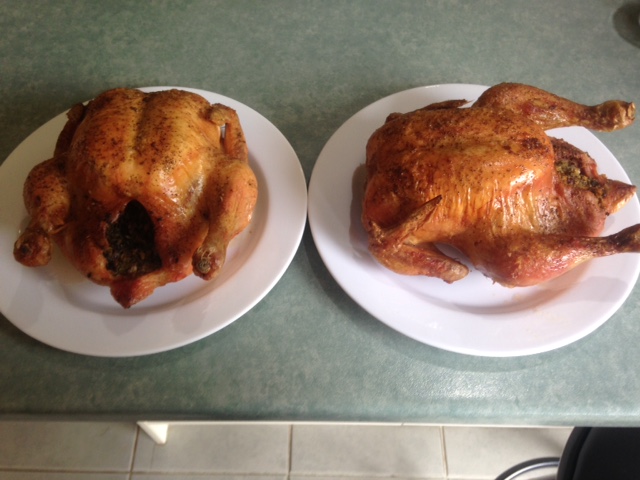
And so it was that, last Monday – a public holiday in our city – Maggie and I served lunch to three cousins and two husbands. The weather was fine and mild – a blessed relief after more than a week of heat and humidity – and we were all in good spirits. We kept the menu relatively simple: two chickens, flavoured with a herb-rich stuffing and roasted in the Weber; four salads – fennel and orange, ‘beetroot Waldorf’, pea and lettuce and warm potatoes tossed with olive oil and herbs. And to follow: pears that had been poached in a spicy red wine syrup.

There was lots of conversation: sometimes earnest, other times light; sometimes personal, other times about the wider world. Three hours were spent very comfortably and, for the four cousins in the room, it was an unexpected development from the brief contact we had early last year. A good thing to do, done well.

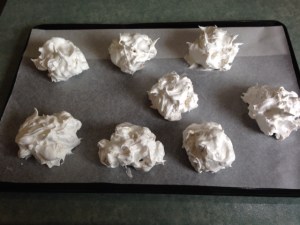
Now, briefly back to the food. For those who are interested, recipes for the menu elements can be found via the Index of recipes. To prepare our herb stuffing for two chickens, we needed to use two egg yolks. We don’t use the egg whites – the stuffing cooks too firm and we prefer it to be loosely packed. So, we made a batch of meringues, which we have shared with a colleague who is doing it tough at Maggie’s workplace.

Here are the chickens, just after coming out of the Weber, and the meringues, just before they went into our indoor oven. No, you’re not seeing double – two egg whites = eight meringues!
Chicken 160314   Meringue 0

Posted in Cooking | Tagged , , , | Leave a comment

In digest: week ending 13 March 2016

It’s been another week in which we have cooked mostly outdoors and, with just one exception, all the dishes have been established favourites.

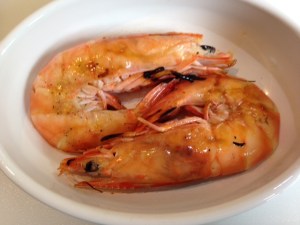
The only departure from our regular fare was whole prawns chargrilled on the Weber Q. (I am at a loss to explain how this could be a novelty in our repertoire.) The prawns were a good 20cm long from head to tail, plump and juicy. We simply brushed them with basil-infused olive oil just before they were grilled, and served them with a simple salsa of fresh tomato, spring (green) onion and sweet chilli sauce. Five between us covered lunch, with two leftover for Maggie to enjoy the next day.

Prawn bbq

Recalling a technique from a recipe for seafood pancakes, I saved the shells and heads from the five prawns and simmered them for 15 minutes in the quantity of white wine we would need to steam some mussels for an evening meal of mussels with a cream and saffron sauce. The infusion provided a lovely extra touch to our favourite seafood meal.

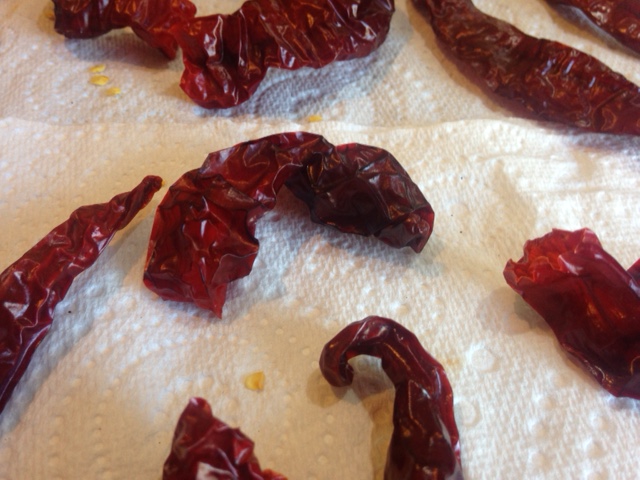
The dry and very warm tail of our summer season has continued, but with two positive side-effects: a steady supply of roses for our dining table and Maggie’s work station; and ripe chillies in the kitchen garden. This week, I was able to harvest enough to justify the somewhat tedious effort of drying them in a very low oven, which can take at least three hours. However, I now have at least half of the quantity I need to make our annual supply of berbere spice mix, which we use to flavour chicken wings and pork ribs for roasting in the Weber. Yum!

Chillies 0   Chillies 1

Chillies 2   Chillies 3

Posted in Cooking, Home life | Tagged , , | Leave a comment

In digest: fortnight ending 6 March 2016

Culinary innovation has been in short supply in our kitchen during the last couple of weeks. However, there have been mitigating circumstances for our apparent indolence.

We had a housepainter in for just over a week, with all the associated moving of furniture, and some consequential, long-overdue decluttering. We spent three days in the fortnight being active grandparents to Iris, while Julian and Sara managed the challenges of the 2016 wine vintage. And we are having an atypically dry and very warm tail-end to summer, sucking time and energy out of our days as we work to maintain an adequate level of moisture in the kitchen and ornamental gardens.

So, cooking-wise, we have resorted to a rolling program of familiar favourites, predominantly proteins grilled on the Weber, and various salads.

We did manage to try another recipe from Mastering the art of French cooking – tomato sauce – to take advantage of the late-summer supply of inexpensive, ripe tomatoes. In its complexity and cooking time, it was not unlike the preparation of a master stock, and about as remote you could get from an Italian community ‘tomato sauce’ fiesta.

The effort to strain the cooked pan of ingredients was out of all proportion to the volume of sauce but we think we know how to expedite that part of the process next time. For now, we have several half-cup containers in our freezer of a rich sauce that is unlike anything we could purchase, even at a gourmet deli, and it will add a special touch to some of our winter dishes. Think beef goulash, chicken cacciatore.

We also had a breakthrough experience in cooking a substantial whole fish in our Weber Q. We first attempted to do this a couple of years ago, not long after we had purchased the Weber. On that occasion, we filled the cavity of the fish with a combination of cooked rice, braised tomatoes and herbs, wrapped the fish in foil and cooked it as for a roast. The end result was quite soggy, with a texture that detracted from its flavours.

It wasn’t until we returned from our travels on the Adriatic Coast of Croatia last September/October that I could bring myself to make a further attempt at cooking fish outdoors. We began with a meal inspired by our fresh-in-the-palate-memory experiences of char-grilled seafood. In that case, the items of seafood were placed directly on the grill plate. The flavours were very good but most of the skin of the small fish stuck to the grill, depriving us of one of the pleasures of this rustic cooking method. (I have just acquired a well-designed device that should resolve this issue. Can’t wait to put it to the test!)

Anyway, a couple of weeks ago, still feeling anxious about technique, I bought a fresh, cleaned, whole snapper, weighing about 1.2kg. We placed some herbs in its cavity, cut two slits into the flesh on both sides and rubbed a paste of mashed preserved lemon, baharat and olive oil into the slits and the skin. We cooked it as for roasting but without any foil wrapping; the result was moist, flavoursome flesh within a just-beginning-to-crisp skin. It looks a bit prehistoric on the platter but, hey, looks aren’t everything! Can’t wait to do that again, either.

Snapper weber


Posted in Cooking | Tagged , , | Leave a comment

Fruitless Waldorf is a beet-up of a story

I am sure that most readers are familiar with Waldorf salad and that many of you have made one on numerous occasions. As is also well known, this salad takes its name from New York’s Waldorf Hotel, where it was first created in the years before the hotel was merged with its neighbour to form the Waldorf-Astoria.

We quite like a Waldorf salad ourselves, especially when suitable apples are in season. The only variations we make to the traditional composition are to add some slices of dried apricot to the apple, celery and walnuts, and use a modified dressing, as I have previously described. And we lightly toast the pieces of walnut in a dry pan, for extra crunch!

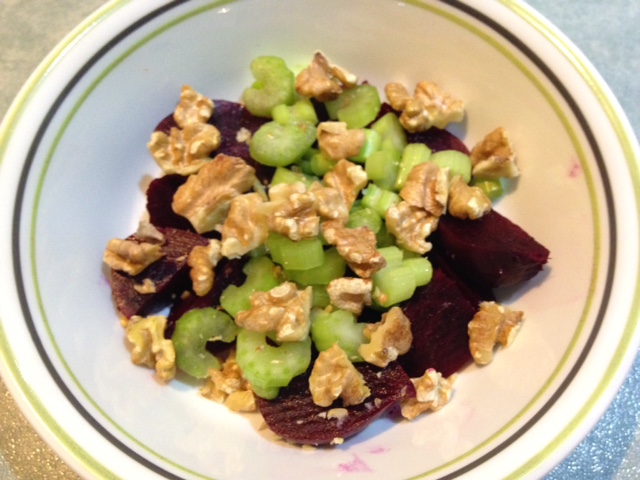
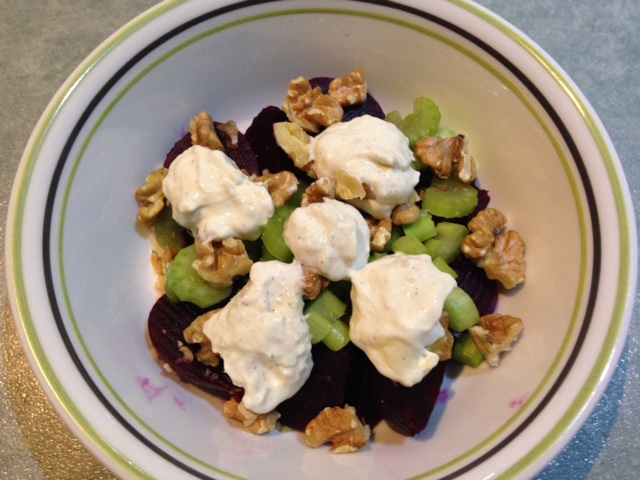
Whenever we do make a Waldorf, it is as a side-dish for pork or chicken. However, we also like to have a dressed salad of baby beetroot with these meats. So, drum roll please Maestro, we have cross-bred the two, substituting the sweetness of the baby beetroot for that of fruit and the heat of a little homegrown, grated horseradish for Dijon mustard in the dressing. Simple yet complex, and very delicious.

Beetroot waldorf 1   Beetroot waldorf 2

Posted in Cooking | Tagged , | Leave a comment

O Cisco! Gazpacho!

I have never been anywhere close to the Texas-Mexico border-lands frequented by the fictional Cisco Kid and his side-kick Pancho, but I would be surprised if you couldn’t find a taberna with gazpacho – my favourite tomato soup – on its sunny-season menu.

I first made gazpacho in the southern summer of 1981/82. I was living in Fremantle at my new friend Bill’s home and, over the course of that summer, we established a Saturday lunch tradition. We’d have Jimmy Buffet on the record player, cruising his way through Margaritaville, searching for his ‘lost shaker of salt’; a tasty terrine and French breadstick from Fremantle Markets; and bowls of my rustic gazpacho, prepared according to a recipe card from a Robert Carrier box set handed down from my mother. And bubbles in glasses, lots of bubbles. All shared with a few friends on the basis of whoever was around at the time.

That gazpacho recipe used all the traditional ingredients but, rather than machine-blending, it relied on a couple of hours of steeping for the flavours to inter-mingle. I was happy with the result but, by the following summer, life had become more earnest, my culinary enthusiasms had moved on and I rarely gave it another thought.

Three decades later, Maggie and I visited Spain for just over two weeks. During our travels, I enjoyed several bowls of blended gazpacho and resolved to bring it back into my repertoire. When the following summer’s fresh tomatoes ripened on our bushes, I drew on a couple of published recipes and my own trial and error to produce a dish that is both rich and refreshing.

Ingredients

900ml commercial tomato juice
700g ripe tomatoes, peeled and coarsely chopped
½ bunch spring onions and 2 cloves garlic, coarsely chopped
1 Lebanese (small) cucumber, peeled, deseeded and coarsely chopped
1 slice of dense bread
1 cup chicken stock (optional)
¼ tsp Tabasco
2 tsp sherry vinegar
generous pinch of salt and several grinds of pepper

Method

  1. Combine all ingredients in a large bowl then blend batches in a food processor.
  2. Stir well and place in your fridge to chill.

How easy is that? The amount of salt and sugar you add will depend on your personal preferences and also on the ingredients in the tomato juice you buy. If you use a no-added-salt juice, you might, like Jimmy Buffet, need to find your salt shaker!

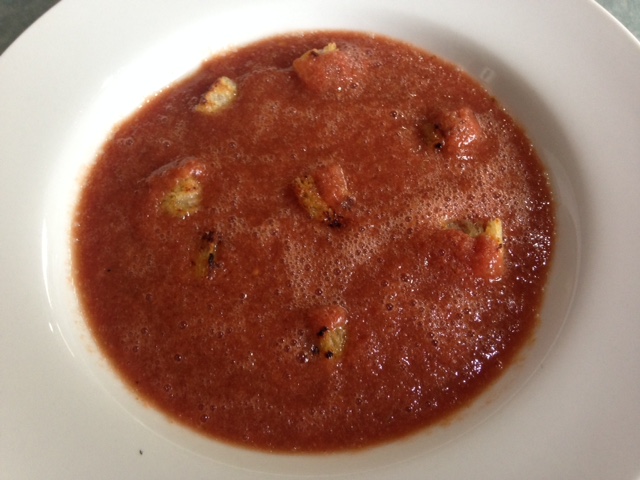
To serve the gazpacho for 4 persons, we make croutons from 2 trimmed, thick slices of sour dough bread, coarsely cubed and tossed with two crushed cloves of garlic, olive oil, salt and pepper, then fried in a lightweight non-stick pan over medium heat until golden brown. This method reduces the quantity of both garlic and bread in the actual soup, making it pleasurable for a wide range of palates.

Gazpacho 1   Gazpacho 2

Don’t be alarmed by the pale colour of the gazpacho just after it has been blended. That’s just a temporary side-effect of the blending process, as you can see by the colour of the bowl I served myself last night.

Gazpacho 3   Gazpacho 4

As I prepare to publish this post, it is 31 degrees celsius in the shade at 10am, on its way to 38 degrees. I will definitely be looking forward to another bowl of gazpacho, possibly for both lunch and dinner!

Posted in Cooking | Tagged , , , , , | Leave a comment

So, not every aubergine goes into ratatouille

The latest recipe I have used from Mastering the art of French cooking (Mastering) is ‘Aubergines farcies duxelles’ (Eggplants stuffed with mushrooms). The eggplant I used was originally destined to be chargrilled on our Weber Q, as we have done a couple of times this summer. However, Melbourne’s famous weather headed south, so I needed a plan B.

I opened Mastering, knowing there would be a recipe for ratatouille but hoping there would also be something unfamiliar and tempting. There was only one alternative but the recipe involved mushrooms and cream cheese, two ingredients I had not associated with eggplant. So, a definite tick for the unfamiliar box and, with the mushrooms, a tentative tick in the tempting box.

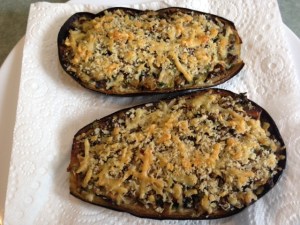
The mushrooms were finely chopped – ‘minced’ according to Mastering – and sautéed, then combined in a mixing bowl with the cream cheese, sautéed minced onion, chopped parsley, thyme leaves, seasoning and some of the flesh of the eggplant. The flavour of the mixture was very appealing. The stuffing was sprinkled with a topping of homemade breadcrumbs and grated gruyere-style cheese, before being baked in a moderate oven.

We were very happy with the texture and flavours of the dish but we would add an egg yolk to the stuffing next time to produce a firmer finish.

Eggplant 1   Eggplant 2

Eggplant 1   Eggplant 2

Eggplant 3

The recipe introduced me to at least two techniques, which is one of the main reasons why I am disciplining myself to search Mastering for recipes that are both novel and appealing. There are plenty those!

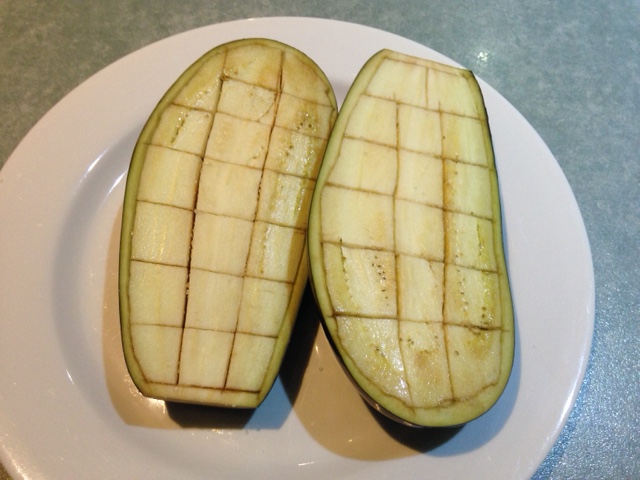
The first new technique prepared the flesh of the eggplant to be incorporated in the stuffing mixture. I used a knife to cut into the surface of the two halves, lengthwise and crosswise, at 2cm intervals and to about half a cm from the edges and skins, before sprinkling the surface with salt. Half an hour later, after brushing away the salt etc, the flesh was brushed with olive oil and the halves were grilled gently for about 15 minutes. After this, it was easy to scoop the flesh out, leaving the shells neat and intact for filling.

The other technique involved the mushrooms. After I had ‘minced’ them, I rolled them up in a tea-towel and squeezed and twisted the towel to extract as much liquid as possible. So, when I sautéed the pieces of mushroom, they cooked much drier than usual. Which was a good thing!

As it happens, I’m not a big fan of ratatouille; I prefer its Italian counterpart, caponata. I have also enjoyed preparing and eating my version of imam bayildi, an elegant Turkish dish of stuffed eggplant. More on the latter another time.

Posted in Cooking | Tagged , , , , , | Leave a comment

Peaches hit the high notes

In Melbourne, as in many other parts of the world, the summer months bring an abundance of fruits which can be enjoyed as the basis of a light and refreshing dessert. Think strawberries, raspberries, blackberries, blueberries, nectarines and peaches.

Of the stone fruit, the best performed in our home state this season have been the yellow peaches, which suits us just fine. We like them ripe and eaten raw; halved and chargrilled, to accompany spatchcock; halved, covered in a mix of ground hazelnuts, sugar, spices and cream, then baked; and poached. I have mentioned the last of these in relation to a peach and raspberry trifle we shared with my father in the festive season of 2014.

Trifle 1

With such a plentiful supply of quality fruit, I have poached peaches regularly this summer, usually four at a time. My recipe, which can also be used to poach larger nectarines, produces a result that is quite luminous, as well as delicious.

Ingredients

1 cup raw sugar
1 cup water
2 cups lightly-wooded Chardonnay
juice of ½ lemon and 1 orange (you could peel some of the skin and add that too)
1-2 cinnamon sticks
4-6 cloves
3-4 cardamom pods
3 cm of fresh ginger peeled and cut into matchsticks
½ vanilla bean cut into thick matchsticks (or ¼ tsp vanilla essence)
4 peaches that are firm and just ripe

Method

  1. Place all ingredients except fruit in a saucepan large enough to hold fruit and liquid snugly, and bring to simmering point to create a thin syrup.
  2. Simmer the syrup for 20 minutes to allow the flavours to develop.
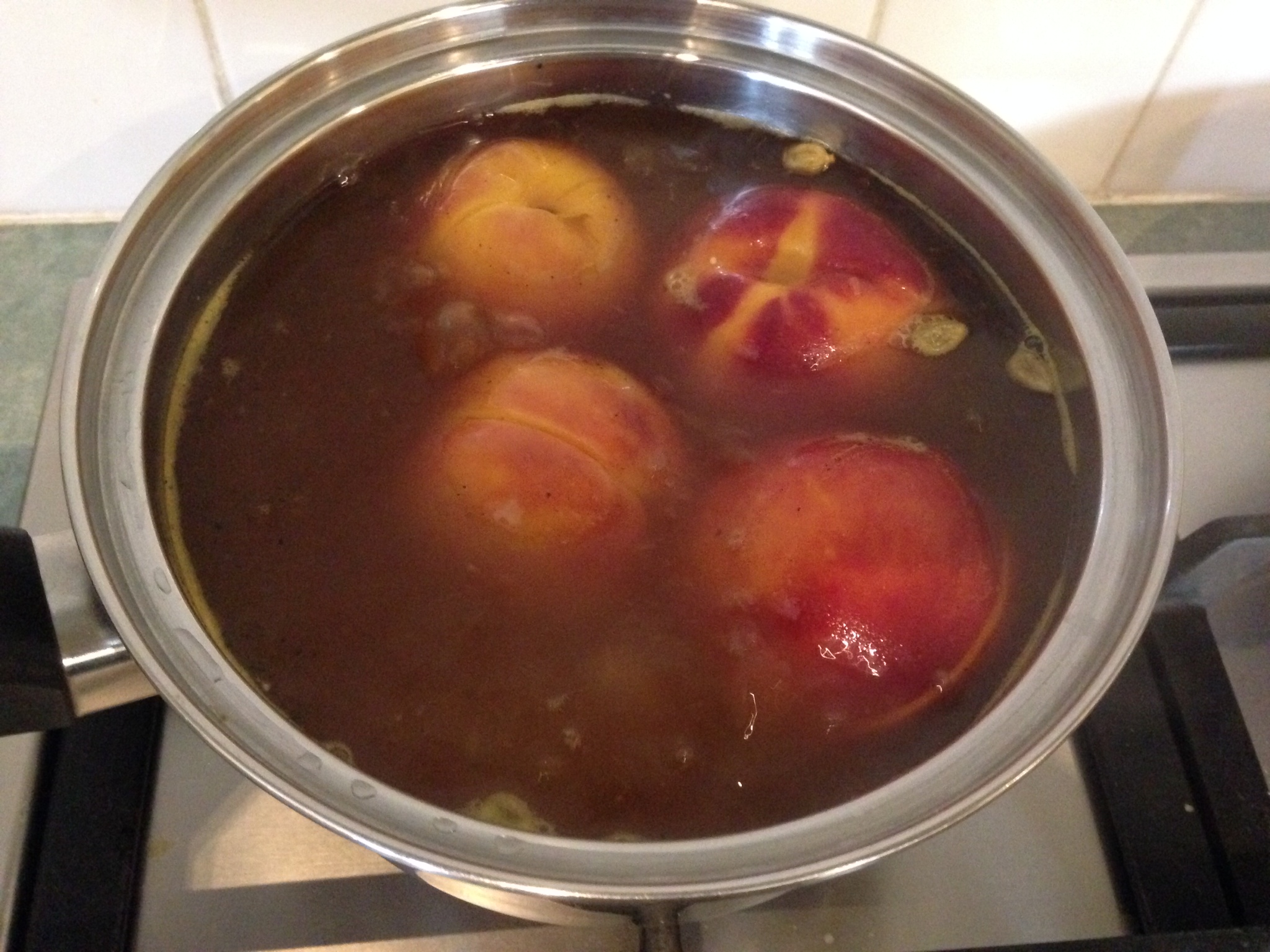
  3. Score the skin of each piece of fruit along the natural groove before poaching; then it will come off easily once it has cooled.
  4. Add fruit to the syrup and simmer gently for 10-12 minutes. (I use a wooden skewer, gently, to confirm that the fruit is just cooked through.)
  5. Remove fruit using a slotted spoon and boil syrup to reduce by about one-third. Allow the syrup to cool a little then strain over peeled fruit.
  6. Serve at room temperature.

Peaches 1   Peaches 3

A poached peach is quite versatile. You can eat it adorned only by the syrup; slice some over your breakfast cereal; insert fine slices into a pocket cut into a very thick slice of bread en route to a luxurious dish of French toast, as we have; incorporate slices in a trifle or, as many Australians do, to decorate the whipped cream atop a pavlova.

Or, continuing the nationalistic theme, you can prepare a Peach Melba.

As many Australians know, this dessert was created and named in honour of Dame Nellie Melba. As even more Australians know, Melba was born and raised in Melbourne – hence her adopted surname – and became one of the most renowned operatic singers of the late 19th and early 20th centuries.

The original Peach Melba was created at London’s Savoy Hotel by the legendary French chef Escoffier. He subsequently amended the recipe to produce something akin to what we know today.

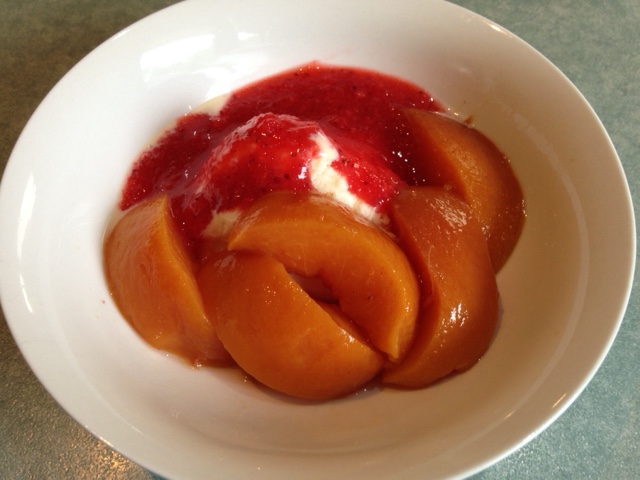
There are countless thousands of ways in which Peach Melba can be prepared, but all of them include peach, a berry and a cream. My version is relatively simple: a scoop of vanilla ice-cream, segments of poached peach and a strawberry coulis. Here are two pics of how it turns out. The first, prepared by Maggie, looks prettier. For the second take, I increased the ratio of peach to coulis, to suit my palate.

Peach Melba 1   Peach Melba 2

To make the coulis, I put one punnet of hulled ripe strawberries, about 30ml of lemon juice, 20ml of Cointreau and 60ml of caster sugar in a food processor and work it for about 30 seconds to dissolve the sugar. These ratios will vary, depending on the flavour of the berries, but, if you are going to serve it with ice-cream and sweet-ish peaches, it is important to retain a tart edge to the coulis. That is, unless your sweet tooth is over-sized!

Pavlova PS. For decades, Australians and New Zealanders have argued, mostly good-naturedly, about which country can lay claim to being the birthplace of the pavlova. For the latest findings on this topic, read here. Very interesting!

Posted in Cooking | Tagged , , , , | Leave a comment

Valentine’s Day mass….

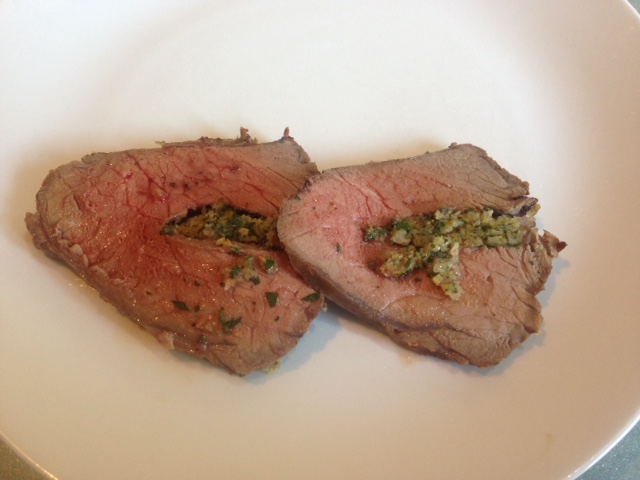
… of meat. No Al Capone, no bone. No South Side, no North Side. Just a lovely piece of topside. No ugly pools of blood on the floor; a pleasing little puddle on the plate.

About 80 years after the infamous massacre in Chicago, I began to write a blog, mostly about the food that Maggie and I were cooking at home. Unfortunately, the blog host I signed up with was woeful technically, to the point of inhibiting me from writing posts. Eventually, I discovered WordPress.com, created this blog and launched it by posting the small volume of material I had placed on the previous site. That was in July 2010. I added a couple of new posts but my well of creativity ran dry as I struggled with my parents’ need for my assistance at their home and in their daily lives. It would be early 2014 before I felt able and enthusiastic enough to resume writing.

Nearly 200 posts later, I find myself revisiting the oldest post on my blog, to which I had given the name A corner piece of romance. By the time you read this, that post – with the wrong font and devoid of photos – will be in the trash can. I hope you enjoy the new version, inspired by last night’s dinner.

Topside 7

A roasted corner piece of beef topside has a special place in our years together, dating back to the period from 1969 to 1972. Maggie and I met at a dancing class in 1968, began to date late the next year, became sweethearts and remained so until mid-1972. We often ate at each other’s family home. Our parents liked good food, could afford to pay for it and our mothers were both excellent cooks. Lucky us!

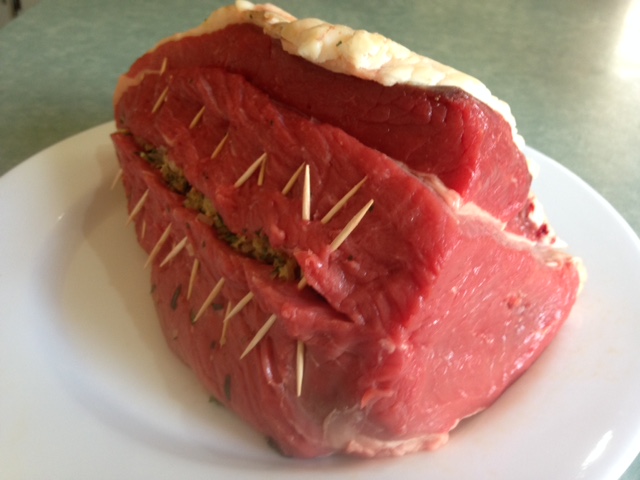
One of my strongest palate memories of the meals cooked by Maggie’s mother, Isla was a roasted, stuffed corner piece of topside. The meat was moist and flavoursome and the stuffing was delicious.

From 1974 to 2004, Maggie and I had no contact, partly due to the fact that I had left Melbourne and settled in Western Australia. From time to time during those three decades, I would try to replicate what Isla had served us, but the flavour always fell short of what I was aiming for. It wasn’t until Maggie and I were reunited and living together, finally, that my conundrum was resolved – the missing ingredient was sage!

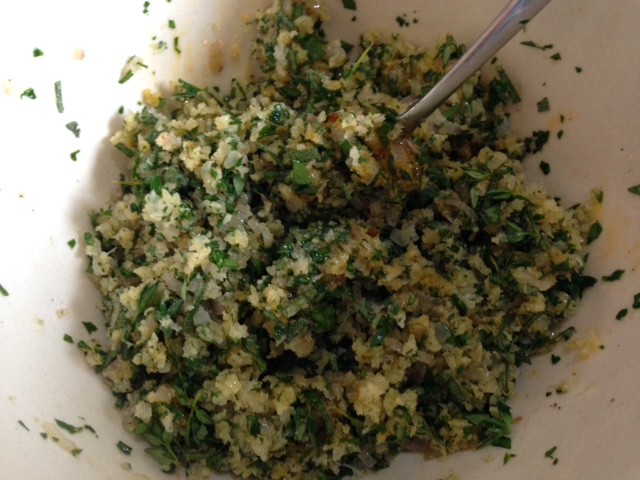
Here is the recipe for how we make the stuffing, enough for a piece of topside weighing about 1.5kg. We like to ‘herb it up’, so we use the higher quantities of the three herbs.

Ingredients

20g unsalted butter
100g French shallots or onion
1-2 tsp Dijon mustard
3/4 cup of homemade breadcrumbs
3-4 tsp chopped sage
2-3 tsp chopped parsley
1-2 tsp thyme leaves
1 tbsp olive oil
pinch or two of salt and a generous amount of black pepper
1 egg yolk

Method

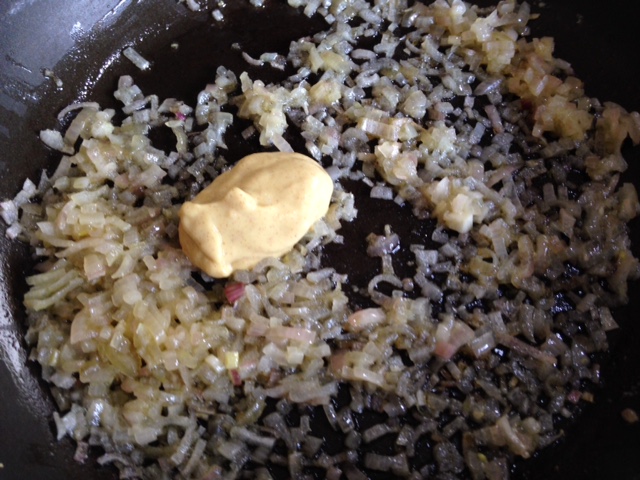
  1. Heat the butter over low heat and sauté the shallot for 6-8 minutes or until soft. Add mustard off the heat, mix together.
  2. Place the breadcrumbs in a bowl, add the shallot mixture and stir briefly.
  3. Add herbs and olive oil, mix well, add seasoning, taste and adjust.
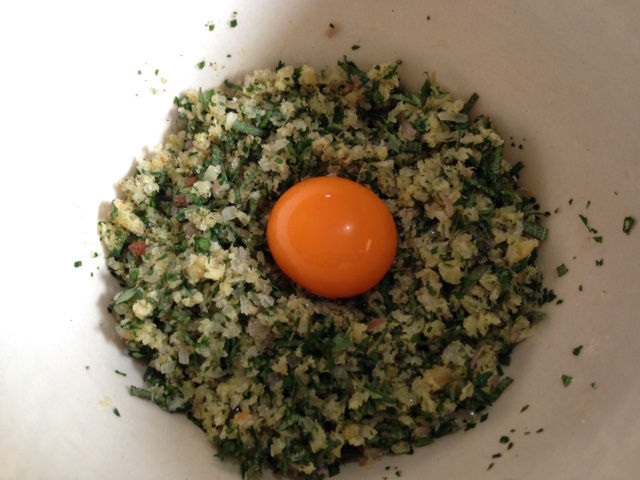
  4. Add egg yolk and mix well.
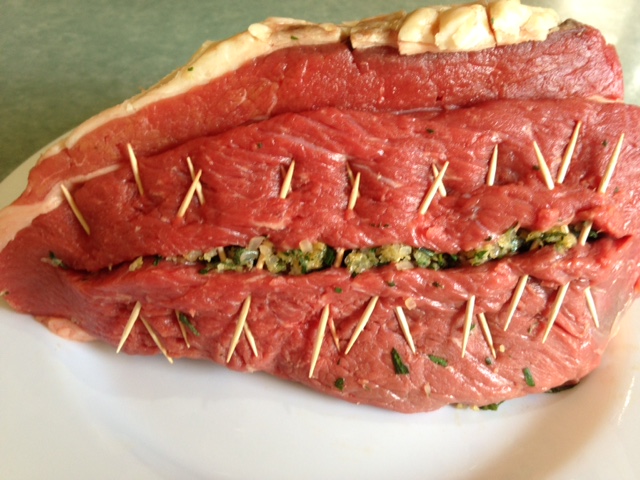
  5. Cut a pocket into the larger face of the meat, running to about 1cm from each end and at least half way through to the other side. Spoon in the stuffing and secure with toothpicks.

The cooking time varies from oven to oven and palate to palate. We roast such a piece at 180C for 55-60 minutes, then double wrap it in foil and rest for a good 20-25 minutes, fully expecting that the mid-section of the piece will need a fraction more cooking when we heat it up another day for a second main meal, with lunch sandwiches to follow.

Topside 1   Topside 2

Topside 3   Topside 4

Topside 6   Topside 5


Posted in Cooking | Tagged , , , | Leave a comment

A lamb-friendly warm potato salad

A creamy, slightly-chilled potato salad goes well with most meats that have been barbecued. Maggie and I make one several times during the warmer months; the latest one was one of our best ever, thanks to some ultra-fresh small potatoes and the seasonal supply of parsley and chives from our garden.

However, when we barbecue a piece of lean, boneless lamb – the backstrap as it is known here – we prefer to make a warm potato salad and dress it with olive oil. It’s quick to prepare and has a high flavour-to-effort ratio.

Ingredients

500g small potatoes, skin left on
2 tbsp olive oil
plenty of salt flakes and freshly-ground black pepper
2 tbsp finely chopped fresh parsley
2 tbsp chopped fresh spring onion

Method

  1. Cut any larger potatoes into segments (3 to 4 cm). Place potatoes in saucepan of cold salted water and bring to the boil.
  2. Cook the potatoes for about 7 to 9 minutes from the time they come to the boil.  The potatoes should be firm but cooked through.
  3. Drain potatoes and return to pan or a large bowl. Add olive oil, salt and pepper and gently toss to coat the potatoes.
  4. Leave for about five minutes then add the parsley and onion and gently toss before serving.

Last night, I used kipfler potatoes to make the salad. I barbecued the lamb for 5 minutes on one side and 3 minutes on the other, yielding a nice pink colour in the centre of the meat. The other item on my plate was a salad of our cherry tomatoes, tossed with some pearls of mozzarella-style cheese, shredded basil, a little balsamic vinegar and a little less olive oil.

Potato salad warm 1   Potato salad warm 2

Posted in Cooking | Tagged , , , , | Leave a comment

As cool as a cucumber soup

Our Greek neighbours, Nik and Sula, have been sharing some of the seasonal produce from their vegetable garden with us. Nik, now in his 70s, is very accomplished at working his soil to produce bountiful crops from a small area and this summer has been no exception.

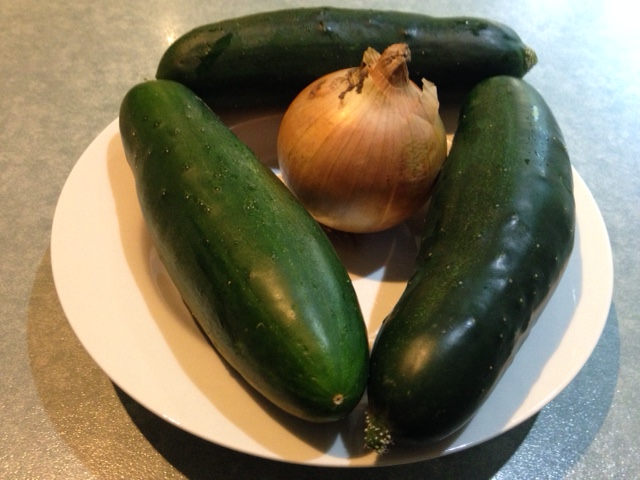
Late last week, Sula brought us 2kg of green tomatoes – pickled by Maggie on Sunday – and three large cucumbers, which went into the cold soup I mentioned at the end of my previous post.

I don’t make this soup very often, mainly because it contains some semi-raw egg yolk, so it doesn’t keep for more than two or three days. However, I knew I would be able to take some to Healesville when I returned Stevie Nicks to Julian and Sara’s home. So, I made a batch, and kept enough for me to enjoy as part of a light lunch.

Cuc soup 5

Now, a bowl of chilled cucumber soup can be quite refreshing on a warm summer’s day. However, in terms of flavour, it is at the ‘light’ end of the spectrum, assuming you don’t want to overwhelm the cucumber with other ingredients. So, you need to add just enough salt to enhance the soup’s delicate flavours, which is one of salt’s main virtues.

My other tip is to be careful not to use too much cream; this would spoil the soup’s mouth-feel. We use a fat-reduced sour cream; if not, we would reduce the quantity specified in the recipe by about one-third.

Ingredients

2 tbsp olive oil
1 medium brown onion, finely chopped
¼ tsp paprika
½ tsp cumin
2 long cucumbers or 6 Lebanese cucumbers, peeled, deseeded – using a fine-lipped small spoon – and coarsely chopped
3 tsp chopped dill leaves or 1½ tbsp chopped mint leaves
3 cups chicken stock
grated zest of 1 lemon (or a small piece of preserved lemon skin)
<½ cup sour cream
2 egg yolks (you could use the whites to make meringues)
1½ tbsp dry sherry
salt, as necessary

Method

  1. Heat the olive oil over low heat, add the onion and sauté for 5 minutes or until soft.
  2. Add the spices, stir to combine with the onion and add the cucumber. Cook for 5 minutes, add the stock, dill (or mint) and lemon zest, bring to the simmer and cook for 10 minutes.
  3. Allow to cool slightly then blend in a food processor.
  4. Whisk the egg yolks, sour cream and sherry and combine with a cup of the blended soup, then whisk it back into the rest of the soup. Adjust seasoning.
  5. Serve chilled.

Cuc soup 1   Cuc soup 2

Cuc soup 3

Posted in Cooking | Tagged , | Leave a comment