Dijon inspiration

Earlier this year, Maggie and I spent three days in Burgundy, dining and wining as if we were heirs to the French throne. Our next stop was Dijon, a city we expected to enjoy while staying two nights at the Ibis Dijon Gare. (As the name implies, this hotel is located close to Dijon’s main railway station, from whence we would be travelling to Salzburg via Zurich.)

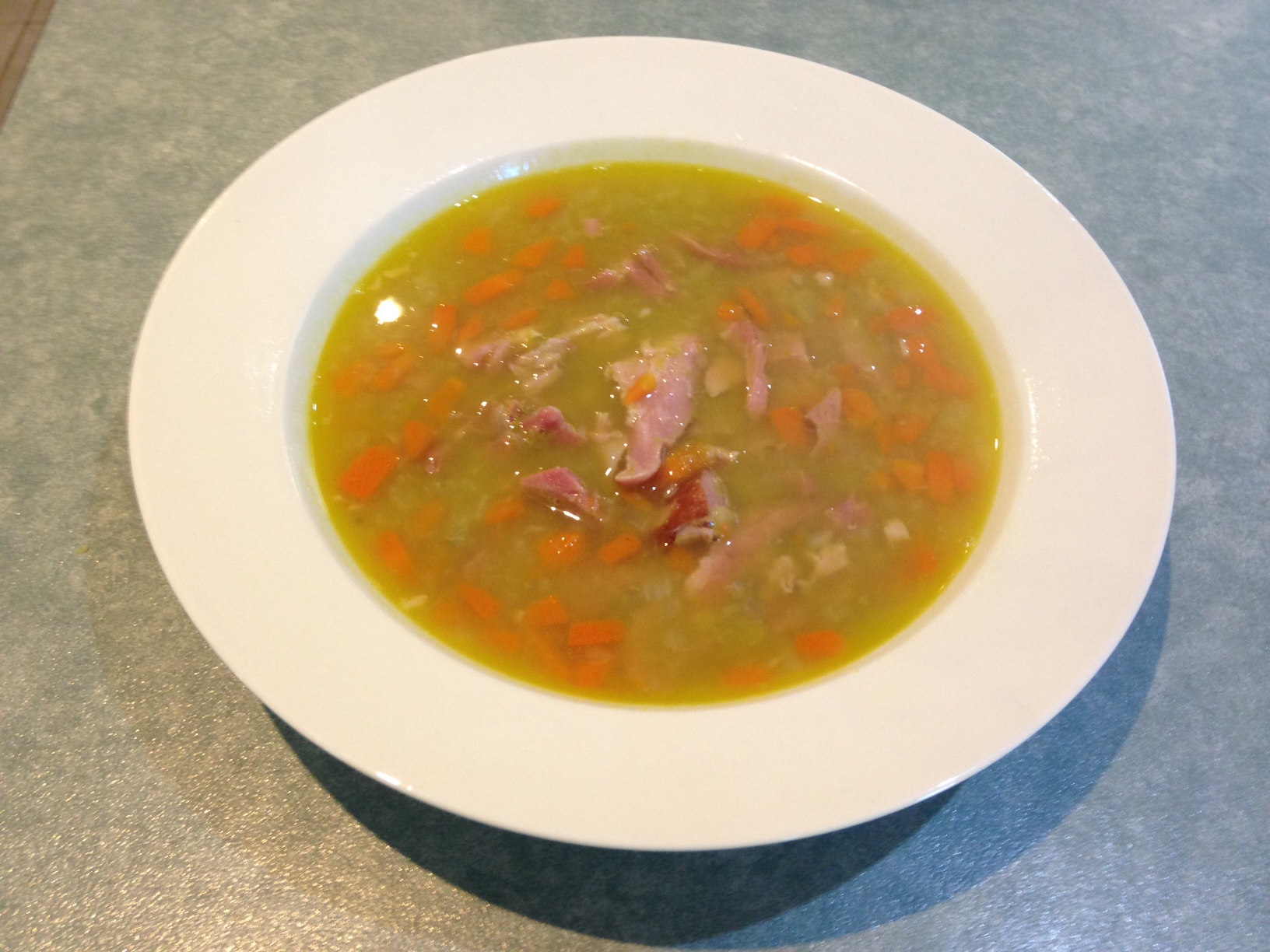
Unfortunately, yet not very surprisingly, the excesses of the previous three days caught up with one of us – poor Maggie. She needed several daylight hours of sleep and, when she did feel up to venturing out, her appetite for fine food was zilch. For instance, our visit to Dijon’s wonderful food market was limited to window shopping rather than buying a few items to make up a DIY picnic hamper. So, on our second evening, I dined alone in the hotel’s bistro. My solitude was more than compensated for by a delicious and perfectly-grilled veal steak on the bone, as shown in the first photo.

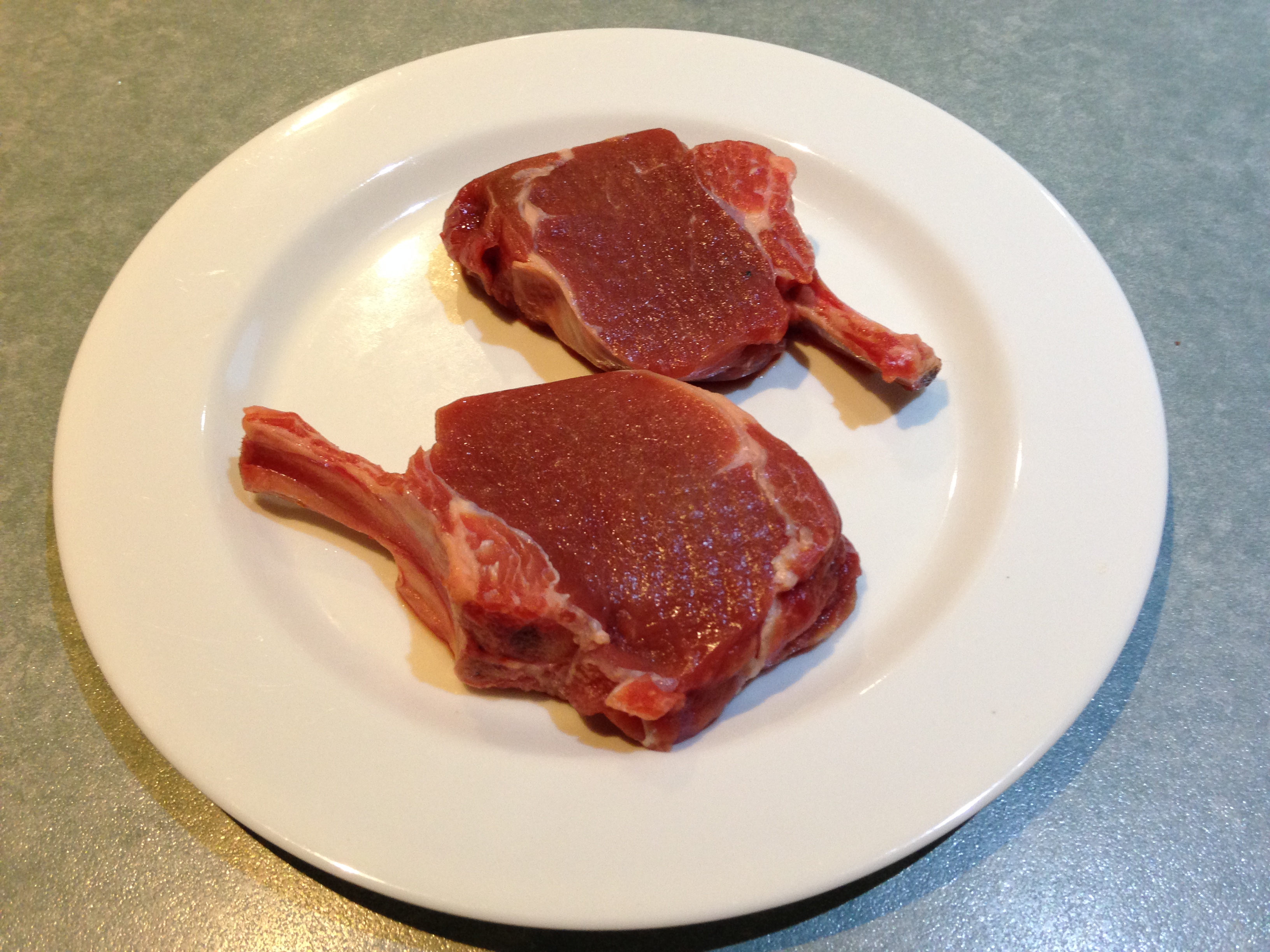
Last night, we prepared our interpretation of my Dijon experience, using veal chops bought at Prahran Market. This cut of veal is tender and moist when cooked, without needing to be braised for an extended period.

Ibis veal chop   Veal chop 1

Before I cooked the chops, I heated some leftover chicken stock in a saucepan, to which I added a few sprigs of thyme, a beef stock cube and a little water.  After the stock had simmered for about 10 minutes, I removed it from the heat and discarded the thyme.

To cook the chops, I began by heating a dob of butter in a non-stick pan over low-to-medium heat, once the pan was hot. I browned each side for about 4 minutes. After turning the chops, I put the lid on the pan but slightly ajar – this helped cook the meat next to the bone.

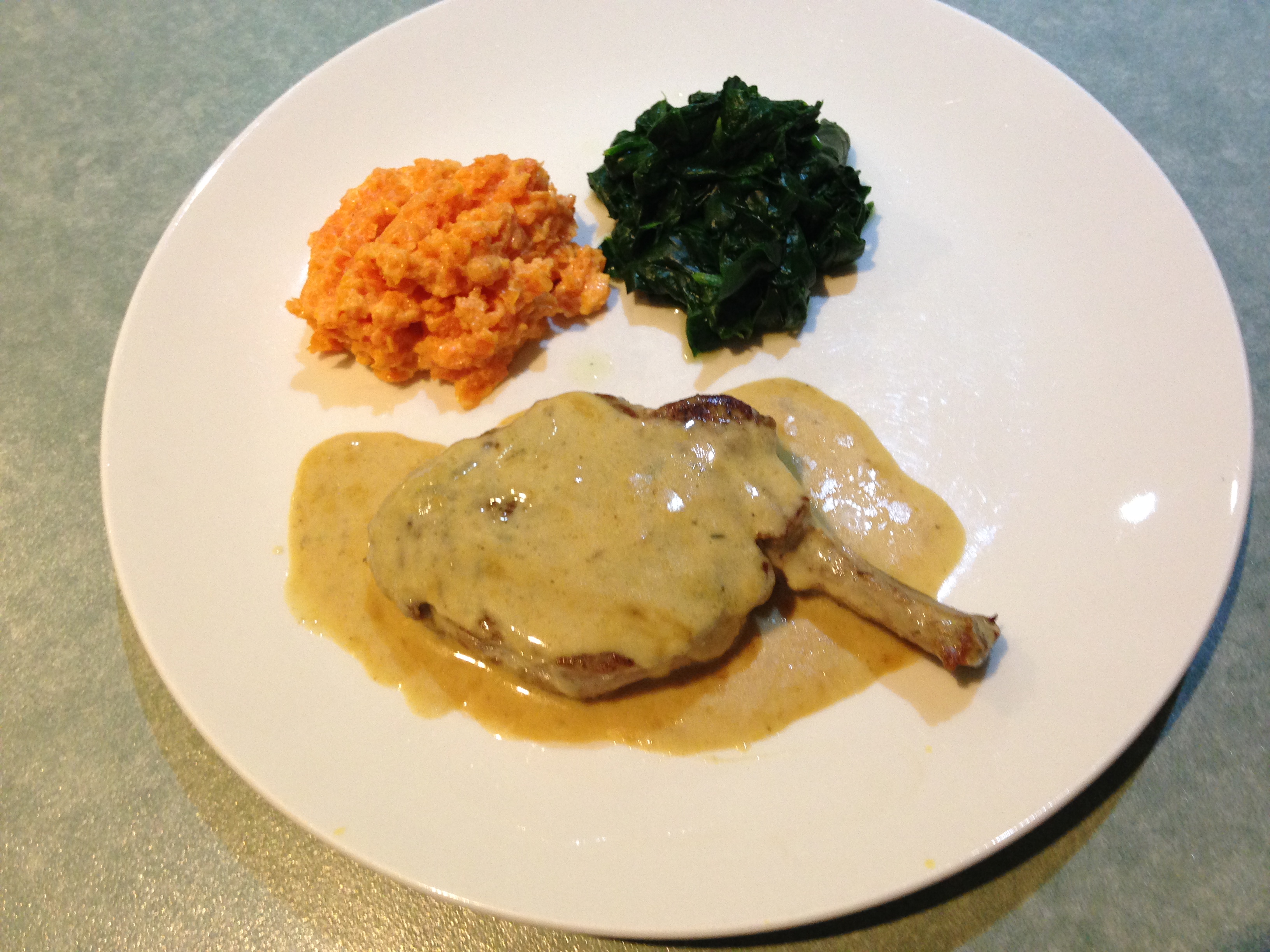
I removed the chops and kept them just warm. While Maggie worked with the wooden spoon, I poured about 1/4 cup of dry white wine into the pan; this bubbled and reduced for a couple of minutes. Next, 1/3 cup of the stock – the balance is destined for a pepper sauce tonight. When the sauce had returned to the boil, I added 1 tsp of Dijon mustard. When Maggie had integrated the mustard into the sauce we stirred in about 30ml of cooking cream, let it thicken the sauce, then added the meat resting juices and finally the chops, to coat them in the sauce (see photo).

We served the chops with some gently-boiled silverbeet and a mash of carrot, butter, sour cream and nutmeg. (This mash is a perfect partner for veal dishes but, because there is no starch in a carrot, you must drain the boiled carrots thoroughly and let the steam evaporate for a minute or two before you mash them.)

Thank you Ibis Dijon Gare – we have a new dish for our veal repertoire and we have named it Veal chops Dijonnaise!

Veal chop 2   Veal chop 3

Posted in Cooking, Travel | Tagged , , , | Leave a comment

Roasted garlic and lemon chicken marylands

When I was growing up – alas, several decades ago – a meal of roast chicken was something of a treat, reserved for birthdays and other special occasions.  Today’s children would find that difficult to believe but this was in the days before large-volume production of hens.

We like a roast chicken as much as the next person but we only go the whole bird when we will be serving it to a table of four or more. Our menu is busy and room has to be made for other favourites. So, our everyday chicken roast is just two maryland pieces.

In warm, salad-friendly weather, we flavour the chicken overnight with a marinade built around our homemade berbere spice mix; more on that later in the year. While the weather is cool, Maggie makes up a paste of olive oil, chopped preserved lemon (flesh and skin), crushed garlic and black pepper. This is pushed into three cuts she slashes across each maryland.

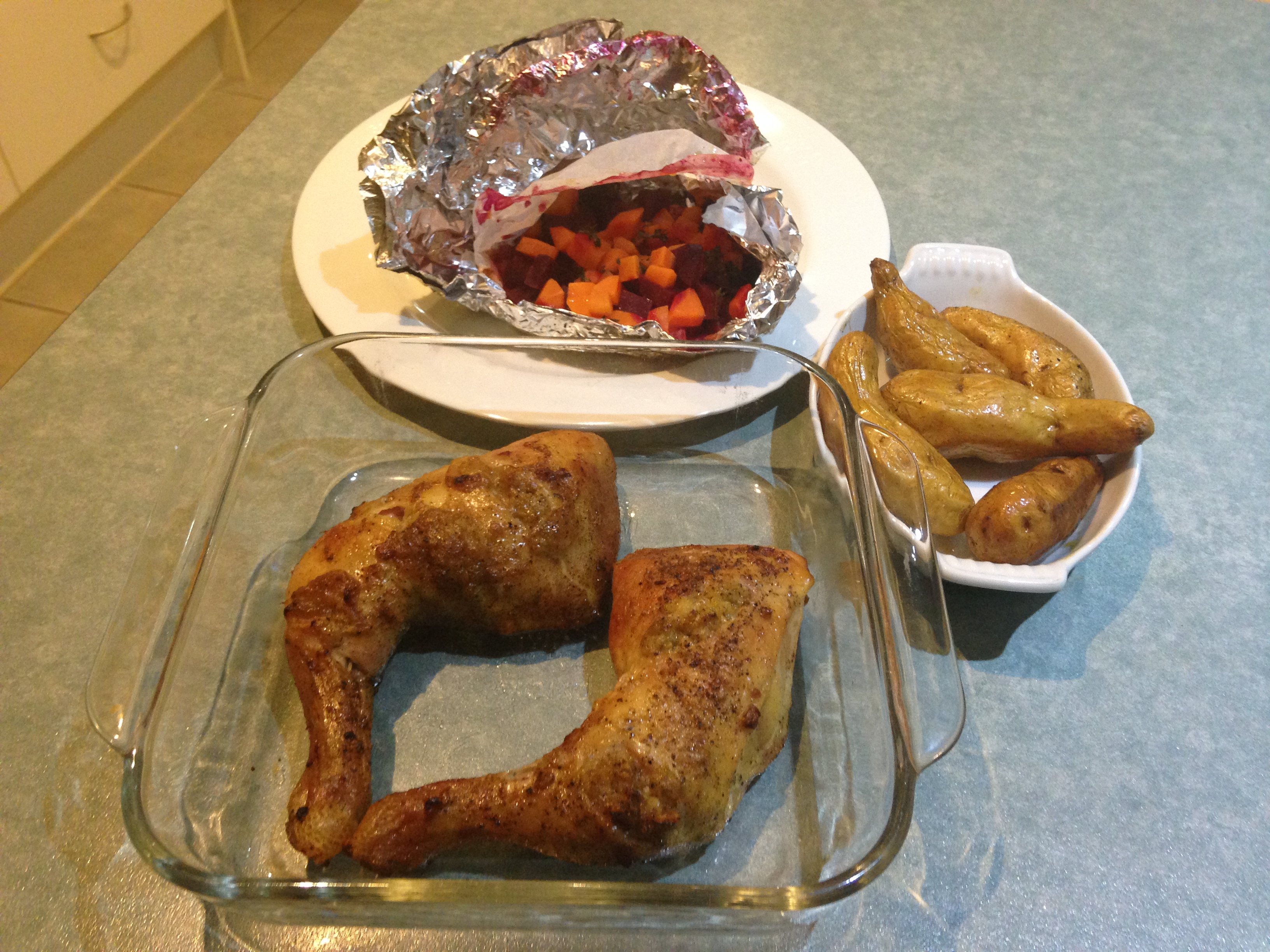
Last week – the last of the calendar winter – brought sunny days in Melbourne, followed by cool nights; we were able to roast the chicken in our Weber Q. We added a few whole kipflers, which I had par-boiled for about 12 minutes, and a beetroot and carrot parcel. (The recipe for the latter can be found on my post Braised duck with a red wine sauce.)

The meal was completed by a green salad of homegrown leaves, just-cooked fresh peas, chopped mint, slices of Lebanese cucumber and homemade vinaigrette dressing.

Chick marylands 1   Chick marylands 2

Chick marylands 3   Pea salad 1

Posted in Cooking | Tagged , , | Leave a comment

Roast stuffed quail

Some persons don’t like to eat quail. My mother – who was very fond of food – was one; although she did eat the quail saltimbocca that was the centrepiece of our 2006 wedding feast.

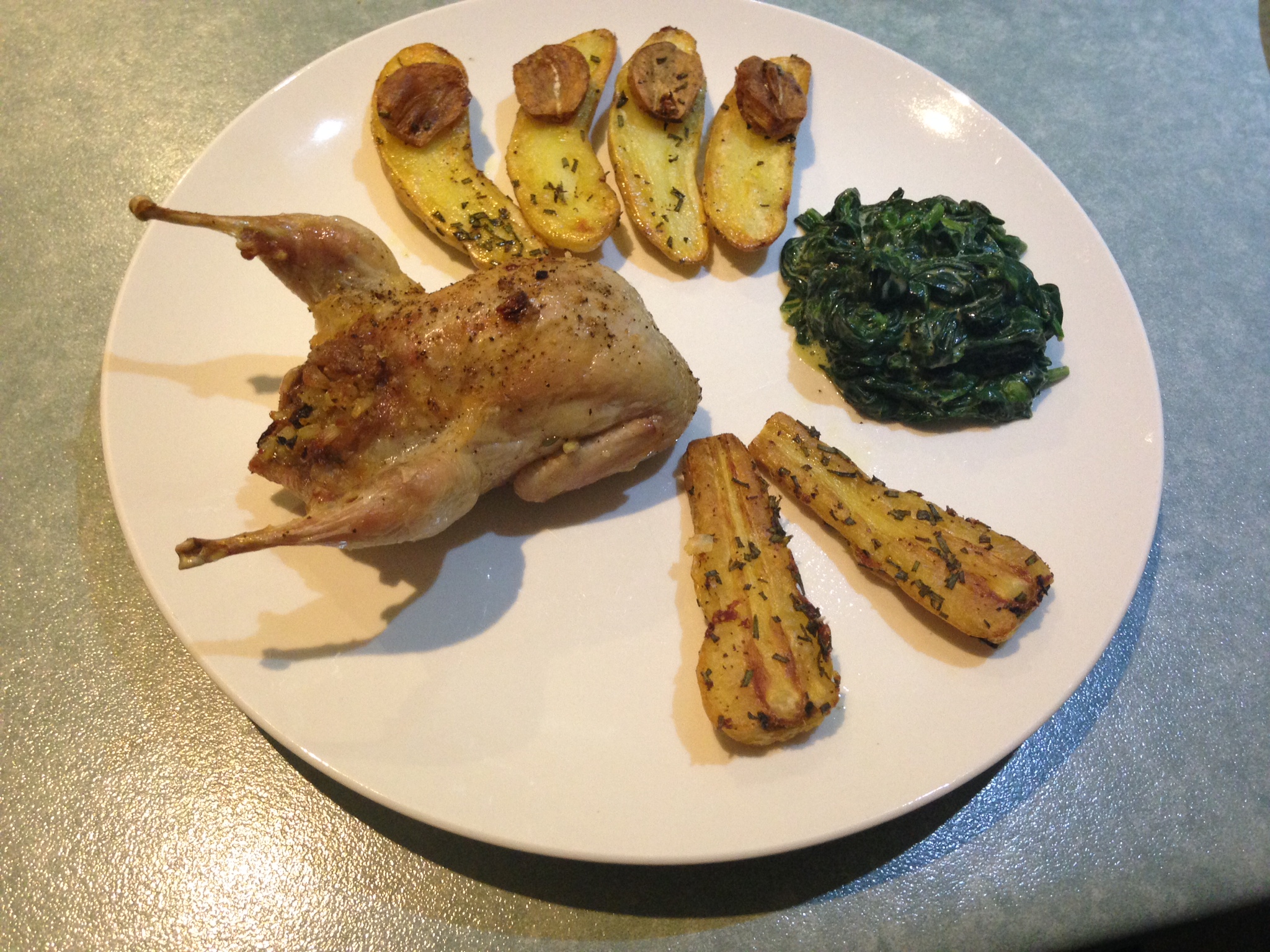
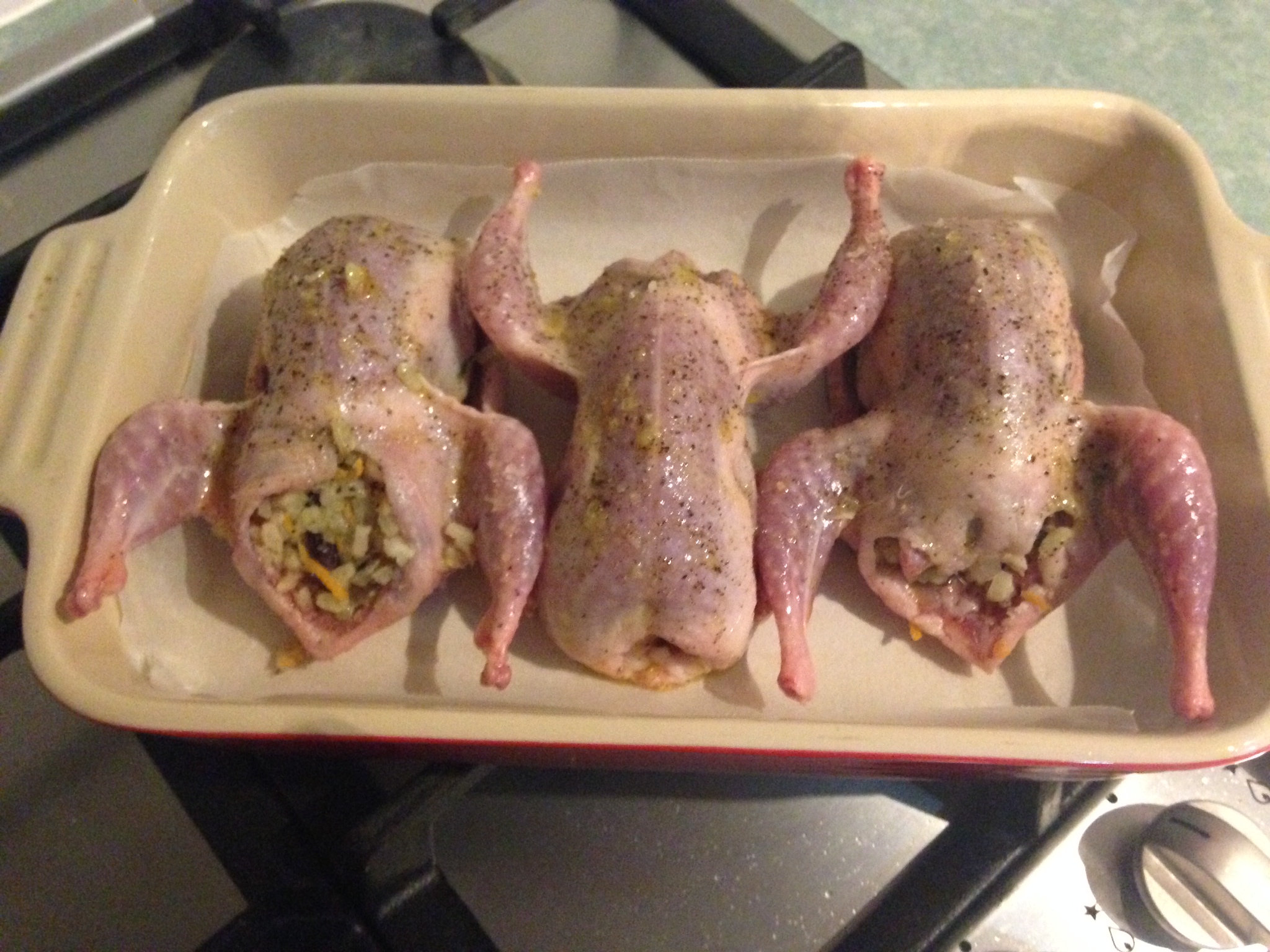
Maggie likes quail. A lot. She introduced it to my diet – now, there’s an oxymoron for you – and there are now three quail recipes in our repertoire. The other two were added in 2013: quail involtini, for which Maggie did the boning; and roast stuffed quail. We cooked the latter again last weekend.

Quail 3

We first put this recipe together using a list of ingredients – names only – buried in an anecdotal piece about cooking quail by the much-admired Maggie Beer. This time we introduced two alternative ingredients, as indicated, to take advantage of cherries we had pickled and chestnuts we had roasted. Either way, the result is delightful.

Ingredients

½ cup brown rice
20g butter
2 French shallots, finely chopped
grated zest of 1 orange
50g currants; or 40g pickled cherries, pips removed and flesh chopped
50g almond flakes, crushed by hand; or 50g roasted chestnut, chopped
leaves from 3 sprigs thyme
salt and pepper
4 quails (we cooked 3 but there is enough stuffing for 4)

Method

  1. Cook the rice in plenty of salted, boiling water for 35 minutes; it must be tender. Drain and place in a mixing bowl.
  2. Meanwhile, melt the butter in a small, non-stick pan and sauté the shallot for about 12 minutes, until it is quite soft. Add shallot to rice.
  3. Add fruit, nuts and thyme leaves, stir, season well and mix thoroughly.
  4. Remove the last wing segments from the quail and divide the stuffing between the four quail cavities; use less rather than pack the stuffing tightly.
  5. Place quail in a small ceramic or glass roasting dish lined with baking paper, brush upper quail surfaces with olive oil and roast in an oven pre-heated to 180C. Baste after 10 minutes and 20 minutes.
  6. Stuffed quail cook more slowly, so it should take up to 25 minutes to produce quail that are a light, golden brown.

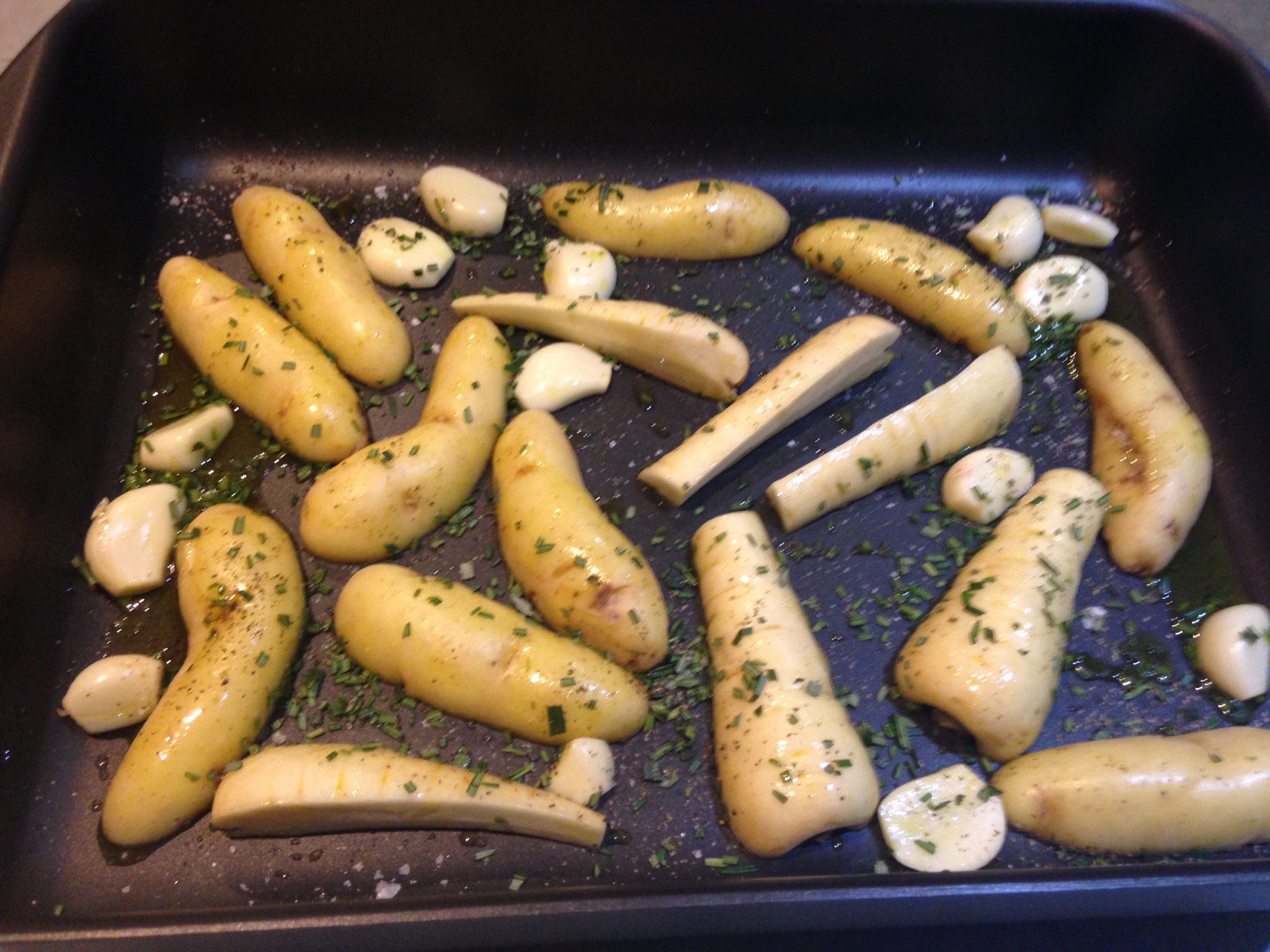
To accompany the quail, we roasted some well-seasoned pieces of kipfler potato and parsnip with olive oil, garlic and chopped rosemary leaves; and we wilted a bunch of spinach leaves and mixed them with Dijon mustard and cooking cream.

Quail 1   Quail 2

Posted in Cooking | Tagged , , | Leave a comment

Blanquette de veau – the method, in pictures

Here again is the method for preparing blanquette de veau, followed by some photos of the various steps.

  1. Cut the meat into cubes of about 2½cm. Melt 25g of butter in a heavy-based non-stick pan over moderate heat, and fry the meat in three batches until well coloured – about 8 minutes per batch. Transfer to a dish.
  2. Add the mushrooms to the pan and sauté for 10 minutes, tossing frequently, until glazed and tender.
  3. Meanwhile, melt 15g of butter in a flameproof casserole, add the carrot and leek and sauté for about 10 minutes.
  4. Add the bouquet garni, meat and mushrooms to the casserole, add the stock and water and bring to the boil. Place in an oven heated to 150C and bake for 30 minutes (reduce heat if liquid bubbles rapidly).
  5. Add salt and pepper, stir well and cook for another 25 minutes or until meat is tender. Remove from oven.
  6. Drain off the liquid and, if necessary, make it up to 400ml using water or stock. Discard the bouquet garni. Keep the meat and vegetables warm.
  7. To thicken the sauce, melt the remaining 25g of butter in a saucepan. Add the flour and cook, stirring, for a minute. Add the measured stock all at once, whisking briskly. Bring it to a boil and let it simmer for several minutes, stirring gently. Whisk the cream and egg yolk together, stir in a little of the hot liquid then pour it into the saucepan, whisking all the time.
  8. Take the sauce off the heat, add lemon juice to taste, adjust the seasoning and pour the sauce into the casserole. Heat through gently but do not allow the sauce to boil (or it might curdle).
  9. If you would prefer to use less butter, complete steps 1 to 5 on one day, refrigerate overnight and, next day, remove the butter, which will have accumulated on the jellied surface of the dish. Use this butter in step 7 – it works just fine!
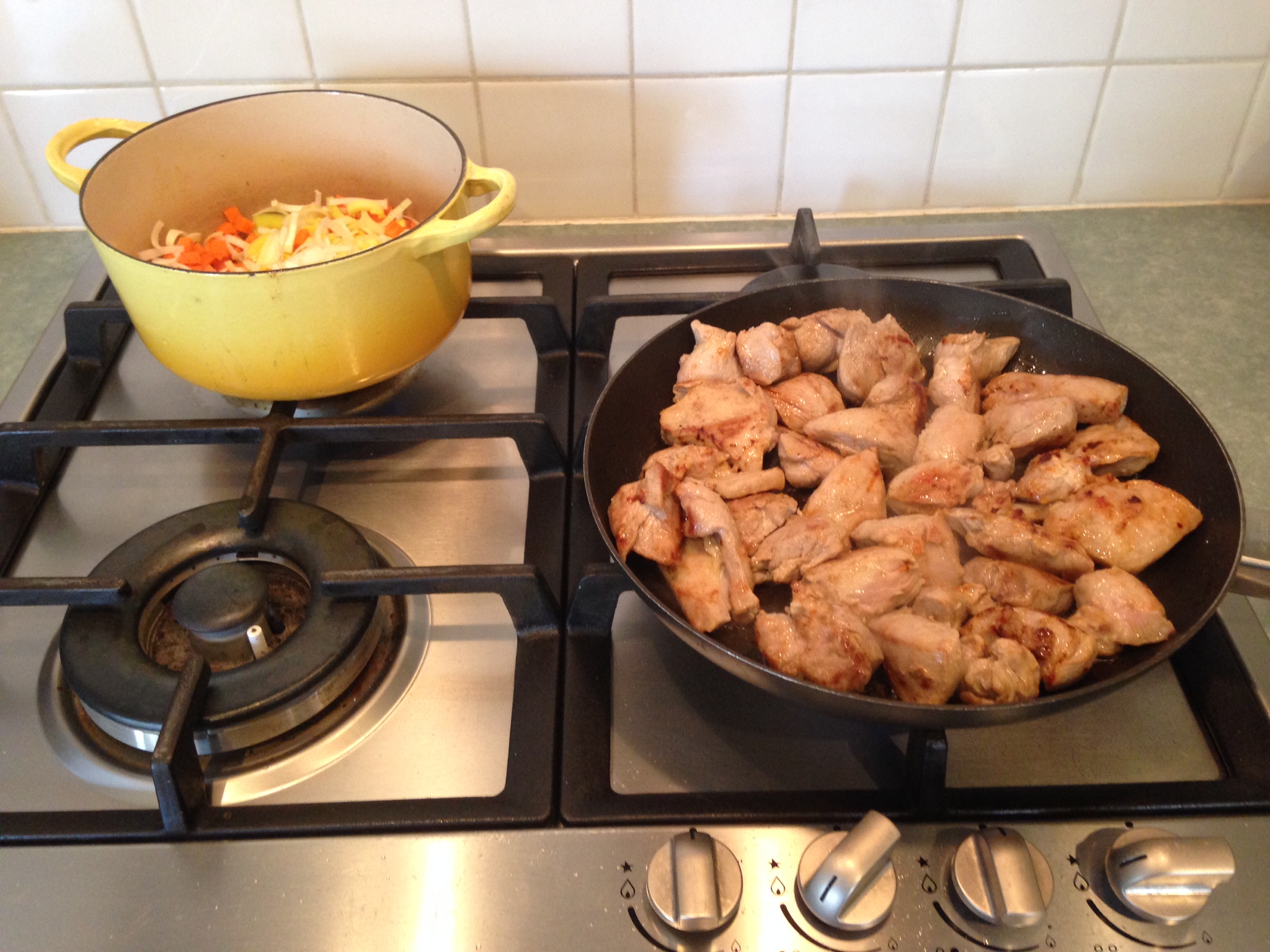
End of step 1 and start of step 3

End of step 1 and start of step 3

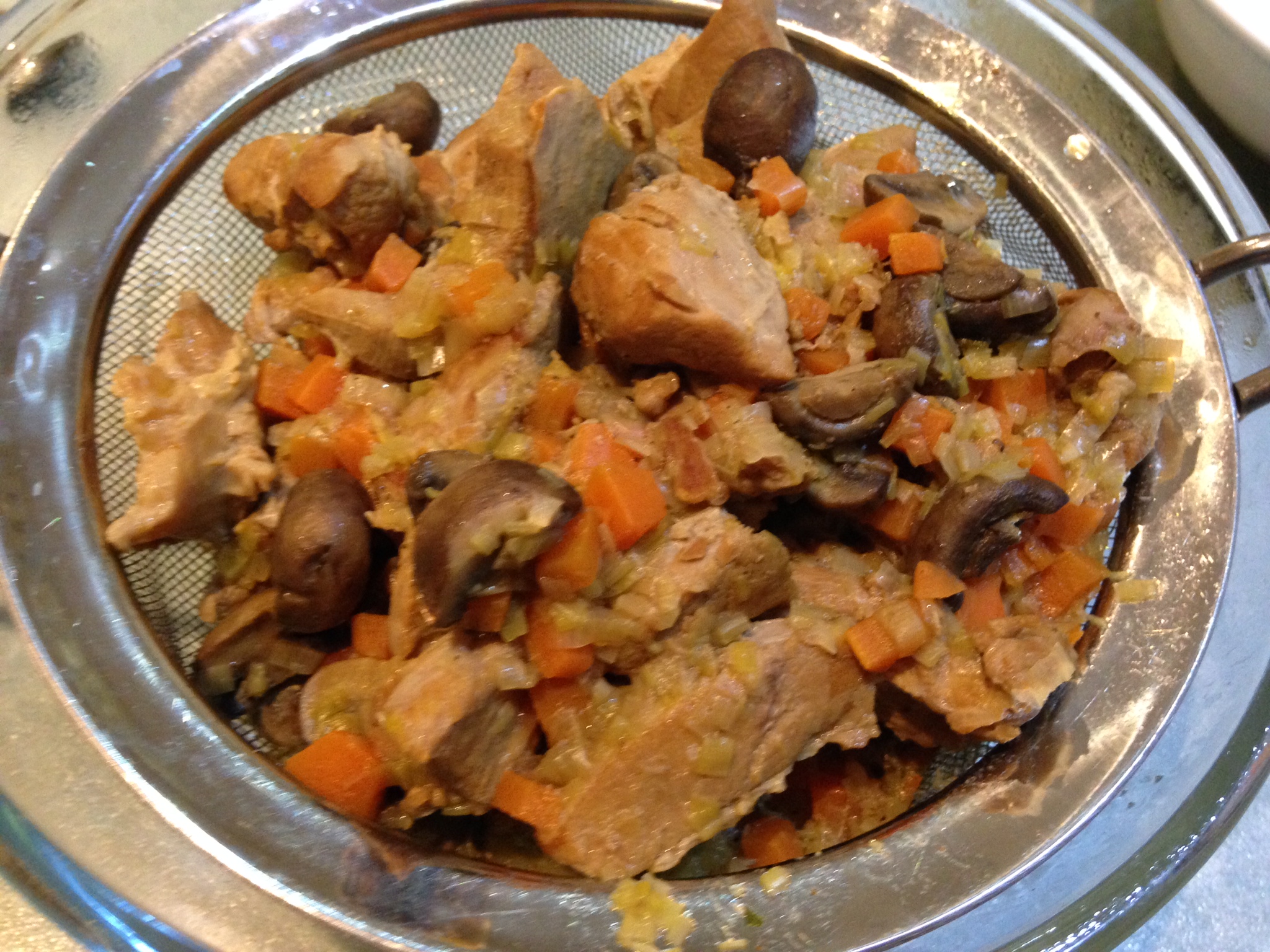
End of step 2 (mushrooms

End of step 2 (mushrooms) and ready for step 4 (casserole)


Mushrooms added for step 5

Mushrooms added for step 5

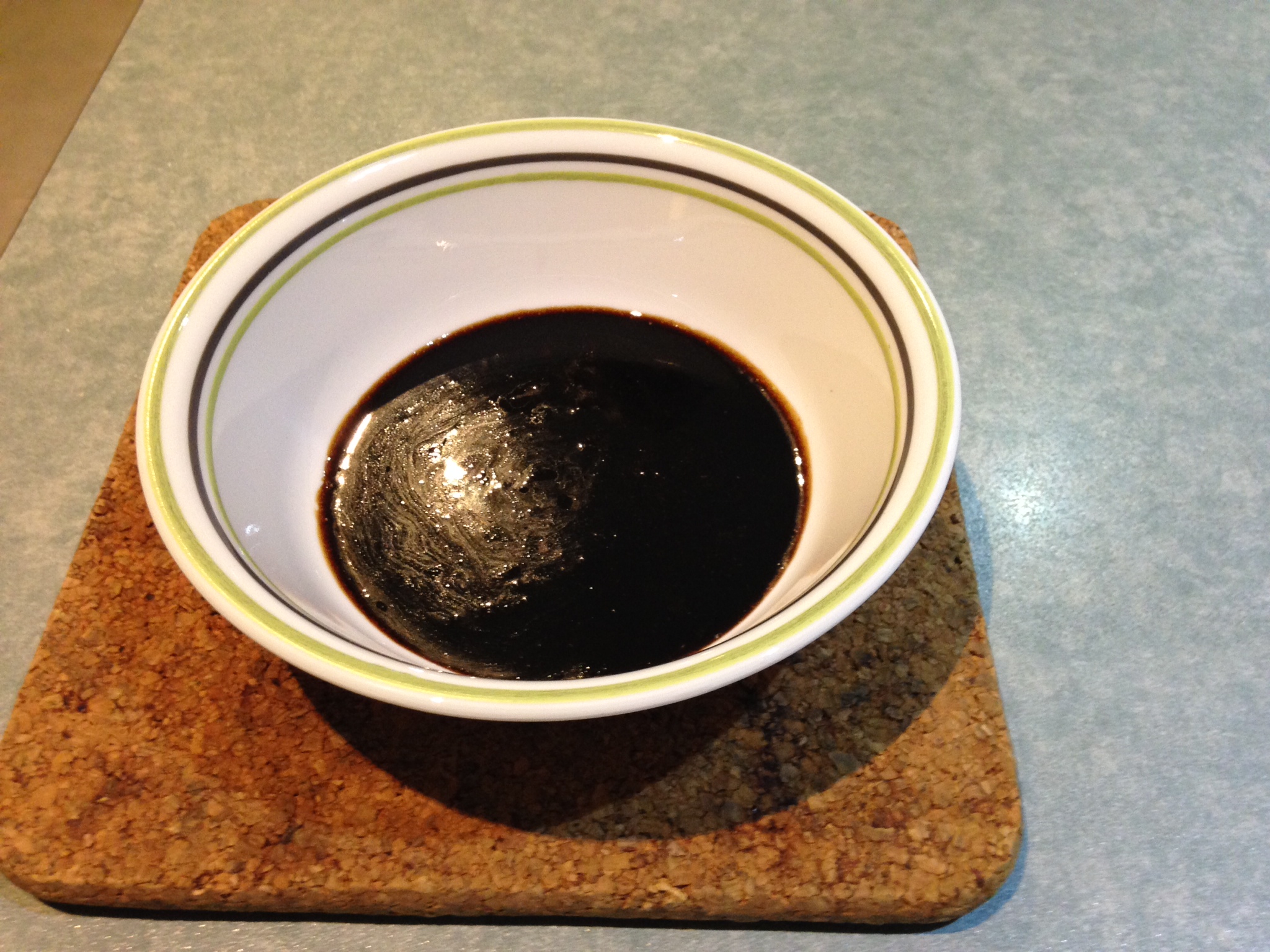
Beginning of step 6

Beginning of step 6

Step 7

Step 7 before adding the egg yolk and cream

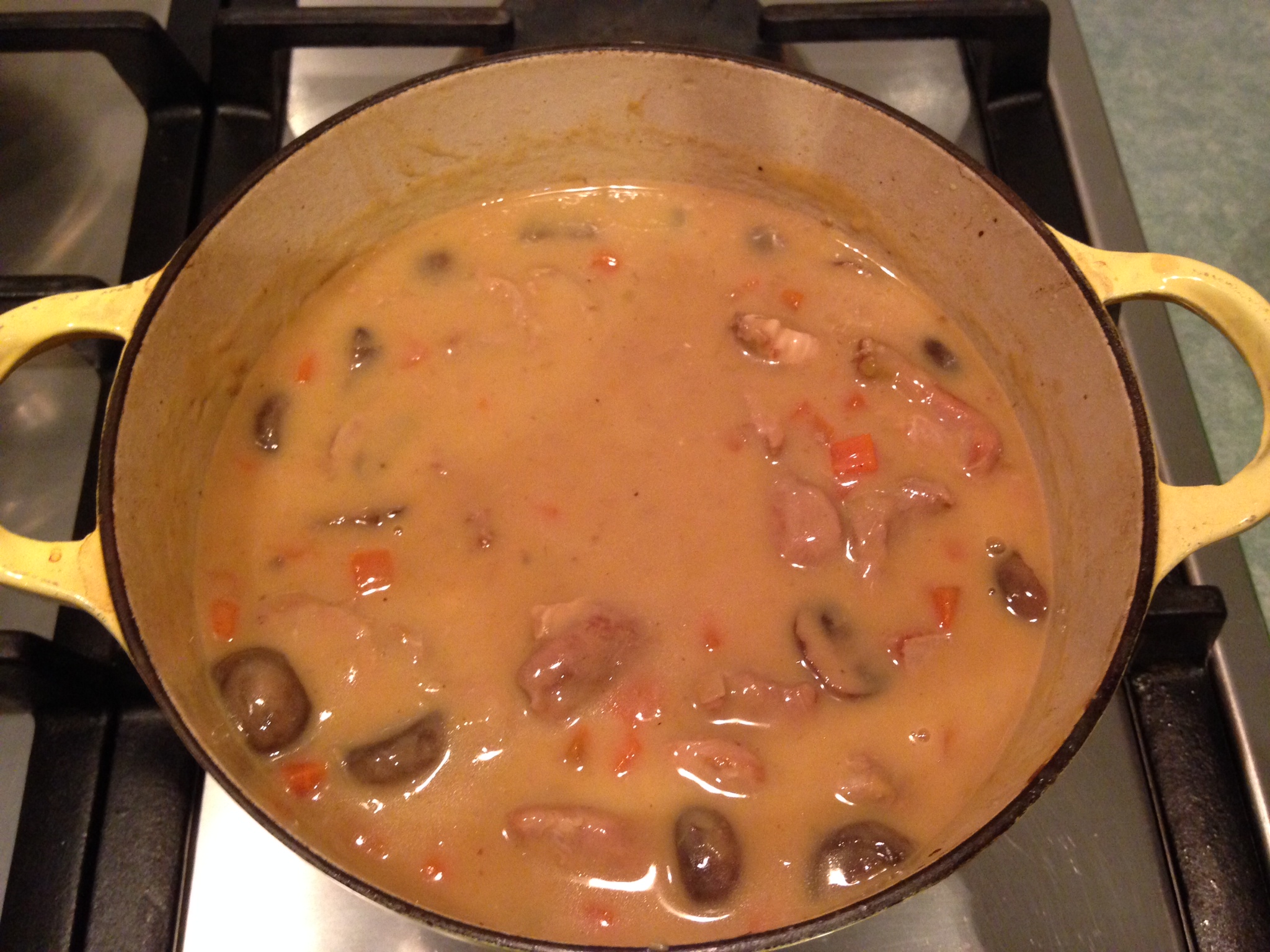
Reheating during step 8

Reheating during step 8

Posted in Cooking | Tagged , , | Leave a comment

Blanquette de veau

If you don’t like the flavour – yes, flavour – of veal, I suggest that you stop reading now. Because there is no way known that you are going to want to cook blanquette de veau!

As mentioned in a previous post, Maggie and I bought a whole vealer in 2012 and made several additions to our repertoire of veal dishes. That host of recipes numbered nine, to which we added a dish of veal meatballs a few months ago. Through this winter, we have begun a cull, in order to end up with a group of recipes which we will look forward to using year-in, year-out. Going by what we ate last night, blanquette de veau will definitely be one of the stayers.

Our blanquette de veau, with tender brown rice and fresh green beans

Our blanquette de veau, with tender brown rice and fresh green beans

We have tried two different recipes for this classic French dish. The first required a lot of fuss and bother that was not rewarded with an enjoyable result. Our second attempt was based on a recipe in Vogue French Cookery, published in the 1980s. It produced an elegant dish that passed the dinner party test. This week, we undertook a substantial makeover of the favoured version and this is the recipe that appears below.

Ingredients

800g boneless shoulder veal
65g butter
1 medium carrot, peeled and finely chopped
white part of 1 leek, finely chopped
1 bouquet garni (bay leaf and srpigs of thyme and parsley wrapped in muslin)
1 cup veal stock and ½ cup water
½ tsp salt and ¼ tsp white pepper
150g button mushrooms, halved
1½ tbsp plain flour
1 egg yolk (optional, we don’t)
30ml cooking cream
2-3 tsp lemon juice (optional, we don’t)

Blanquette 1   Blanquette 2

Method

  1. Cut the meat into cubes of about 2½cm. Melt 25g of butter in a heavy-based non-stick pan over moderate heat, and fry the meat in three batches until well coloured – about 8 minutes per batch. Transfer to a dish.
  2. Add the mushrooms to the pan and sauté for 10 minutes, tossing frequently, until glazed and tender.
  3. Meanwhile, melt 15g of butter in a flameproof casserole, add the carrot and leek and sauté for about 10 minutes.
  4. Add the bouquet garni, meat and mushrooms to the casserole, add the stock and water and bring to the boil. Place in an oven heated to 150C and bake for 30 minutes (reduce heat if liquid bubbles rapidly).
  5. Add salt and pepper, stir well and cook for another 25 minutes or until meat is tender. Remove from oven.
  6. Drain off the liquid and, if necessary, make it up to 400ml using water or stock. Discard the bouquet garni. Keep the meat and vegetables warm.
  7. To thicken the sauce, melt the remaining 25g of butter in a saucepan. Add the flour and cook, stirring, for a minute. Add the measured stock all at once, whisking briskly. Bring it to a boil and let it simmer for several minutes, stirring gently. Whisk the cream and egg yolk together, stir in a little of the hot liquid then pour it into the saucepan, whisking all the time.
  8. Take the sauce off the heat, add lemon juice to taste, adjust the seasoning and pour the sauce into the casserole. Heat through gently but do not allow the sauce to boil (or it might curdle).
  9. If you would prefer to use less butter, complete steps 1 to 5 on one day, refrigerate overnight and, next day, remove the butter, which will have accumulated on the jellied surface of the dish. Use this butter in step 7 – it works just fine!

To prevent this post from becoming too-many-bytes-sized, I will follow it up with a separate post that contains photos of some of the steps in the method.

Posted in Cooking | Tagged , , | Leave a comment

Lime and coconut cakes

In the page about our sources of recipes and cooking advice, I mention David Herbert. Maggie has only become aware of him since we began to live and cook together. During the previous eight years, which I spent living alone, David was one of the two greatest influences on my cooking skills, knowledge and repertoire. (Towards the end of this phase of my life, my ideal concept for a dwelling was a wonderful kitchen with an en-suite bedroom; fortunately, Maggie rescued me!)

In 2013, Penguin Australia published twelve Lantern Cookery Classics, each one devoted to time-tested recipes from an Australian cookery writer. We bought two copies – one copy for us, the other for a cooking group I support at an aged care facility in Melbourne.

One of the first recipes I tested with the cooking group was for lime and coconut cakes – they were very well received. On the weekend, Maggie and I made a batch, including a lime and sugar syrup that is spooned over the cakes after you have made several holes in each cake with a skewer.

Lime cakes

The publishers of David’s book have given me a link to the recipe to share with you:

http://www.penguin.com.au/products/9781921383267/lantern-cookery-classics-david-herbert/19287652/sticky-coconut-and-lime-cakes


Posted in Cooking | Tagged , , | 3 Comments

Glazed beef short ribs

The beef short rib is one of those ingredients that became more popular in Melbourne in the wake of the 2008 global financial crisis.  Restaurants turned to offal and cheaper cuts of meat as part of the effort to maintain a viable customer base.  This encouraged more meat wholesalers to supply such items, recipes began to appear in print and online and retail butchers got on board. Then the whole smoking/long braise/tex-mex/pulled meat craze hit town and the market for finger-cleaning products went off the scale!

Maggie and I rarely dine out in our home city. We have a tight budget when at home so we can splurge when we travel; and we can’t afford to eat at many places where the menu is superior to what we prepare in our own kitchen.

However, we do notice trends and, eventually, we make room in our cooking priorities for them. (An advantage of being a year or so behind trend is the volume of recipes available.) This winter, we first gave priority to versions of what we enjoyed in Europe earlier this year, before turning to beef short ribs.

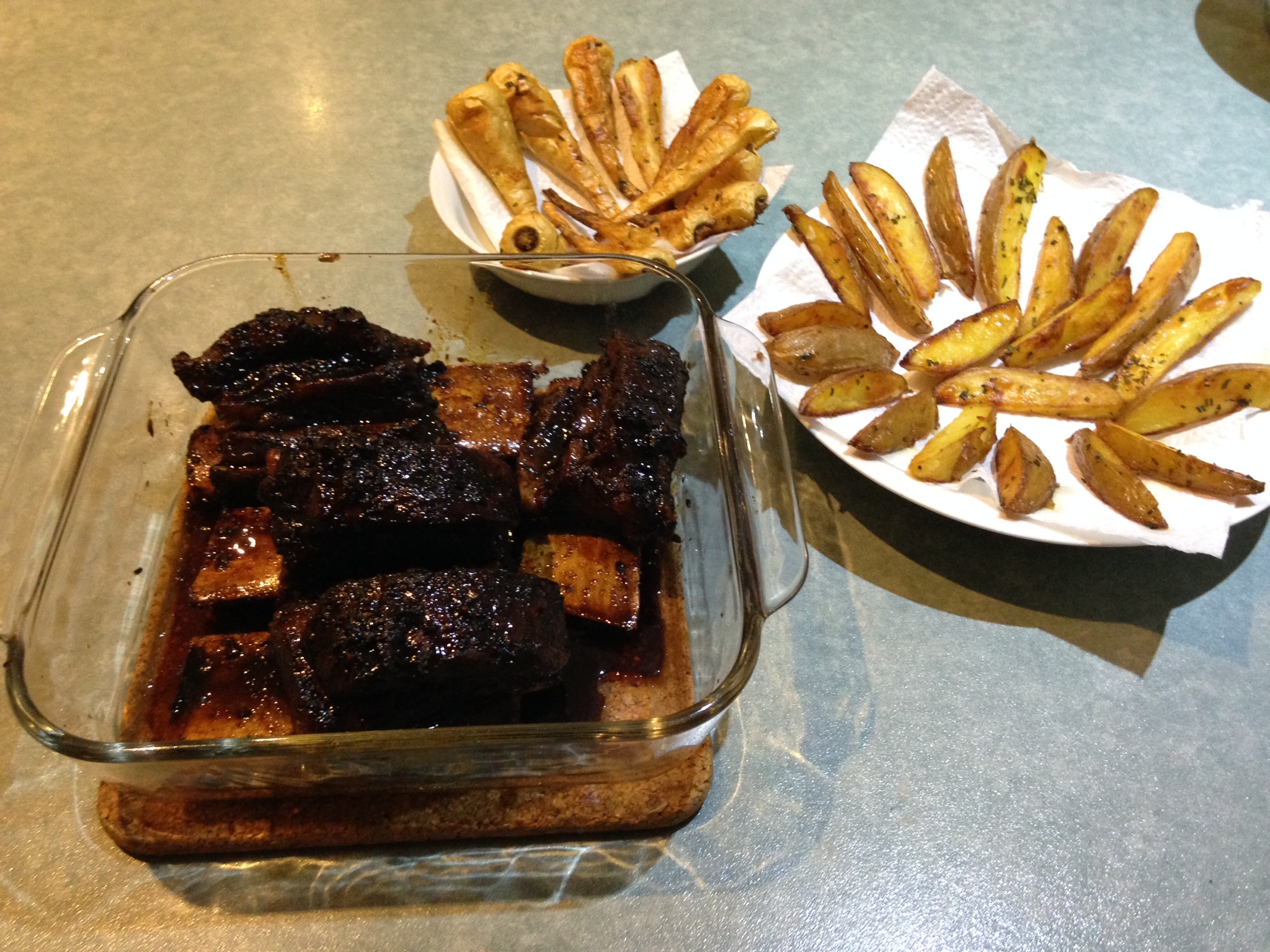
So far, we have cooked two meals of beef short ribs using a different recipe each time. The first recipe, found online at http://www.smittenkitchen.com,  produced a high quality result. However, the flavours were in the same family as those of Coq au vin and Boeuf Bourguignon, two of our established favourites, so it wasn’t such a blast for our palates. The second attempt produced the sort of sticky-finger experience that Maggie had envisaged. We began with a recipe in a beef promotional pamphlet and modified it to suit our own tastes and methods. The ingredients produced enough for us to have a generous dinner each and a workday lunch for Maggie.

Ingredients

1 kg or four pieces, beef short ribs
2 large cloves garlic
1 tsp salt
2 tsp chopped rosemary leaves
2 tsp dark brown sugar
¼ tsp black pepper
½ tsp cayenne pepper
2 tsp balsamic vinegar
¼ cup balsamic vinegar, extra, for glaze
1½ tbsp dark brown sugar, extra, for glaze

Beef ribs 1   Beef ribs 2

Method

  1. To prepare the marinade, smash the garlic and salt to a paste then add rosemary, sugar, peppers and vinegar and combine.
  2. Rub marinade over the rib meat, transfer ribs to a dish, cover and refrigerate for up to 24 hours.
  3. Remove dish from fridge at least one hour before cooking. Preheat oven to 175C.
  4. Place ribs in a roasting pan, add ¼ cup of water and cover (we cooked our ribs in a Le Creuset dish). Cook until meat is very tender – about 1½ hours depending on quality of the meat. Remove pan from oven.
  5. Transfer meat to a clean dish and drain rendered fat from pan. Add ½ cup of hot water to pan and use a wooden spatula to combine water with brown bits from cooking the ribs. Heat pan – or another pan if not flame-proof – and add extra vinegar and sugar. Simmer for about 10 minutes until reduced to ½ a cup.
  6. Brush ribs’ meaty surfaces with the glaze, transfer to a grill tray and place tray on the highest shelf of oven. Bake for about 10 minutes until the ribs are hot and caramelized.

We served our ribs with crunchy homemade potato wedges and adorably sweet, roasted baby parsnip. I think there was something green on the plate too but it didn’t make it to a photo, nor to my palate memories!

Beef ribs 3   Beef ribs 4


Posted in Cooking | Tagged , | Leave a comment

Barbecued lamb backstraps

Our favourite piece of cooking equipment – the Weber Q – has been through what George Harrison long ago described as “a long, cold, lonely winter”. Late last week, the sun shone  warmly for a day, giving us the opportunity to barbecue some meat. Beef, chicken, prawns, garfish and pork were already on the menu for the following days, so we opted for lamb backstraps, an ingredient which, for no particular reason, we hadn’t used for a few years.

This cut of lamb – which might go by other names around the world – is relatively lean, so you have to be careful to avoid making it tough and dry by overcooking it. On the other hand, it is succulent and tender when it is cooked expertly; it is easy to add flavours to the raw meat; and you can cut it up in different ways. Small wonder that it is a preferred cut for making lamb kebabs!

We prepared a simple marinade – some crushed garlic, chopped fresh marjoram, olive oil, ground black pepper and the chopped flesh of a 1/4 piece of preserved lemon.  Two hours later, we heated the Weber to a high heat and cooked the pieces of lamb for 5 minutes on one side then three on the other; the meat was then rested before being sliced to serve. (Next time, I would cook the lamb for one less minute on the first side.)

Grilled lamb goes really well with Turkish bread. Maggie cut about half a loaf into pieces and smothered them in a thin paste of olive oil, salt, pepper and crushed garlic, which she had left to steep for about an hour. She placed the pieces of bread on a piece of foil with upturned edges sitting on a baking tray and placed the tray on the top shelf of the oven, heated to 175C. After a few minutes, when the bread had begun to crisp up and turn a deep, golden brown, she removed the tray and transferred the bread to a serving dish. A platter of sliced, ripe tomatoes and fresh leaves from our garden was all we needed for a tasty and satisfying meal.

We plan to barbecue some more lamb backstraps as soon as possible. Next time, we might try the spicy marinade used when making lamb shawarma.

Lamb back 1   Lamb back 2

Posted in Cooking | Tagged , , , | Leave a comment

Strawberry and cream tart

We are very fond of flavoursome, firm strawberries, irrespective of size; size only matters when you want to make jam, for which smaller strawberries work better. When we were, ahem, young, you could only buy strawberries in Melbourne for a few months of the year. Now we can buy them close to all year round, thanks to varietal development enabling a longer local season; new production areas in climatic niches in Queensland and Western Australia; and improvements to handling and transport.

To our palates, the strawberries grown in southern Queensland are superior, in terms of flavour, texture and durability; we have been less enamoured of the fruit from WA, much of which has a wishy-washy flavour.

When we went shopping for fruit and vegetables at Toscano’s last Saturday, they had well-presented punnets of strawberries at two for $5.00; Maggie chose a pair. We assumed they were from Queensland, so we were surprised when Bob Toscano told us they were from WA and, what’s more, from a new supplier producing better berries than had been available previously from that State.

Perhaps Bob’s brother and nephew – who do the buying for the business – had got over-excited; Bob said he had a lot of punnets to move before the end of the week’s trade later in the day. While we were working our way around the shop, the price dropped to three for $6.00; Maggie took another punnet.

Now, Maggie and I shop differently. I tend to be menu-driven; Maggie is more inclined to be smitten by a product or a price and go ‘off-list’. Anyway, the deed was done – not that I put up much resistance – so, when we returned home, I dragged out recipe books for us to scan in search of options for converting 750g of strawberries into food for two persons before the fruit deteriorated.

Our collection of recipe books didn’t turn up anything that we fancied right now. We like Strawberries Romanoff but we had made that two or three times earlier in the year. So, to the internet, beginning with the Australian site, http://www.taste.com.au, which is where I found a recipe for a strawberry and cream tart.

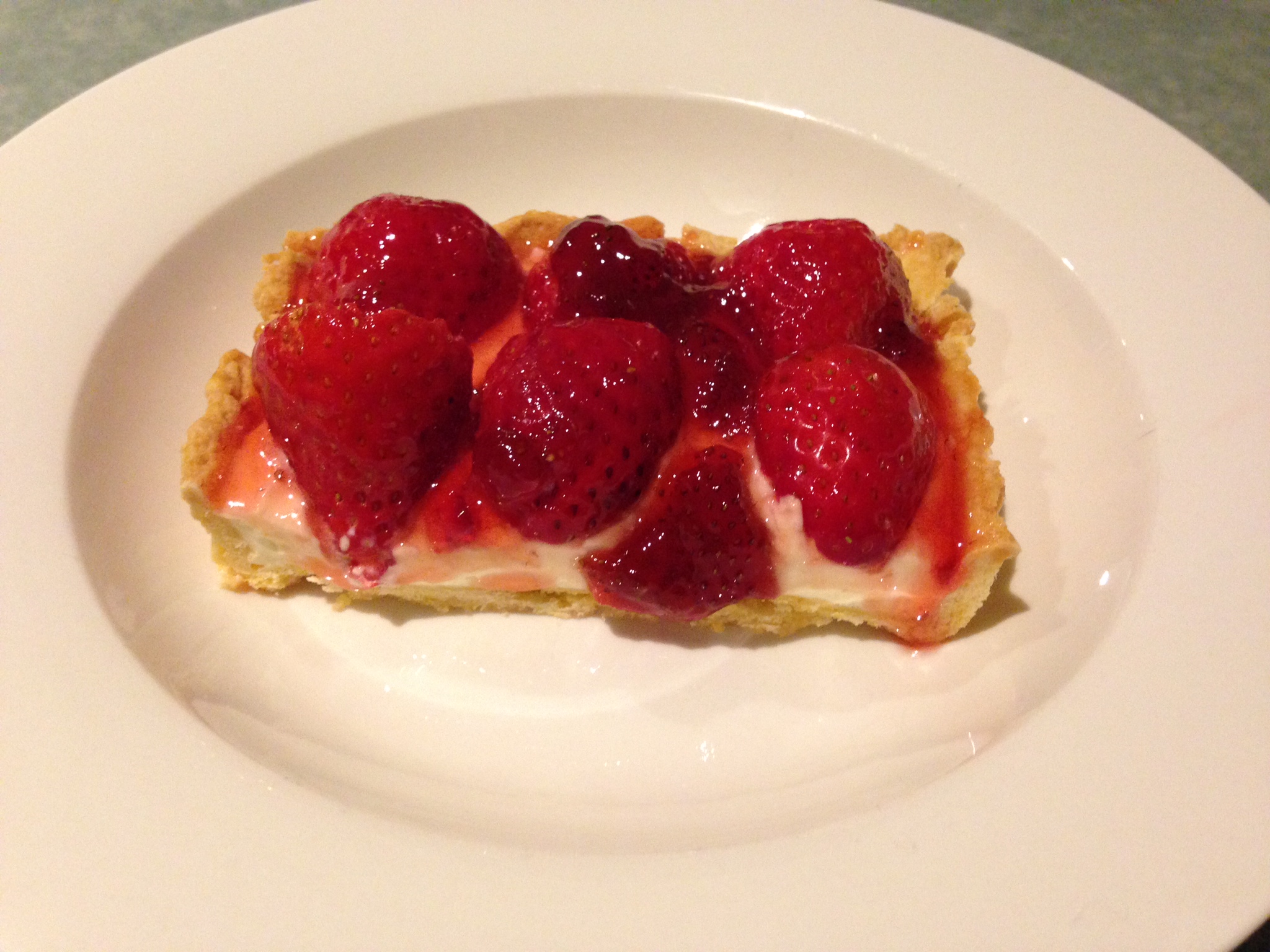
You can see how it turned out; if it appeals to you, the recipe is only a few clicks away.  Our only modifications were to halve the berries and to replace 1 tbsp of rum with close to 2 tbsp of Cointreau; and we had the satisfaction of using our homemade jam for the glaze.

As scrumptious as it was, we didn’t actually eat all of this by ourselves. Maggie walked a generous serve up the street to friendly neighbours who are our guinea-pigs-in-residence for new dishes we make. The balance of the fruit has been tossed with some lovely passionfruit and consumed with a modest amount of reduced-fat ice cream.

Strawb tart 1   Strawb tart 2

Posted in Cooking | Tagged , , | Leave a comment

Pea and ham soup

Pea and ham soup is the hearty, warming type of dish that appeals to residents of those parts of Australia that are chilly for long periods in winter; and to people who experience similar conditions on the other continents.

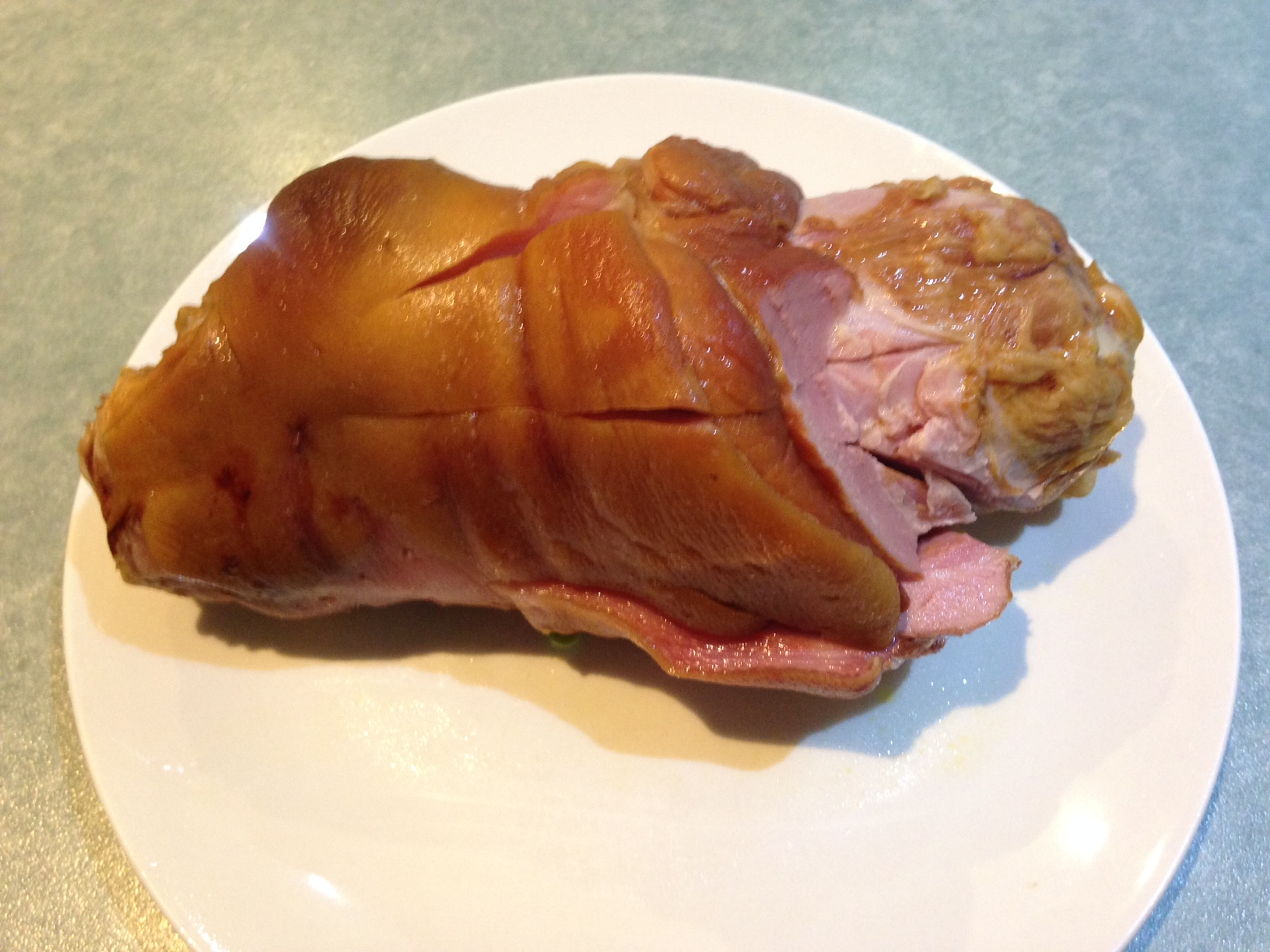
I have clear childhood memories of Mum making pea and ham soup; she and Dad were both partial to it. My young palate didn’t take to it but I was fascinated by how gelatinous the soup was before being heated to serve. Jump to 2010, when Maggie and I prepared a glazed ham for Christmas. We converted the bones and leftover meat into soup using a recipe we found on www.taste.com.au. We have modified and elaborated the recipe, and we have learnt that the quality of the ham hock is critical.

Ingredients

500g green split peas
1 brown onion
1 large leek
3 medium carrots, peeled
3 celery stalks, trimmed
1 tbsp olive oil
1 ham hock, up to 1kg
2¾ litres (11 cups) of water (use a little less if the ham hock has a light flavour)
bouquet garni (3 sprigs thyme, 1 fresh bay leaf, 6-8 black peppercorns bound in muslin)
salt and pepper

Pea and ham 1   Pea and ham 2

Method

  1. Place the split peas in a large bowl, cover generously with cold water and soak overnight. Drain and rinse.
  2. Chop the vegetables finely. Heat the oil in a very large saucepan over medium heat, add the vegetables and cook, stirring regularly, for 10 minutes.
  3. Add the split peas, ham hock, water and bouquet garni. Cover and bring to the boil. Remove any scum from the surface with a spoon. Begin to season by adding 1 tsp salt.
  4. Reduce heat and simmer, uncovered and stirring occasionally, for about 2 hours or until the ham is falling off the bone and the soup has thickened. Season with a generous grinding of pepper and, depending on the amount of the salt released by the hock, an extra pinch or two of salt.
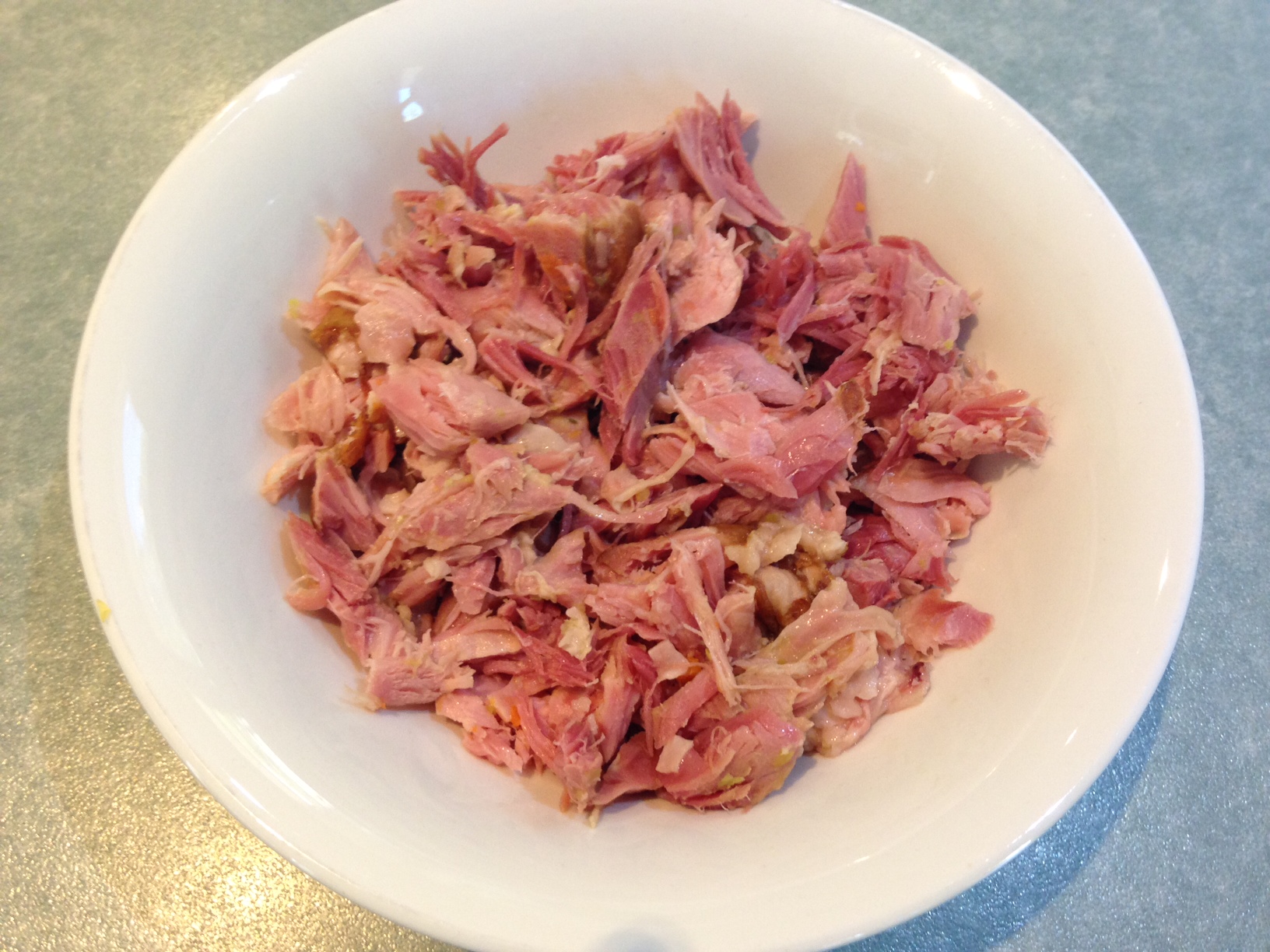
  5. Remove the ham hock and pieces of ham from the pan. When they have cooled, remove all the meat and shred. Return the ham to the soup, stir well and adjust seasoning one last time.

We used an Otway Free Range Pork hock, supplied by Ashburton Quality Meats. The vegetables all came from Toscano’s – the flavour of their carrots is always superior. And the water was delivered to our home by Yarra Valley Water.

Pea and ham 3  Pea and ham 4

Posted in Cooking | Tagged , , , , | Leave a comment