Next morning, a visit to Geelong

The morning after our wonderful dinner at Il Bacaro, we departed from our hotel just after 9am. We had opted out of paying for breakfast – we had a better offer. After I had plotted a slightly tricky exit from the city centre, Maggie drove us in a westerly direction, over the West Gate Bridge and down the road towards Geelong, Victoria’s second largest city.

We had arranged to have brunch with one of my cousins, Linda at a new cafe close to the centre of Geelong. But not just any cafe. It was Little Green Corner, developed and managed by Hugh, husband of Claire, one of Linda’s three daughters, and proud father of 18-months-old twins.

We were making good time so, as it was a sunny morning, Maggie suggested we leave the main road as we approached Geelong and drive around the edge of Corio Bay, the peaceful body of water that lies in front of the centre of the city. It was very photogenic!

Geelong 1

Maggie then took us to the pretty beach at the eastern end of the bay. Eastern Beach, as it is named eponymously, is very family-friendly, with a safe, enclosed seawater swimming pool and an esplanade of grassed areas, walking paths, bench seats and picnic tables. Speaking of which, it was time for brunch!

We joined Linda at a table inside the cafe and began to take it in. I began with a comfort stop, where I came face-to-face with Hugh’s commitment to sustainability.

Little green room?

Little green room?

Next, a coffee. At home, we have one short black (espresso) each morning. Going out for a coffee, I prefer a short macchiatto; Maggie sticks to her routine. Our coffees were delicious, with a long finish which had a mild molasses edge to it. Next, something substantial to eat. (We were mostly chatting with Linda non-stop, pausing only to exchange greetings with Hugh, then Claire who was putting in a couple of hours before going to her part-time teaching job, then Hugh’s mother, who had arrived to wash some dishes!)

While Linda chose the plate of mushrooms and fetta, which she said she had enjoyed very much on previous occasions, I ordered a dish of chick peas, braised with tomatoes and served with bacon, a baked egg and some whole-grain toast. I rarely eat chick peas, except as hummus, but I wanted to try something more complex than the egg & bacon roll that Maggie went for. The dish was tasty and wholesome, although, to me, the bacon seemed a little out of place.

Green corner 2   Green corner 4

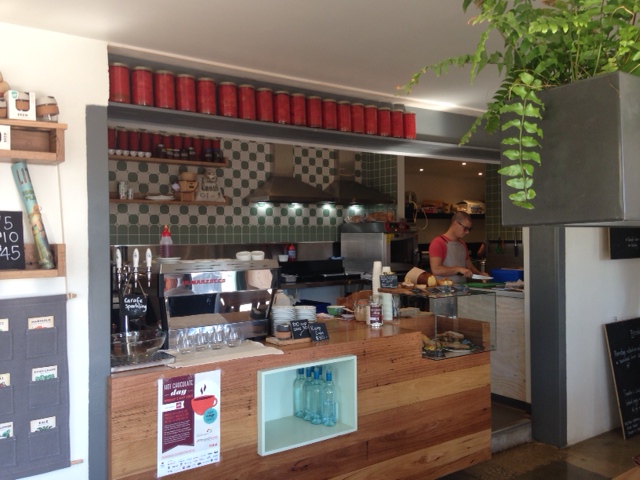
We weren’t there long enough to form a rounded picture of Little Green Corner; besides, we were engrossed in conversation with Linda. However, we certainly saw plenty of evidence of the cafe’s motto: “Local. Sustainable. Simple.” This suits the times and Hugh and Claire are fully committed to these principles – Exhibit A, the rolled-to-order oats for making your morning porridge with maximum nutritional values. So, I do hope their business model works. We will return, for the coffee – I had a second before we left – and to explore the lunch menu.

Quick good-byes, then we turned for home, calling into the bustling South Melbourne Market, for a bag of frozen prawn cutlets, and Toscano’s, for a fresh supply of ingredients to cook at home.

Our next Aussie adventure? Three days and nights in the Barossa Valley, Australia’s most famous wine region. Just 36 sleeps away!
Posted in Eating out, Travel | Tagged , , | Leave a comment

24 hours as tourists in our home city

Anyone who has followed this blog will know that, as well as visiting other countries, Maggie and I like to explore various corners of Australia. The most recent, and shortest, of these adventures was to spend an afternoon, evening, night and morning in and around our home city of Melbourne.

Firstly, we responded to some gentle prodding by the Accor group by booking a night at the Ibis Styles in the old Hotel Victoria in Little Collins Street, one of the nine streets that comprise the east-to-west length of what is known as ‘the Golden Mile’. Being a Thursday night, the rate was barely more than $100, for a spacious, clean and up-to-date room.

After checking in right on 2pm, we headed out to explore some of Melbourne’s renowned arcades and laneways – all dating from the boom years in the second half of the 19th Century – a blend of old faves and new discoveries. In one of the latter, we found Smooth, a clothing business established by two Sydney women in 2000. They specialise in designing and making clothing for mature women. The Melbourne store opened only recently – lucky Maggie, who found a top she will be happy to wear out of an evening (it’s the one in the first row, r-h side, if you follow the link).

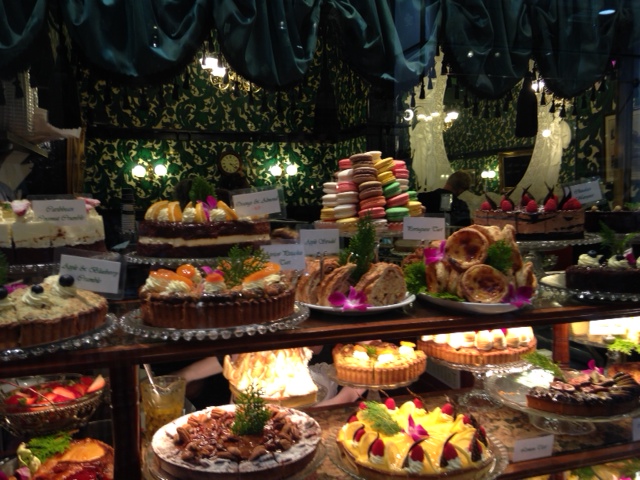
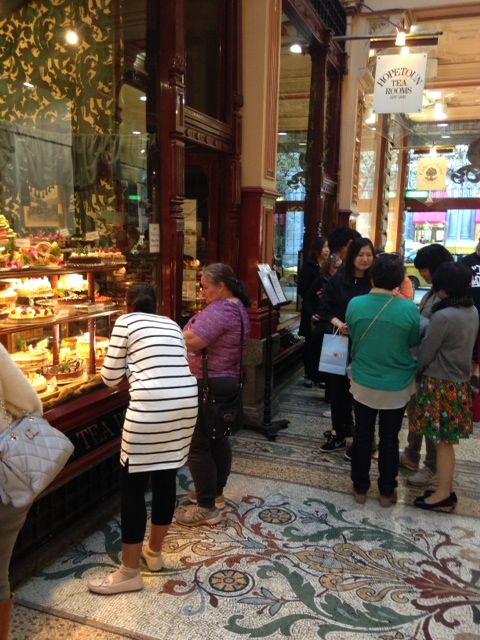
From Smooth, my beaming wife led the way to Hopetoun Tearooms, Melbourne’s most famous cafe, popular with locals and visitors alike and now the setting for hundreds of ‘selfies’ every day of the week.
Hopetoun 1   Hopetoun 2

After a brief viewing of the eye-candy in the window, we joined a not-too-long queue to wait for a table. (Be warned – on weekends, the queue is often very long.) Once seated, we ordered a leaf-tea each – from a delightfully varied range – and, mindful of our ambitions for the evening, we shared one piece of cake. Our fellow-customers comprised visitors – women of all ages, mostly Asian but we met a woman from Brisbane who was there for the third day in a row – and locals – some men but many small groups of women, some needing a rest from shopping, going by the bulging bags!

Our next stop was Hosier Lane, renowned for its graffiti or street art.

Hosier 1         Hosier 2
There are some stunning examples and it is certainly another popular spot for selfies, but we found it a little underwhelming and in need of a dose of TLC. Perhaps we have been spoilt by our various cultural experiences in Europe?

We poked our heads into another couple of laneways – said to be interesting, found to be ho-hum – and then we realised that it was nearly wine c’clock. It was one of those balmy autumn afternoons of which we have had too few this year, without any wind to deter us from placing ourselves at a table on the wide foot path out front of the famous Florentino restaurant complex. Despite the hour, traffic was light, thanks to a nearby stretch of pedestrian mall, so we were happy to spend the better part of an hour sipping on Italian wines – a white each, then a red. Our waiter was courteous and attentive but, to my surprise, he did not respond to my ‘grazie’ with a ‘prego’; Eventually, we discovered that this ‘garcon’ was actually French, from Nice, and in Melbourne for the experience and the income. An animated discussion ensued about an outstanding seafood meal we had enjoyed in Nice in December 2009 and, yes, he had worked at that restaurant!

We returned to our hotel, well-satisfied with our afternoon adventure, and freshened up our faces and outfits in readiness for an evening meal of fine Italian food at Il Bacaro restaurant. We had chosen Il Bacaro on the strength of a positive newspaper review, which Maggie came across soon after we had booked our hotel. Happily, the restaurant was only a few doors up the street from the hotel lobby.

The two hours we spent at Il Bacaro gave us one of the best dining and wining experiences of our shared life. The restaurant had a cosy ambience and gentle acoustics. Our waiter was knowledgeable, attentive and courteous. The list of wines by the glass catered for most palates. And the menu was varied and enticing. Here is what we had (no photos, we were there only to dine).

From the antipasti section, Maggie chose venison carpaccio with black garlic aioli, mustard fruits, pink peppercorns and saltbush; for me, a plate of tuna crudo (cured) with diced cucumber (remarkably firm and green), fennel, green tomato dressing (heavenly) and herb emulsion. For company, a glass of nebbiolo for Maggie and a dry white from Italy’s Le Marche region for me. For secondi, I chose braised goat with porcini, pink fir apple potatoes, baby carrots and truffle pecorino, while Maggie went for the special, a plate of chargrilled kangaroo fillet, with a beetroot puree, buffalo mozarella and micro herbs. My second wine was French, a glass of Petit Chablis, which had some sweet notes that went well with the flavours of the goat meat; on our waiter’s recommendation, Maggie chose a smooth, rich red wine from the Puglia region (she was still drooling about it the next morning).

We went to bed very content and renewed in our sense of good fortune to be a resident of Melbourne. That said, we don’t kid ourselves that our city has no ugly blemishes, and we know that many families who live in suburbs on the distant outer fringes of Melbourne have little opportunity or capacity to do as Maggie and I did on this occasion. So, we are grateful for our lot in life.

In the next, shorter, post, I will describe what we did on the following day.

Posted in Eating out, Travel | Tagged , , , , , , | Leave a comment

A veal dish for hollow legs

Ossso buco 5

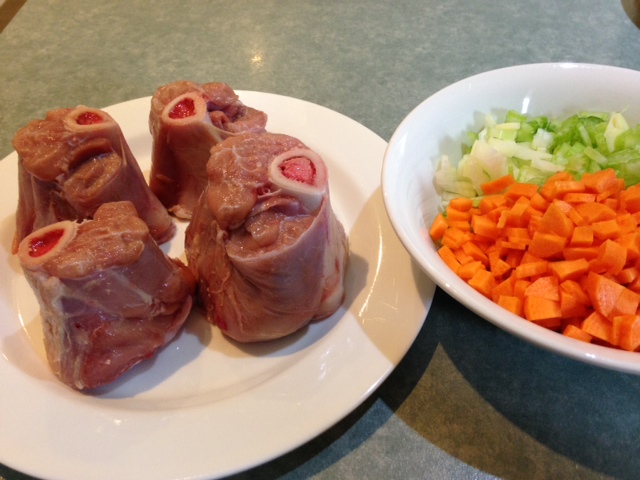
I can still remember the first time I ate my own home-cooked meal of the famous Italian dish Osso Buco, literal meaning ‘hollow bone’. It was 1983 and I had recently bought a Crock Pot, a type of slow cooker that was fashionable at the time. I don’t recall much about the recipe but my palate will never forget the flavours, including my first experience of fresh gremolata, added to the plate immediately prior to eating.

Over the next two decades, I made Osso Buco a couple of times each year. The pieces of shinbone would usually be baby beef, which was more widely available than veal in WA, especially during the years I spent in Albany on the south coast. In Melbourne, however, the supply of veal shanks is plentiful and inexpensive and that is what Maggie and I always use.

Soon after Maggie and I made a kitchen together in 2004, we came across a recipe in which whole pieces of preserved lemon were cooked with the meat and vegetables. We really liked the result and decided that we would dispense with the gremolata; not that we would begrudge anyone who opted for that last-minute flavour kick.

Ingredients (for 4-5 middle-aged adults)

1½-2kg sections of veal shank
olive oil
40-50g butter
1 brown onion, finely chopped
1 leek, halved lengthways and finely sliced
1 large carrot, peeled and finely chopped
1 stalk celery, finely chopped
1 tbsp garlic, finely chopped
1-2 quarters of preserved lemon, including flesh, chopped
200-250ml dry white wine
120-150ml light stock (veal, chicken or vegetable)
300-400g tinned tomatoes, coarsely chopped, or 250-300ml passata
3 sprigs thyme
1-2 bay leaves
3 sprigs fresh parsley
extra stock, if needed

Method

  1. Heat oven to 160C
  2. Add a little oil to a roasting pan and brown the veal shanks in the oven for 20 minutes, turning once or twice. Remove and transfer to a warm dish. Reduce oven temp to 150C.
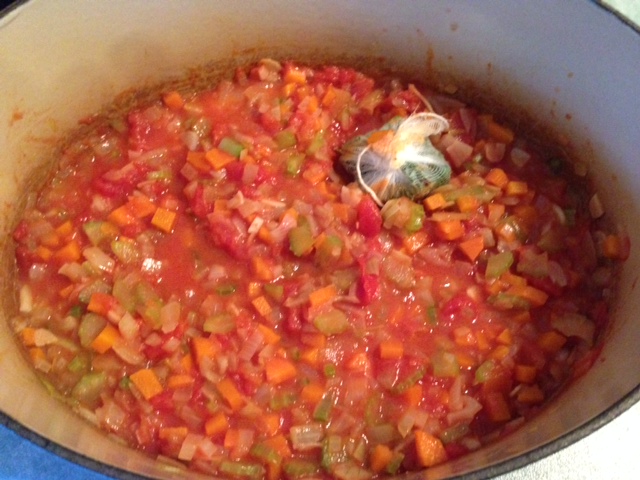
  3. Melt butter in a large, heavy-based, ovenproof pan and sauté the onion, leek, garlic, carrot and celery for 8 minutes. Add preserved lemon and cook for a further 2 minutes.
  4. Add wine, stock and tomato/passata to pan, stir well and bring to a simmer.
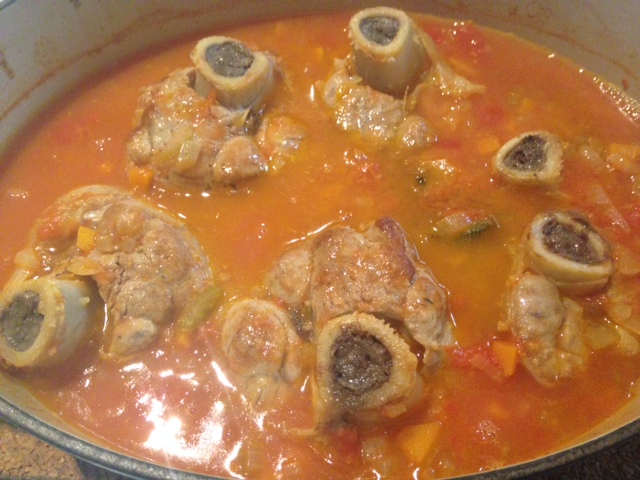
  5. Push the veal pieces into the sauce and tuck in thyme, bay leaves and parsley (or combine them in some muslin, as Maggie does). There should be enough liquid to come about two-thirds of the way up the pieces of veal. If necessary, add more stock.
  6. Bring liquids back to a simmer, cover with lid and cook for up to 2 hours, until veal is tender and sauce is well integrated, almost creamy. Turn the pieces of veal once or twice.
  7. Serve with a green vegetable and either mashed potato, pasta or rice.

Oso buco 1   Osso buco 2

Osso buco 3   Osso buco 4

Posted in Cooking | Tagged , , | Leave a comment

Corned beef with a citrus twist and a hot potato

Corned beef. Nice in a sandwich. Very appealing after a hard day’s work on a Kimberley cattle station, according to some Aboriginal friends of long ago. But, not exactly gourmet food, is it? Well actually, it IS served as a dinner party dish in our home. After some contextual filling, I will tell you how it’s done.

Maggie and I have very different memories of corned beef. An only child, she grew up with her parents and her maternal grandparents. Maggie’s grandmother was an excellent cook and one of her strengths was using economical ingredients to produce delicious food. Corned beef was one of those.

In my childhood home, corned beef was never served as a main meal; in fact, I believe that my mother never cooked it at all. From time to time, she would buy some slices of cooked corned beef from her butcher and make some sandwiches with it. And that was the sum total of my corned beef data pool.

Then, in my early 20s, a professor of Irish descent at my university, encouraged me to give it a try. I was soon hooked and it became one of my go-to-dishes during my undergraduate years of trying to eat well on a limited budget. (I served the beef with boiled potatoes and a gravy made by thickening the cooking liquid, including its pieces of carrot and onion, with some corn flour. Think Irish pub grub.)

However, once I entered the workforce, I could afford to be a bit of a food snob; I discarded corned beef in favour of slow-cooked gourmet braises – think osso bucco – and handsome roast dinners. And then I married a vegetarian.

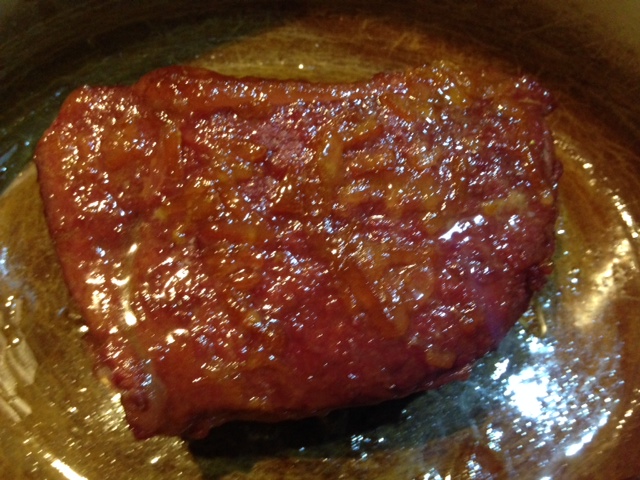
Two decades later, Maggie brought the recipes of Beverley Sutherland-Smith into my life; Beverley has been one of the most revered cookery writers in our home city of Melbourne. In time, flicking through one of her books, we came across a recipe for corned beef, in which the boiled meat was finished off in an oven, basted with a citrus glaze. We liked the result very much and, although we have made various modifications, the core of the recipe came from Beverley.

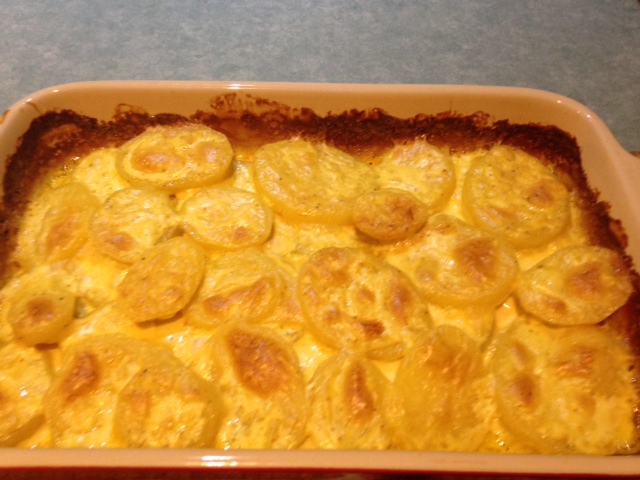
Now, corned beef is often served with a hot mustard sauce, something with which Maggie was familiar. But my palate memory of side dishes was potato-dominant. So, we compromised and developed a version of potatoes dauphinoise infused with hot mustard and, more recently, a hint of grated garlic. To complete the plating, we add a green vegetable, eg beans. If you have access to some sweet carrots, they would go well too.

So, a very tasty dinner dish, but we always save some of the corned beef to go in a lunchtime sandwich, along with Maggie’s green tomato pickle.

Ingredients

1½ kg corned silverside
1 tsp hot English mustard (or ½ tsp mustard powder)
200ml apple cider
3 cloves
1 small onion, halved
1 medium carrot, cut into large chunks
1 bay leaf

Glaze
1/3 cup orange juice
3 tsp lemon juice
½ cup orange marmalade

Method

  1. Place meat in a large saucepan, add mustard and cider and sufficient water to just cover the meat. Stick the 3 cloves into the onion halves and place these in the pot with the carrot chunks and bay leaf. Cover with lid and bring liquid to the boil.
  2. Simmer VERY gently (just a regular bubble) until just tender; this should take about 2, possibly 2½, hours.
  3. Remove beef from liquid and place snugly in an ovenproof casserole. Preheat oven to 170C.
  4. Combine the orange juice, lemon juice and marmalade and pour over the beef.
  5. Bake the beef for 30 minutes, basting every 10 minutes.
  6. Rest beef for 10 minutes then cut into slices and serve.
  7. You can cook the beef a day ahead but you should cool it in the cooking liquid before refrigerating it in the liquid; then warm gently in the liquid so it won’t be cold when placed in the oven to glaze.

Corned beef 1   Corned beef 2

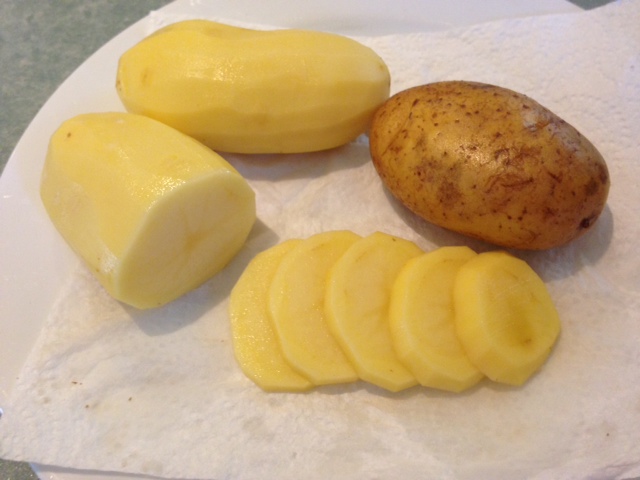
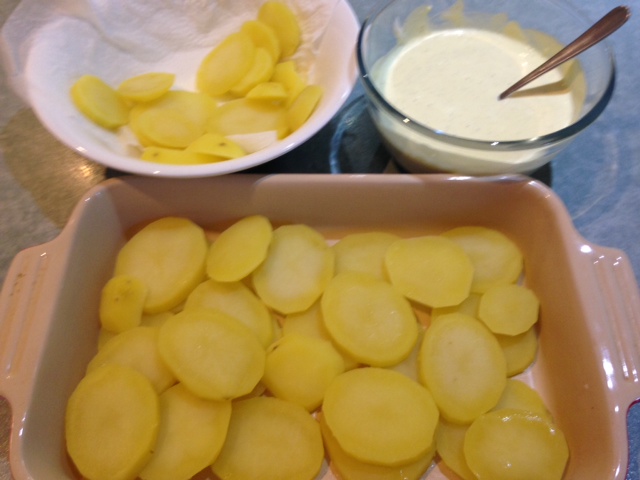
The basic method for potatoes dauphinoise is readily accessible in cyber space, so I won’t formalise our version. To reduce the cooking time, we cut the peeled potatoes into slices about 4-5mm thick, tip them into a large saucepan of salted, boiling water, bring the water back to the boil and cook the potatoes for 1 minute before draining them thoroughly. On this occasion, we used about 700g of Dutch Cream spuds; Nicolas and other waxy potatoes work well too.

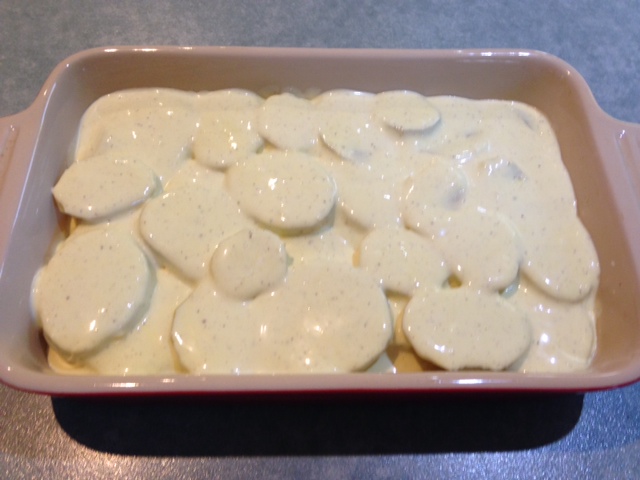
The cream mixture comprises 150ml of light cooking cream, 100ml of light sour cream, two to three cloves of garlic grated (or crushed), 3-4 tsp of Hot English Mustard, 1-1½ tsp of salt and a few grinds of black pepper. (If you whip the mustard with the sour cream before you add the other ingredients, it will be easier to achieve a smooth and well mixed cream.)

As you can see, the cream mixture is poured in after the slices of potato have been placed in the baking dish. We then cover the dish with foil and place it on the middle shelf of an oven heated to about 160C. After 40-45 minutes, we remove the foil and bake the dish on a lower shelf – ie below the glazed corned beef – for a further 25 minutes or so until it is golden brown.

Potatoes dauph 1   Potatoes dauph 2

Potatoes dauph 3   Potatoes dauph 4


Posted in Cooking | Tagged , | Leave a comment

Real men make their own quiche

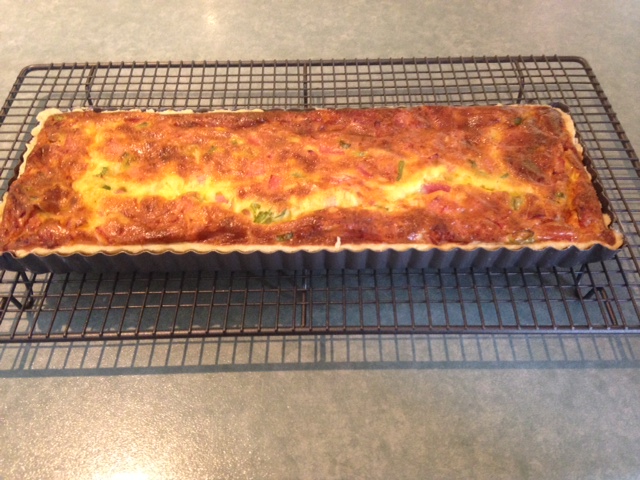
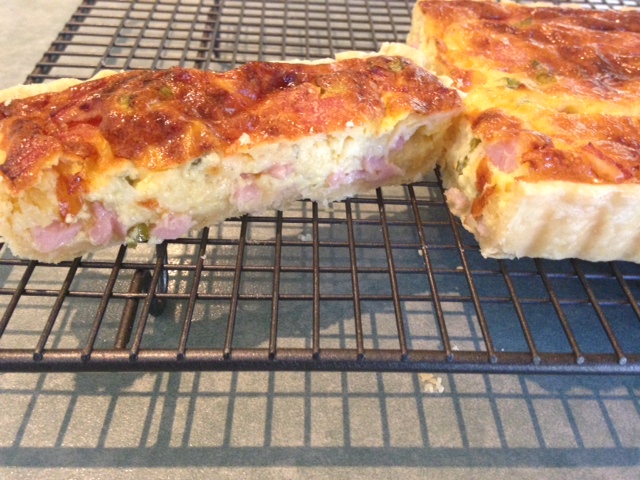
With its relatively high fat-content, a  quiche is not everyone’s idea of good food. And a poorly-made quiche is not my idea of good food either. But four decades on from the first time I cooked one, I still find that a well-made quiche can be the basis of a satisfying meal, especially if it is accompanied by a variety of vegetables in the form of a salad or similar.

Soon after I began to make a quiche on a regular basis, I was taught one of the keys to success by a family friend who had lived in Paris for a couple of years – chop your onion finely and saute it very slowly in plenty of butter. This will produce a soft and slightly sweet result that enhances the texture and flavour of the quiche.

There are two other important rules: don’t skimp on the butter when you make your pastry or it will crumble; and don’t skimp on the cream in the filling or you will miss out on that baked-custard quality that distinguishes a quiche from a savoury flan.

Personally, I prefer to eat a flan-style dish, with silver beet as the key ingredient. However, we use silver beet in various other dishes, so the savoury-filling-in-pastry dish that Maggie and I make a few times each year is our version of the traditional Quiche Lorraine.

If you are particularly averse to the taste of salt, use one less piece of bacon and 20g less of cheese in the filling. Leave some salt in the pastry or it will taste bland alongside the filling

Ingredients

175g plain flour
generous pinch of salt
90g cold butter, diced
50ml cold water
1 medium brown onion
40g butter, for cooking the onion
6 short rashers of bacon, chopped
3 eggs
2 tsp Dijon mustard
300ml cream (we use a fat-reduced cooking cream)
120g grated cheese (we use 50:50 cheddar and gruyere)
green ends of 3-4 spring (green) onions, sliced

Method

  1. In a mixing bowl, use finger tips to combine the flour and diced butter until the mixture resembles coarse breadcrumbs. Add water and combine to form a ball of pastry. Wrap in plastic film and place in fridge for 25 minutes.
  2. Dice onion finely and sauté slowly in the extra butter until soft – at least 10 minutes. Add bacon and saute for a further 5 minutes.
  3. Preheat oven to 170C.
  4. Grease sides and base of a quiche dish (or use a non-stick dish if you have one), roll out pastry on a floured bench to about 2 to 3mm thick, lift gently into dish and gently manoeuvre it to the shape of the dish.
  5. In a mixing bowl, combine eggs, cream and mustard and beat with a whisk until well combined. Add onion, bacon, cheese and spring onion and mix well.
  6. Spoon mixture into pastry shell and bake for 40-45 minutes, rotating occasionally to achieve even cooking, until the quiche is golden brown.
  7. Remove from oven and allow to cool slightly before cutting slices to serve.

Quiche 1   Quiche 2

Quiche 3

Posted in Cooking | Tagged , | Leave a comment

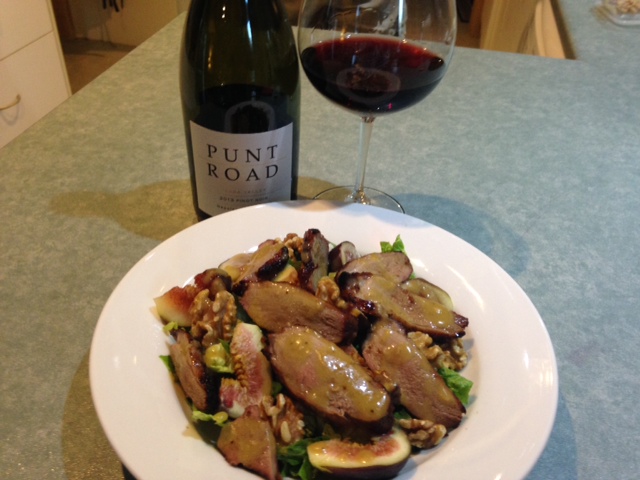
Awesome foursome: duck, fig, walnut and pinot

Here in Victoria, we are only now nearing the end of the most wonderful black fig season that Maggie and I have experienced together. And for all of the second half of the season, the supply has been plentiful, quality consistent and prices fair.

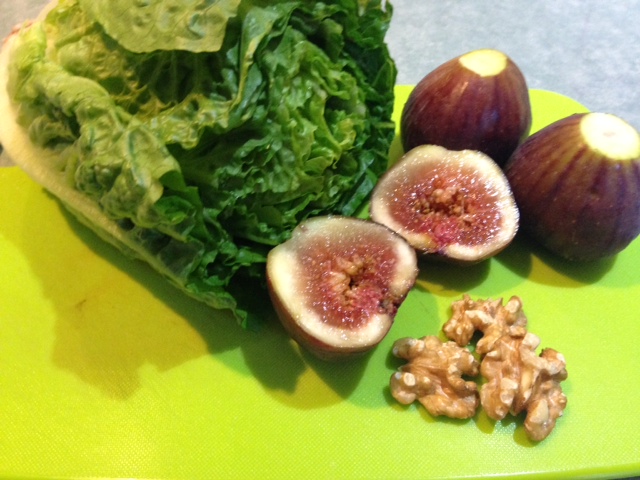
Last week, we realised that we hadn’t savoured one of our two favourite ways of using fresh figs – in a salad that also features duck and walnuts and which is a faultless partner for a pinot noir wine. (The other fave is fig and ginger jam.)

Although we have modified the recipe in various ways, we remain indebted to the original version, published in 2007. It was written by leading Australian restaurant and food writer, Terry Durack and appears, albeit tweaked, courtesy of him.

We first made it to celebrate Valentine’s Day in 2007. It was love at first bite! We made the dish an annual tradition, with occasional second helpings on other dates or to share with friends.

This time, we bought two generous duck breasts, with wings attached, from Cester’s Poultry. Maggie detached the wings but we included them in the preparation to give us a little snack along the way.

The fresh ginger we bought at Toscano’s was a soft variety, with little fibrous content, so it grated elegantly. Also, we warmed the honey gently first and this made it easy to produce a very smooth marinade.

Ingredients (for two to share by candlelight)

2 duck breasts
10 walnut kernels, lightly toasted and rubbed with a dry cloth
3 ripe figs, quartered
mixed salad leaves

For the marinade
3cm fresh ginger, peeled and grated
2 cloves garlic, crushed or grated
1 tbsp honey
1 tsp ground cumin
1 tbsp soy sauce
1 tbsp peanut or vegetable oil

For the dressing (these days, for convenience, we use our vinaigrette dressing instead and it works equally well)
1 small brown shallot, finely chopped
1 tbsp red wine vinegar
2 tsp Dijon mustard
60ml olive oil
¼ tsp caster sugar
1 tbsp finely chopped walnut kernel
2 tsp finely chopped parsley
2 tsp snipped chives
salt and pepper

Method

  1. Preheat oven to 125C (fan-forced). Using a metal skewer, prick and pierce the skin of the duck, with no more than ½ cm between each prick mark. Place breasts skin-side DOWN on a grill-rack sitting in a pan with 1cm of water in the bottom. Bake for 1 hour and remove from oven.
  2. Combine the marinade ingredients in a bowl and mix until smooth. Brush all surfaces of the duck with the marinade, put breasts and any leftover marinade in a suitable container, cover and refrigerate overnight or for at least four hours. Remove from fridge at least 30 minutes before step 3 and brush off any excess marinade (see the first photo below).
  3. Preheat oven to 175C. Place breasts skin-side UP on a grill placed on the top shelf and bake for 25 to 30 minutes or until skin has turned a deep golden brown. Rest breasts while you prepare the other salad ingredients. (This time, we roasted the breasts in our Weber Q – purchased since we last made the dish – and cooked the duck skin-side down for 6 minutes once the skin was golden brown, which added some appealing char to the flavour mix.)
  4. To make the dressing, put shallot, vinegar, mustard, oil and sugar in a jar, put lid on jar and shake vigorously for about 10 seconds. Add chopped walnut, parsley and chives and briefly shake to combine. Adjust seasoning.
  5. Combine leaves, fig and walnut kernels in a large salad bowl. Slice duck breast, place over salad and spoon over about half the dressing. Toss gently to combine and serve immediately.

Duck salad 2   Duck salad 3Duck salad 4   Duck salad 4

We think this was the best version we had ever prepared, reflecting the quality of the duck, a more refined marinade and the impact of the Weber Q. Not forgetting the delicious pinot that Julian and Sara gave me for my birthday!

Next time – alas, not before 2016 – we will take the duck breasts out of the fridge just before we roast them, to see if the end result has pinker flesh in the middle of each breast.

Posted in Cooking | Tagged , , , , , | Leave a comment

Healing journey for a heavy heart

(This post begins with some sad stories but eventually opens out into some pleasant travel and food experiences.)

In a short post late last month, I said that I would be having a quiet period, blog-wise, due to a task I had to perform on behalf of my family of origin. The task comprises various things that need to be done following the death of my mother, whose life ended on 23 January.

Mum had suffered from Alzheimer’s disease for several years and spent the last three years of her life in a nursing home. She was very well cared for and she died gently and painlessly. We should all be so lucky.

For all but her last four years, Mum had a wonderful life and that was the theme of her funeral service, culminating in the song ‘I wanna wash that man right out of my hair’ from the 1958 film version of the musical South Pacific. The movie’s soundtrack was played often in our home as I grew up.

As Maggie and I joined in the farewells to Mum and prepared for life without her, we could never have imagined that there would be two more deaths in our family within the next five weeks.

First, Maggie’s uncle, the last surviving member of Maggie’s parents’ generation and one of life’s gentlemen, lost his life after one bad fall too many. We are close to his two sons and their families and we joined them in celebrating Uncle Tom’s good and full life.

Then, with little warning, came the heart-breaking death of my younger sister, Fi, whose body was overwhelmed by a compounding series of complications triggered by weaknesses in the working of her heart. Yes, there had been danger signs for several years, but she was taking steps to receive some further treatment. Tragically, it was too late and, just five weeks after she had given a eulogy at Mum’s funeral, we lost her.

I am writing this post a few days after Maggie and I returned from attending the funeral for Fi, which was held in Bunbury, a coastal city located about 200km south of Perth, the capital of Western Australia. (Flights between Melbourne and Perth take from 3 to 4 hours, depending on headwinds and tailwinds.) Fi moved to WA in 1984 and, for the last decade, she and her husband, Mick had lived in the smallish rural town of Boyup Brook, deep in Bunbury’s hinterland.

Maggie and I flew to Perth two days before the funeral was to be held, both to give us time to adjust our bodies to the 3-hour time difference and to have an opportunity to spend some time with Mick. From the airport, we drove south in a rental car. Our destination was Bridgetown, not far from Boyup Brook but boasting more and better accommodation options; we had booked a room at the Bridgetown Hotel for two nights.

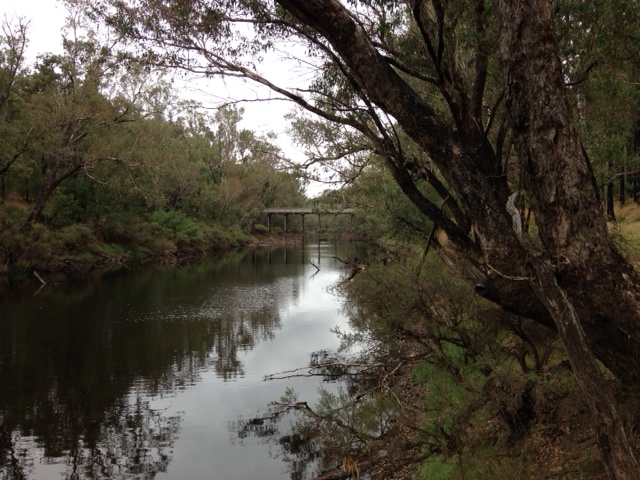
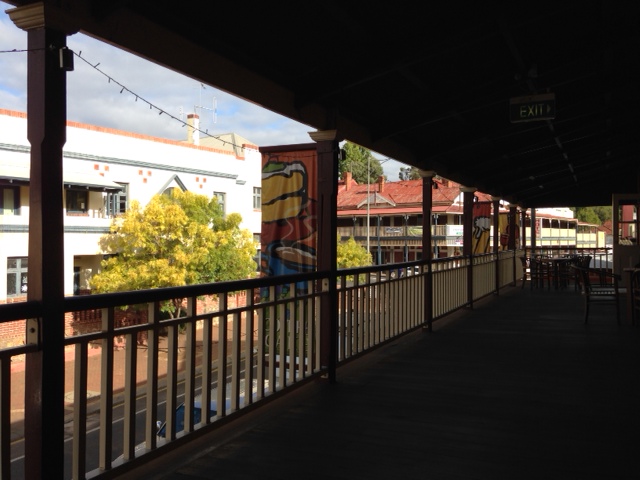
After a light dinner – we had been sitting for most of the day – we spent a pleasant hour or so, sipping wine at the table provided for us on the hotel’s upstairs verandah. Next morning, we had a very good ‘continental’ breakfast before heading off to take in some of the district’s natural features. Having lived in WA for 30 years myself, I was keen to take Maggie on a scenic drive from Bridgetown to Nannup, returning via the Blackwood River valley and the town of Balingup.

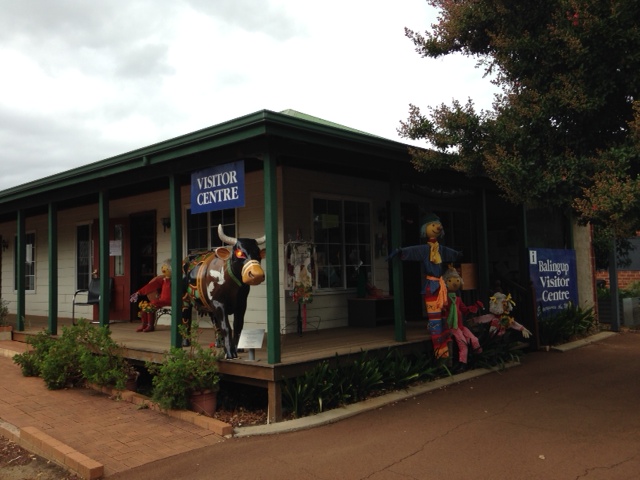
The photos below show: a section of a relatively young forest of Jarrah and Marri – the former is one of the world’s major hardwood species; the Blackwood River, the most significant river in the southern half of WA; some of the sculptures that decorate the main street of Balingup, a small town that has been revived by an influx of artists over the last two decades; and a wine-sipper’s view of the aforementioned hotel-verandah.

Forest   River

Balingup   Verandah

Returning to our hotel, we learnt that we wouldn’t be visiting Mick after all. So, we had a light lunch at a local cafe and then, at Maggie’s suggestion, we drove out to Boyup Brook anyway, to eyeball my sister’s home for the first time, albeit from the outside, and to familiarise ourselves with her hometown. As was the case in the morning, this journey was good for our souls; it also gave us some further context for the imminent funeral service.

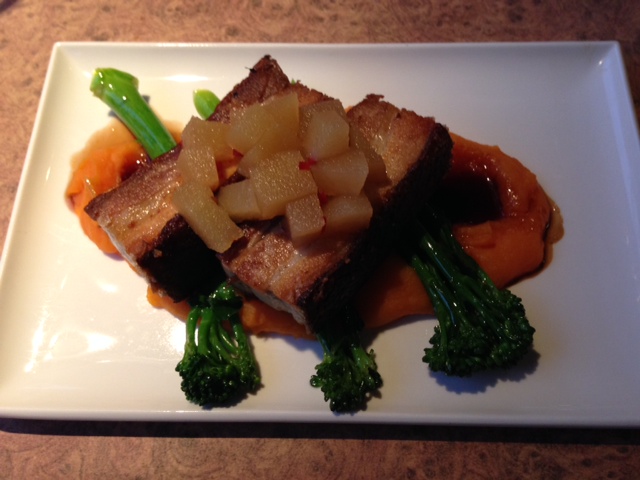
For dinner, we ate at the hotel again; we had seen evidence that there was some skill in the kitchen. Maggie chose a dish of twice-cooked pork belly, with a fruity jus, al dente pieces of apple and broccolini. For me, it was an opportunity to have some fish without being required to negotiate with Maggie to make room on our domestic menu! On this occasion, it was a generous serve of Barramundi, one of my favourites, accompanied by a medley of Mediterranean vegetables and a dollop of skordalia. Both dishes would have found favour with the legion of food critics based in Melbourne.

Pub grub 1   Pub grub 2

I will spare you the details of the following day’s funeral service for my sister, except to say that it was full of love and good humour. I learnt that she was highly respected and that her life in Boyup Brook was a happy one. As you would imagine, all of this was a very good tonic for our depleted spirits.

After the funeral, we drove north to Perth and checked into our motel, located across the road from King’s Park, one of the city’s most important redeeming features. Next day, we spent some quality time with each of two couples who had been among the eleven witnesses to our 2006 wedding ceremony. In one case, it had been more than seven years since we had last been together; the next occasion will be in October, at the famous Bibendum restaurant in London!

So, now we are ready, in mind and spirit, to organise a loving memorial service for Fi, to be held in Melbourne next month.

Posted in Eating out, Home life, Travel | Tagged , , , , , , , | Leave a comment

Classic crustacean cocktail

In a previous post, I wrote about the rather retro festive lunch we shared with my father a few days before last Christmas. The first course was a prawn cocktail, which is a long-established festive season tradition here in Australia. It was so delicious that I decided to turn our approximate-taste-and-modify method into a formal recipe and then wait for an opportunity to give it some test-and-tweak treatment.

Last Sunday, we prepared another three-course lunch, this time to share with two couples, of whom the wives had been close friends with Maggie through her school years. So, yes, we served prawn cocktail as the entree.

Now, when I say prawn, I am referring to the edible crustacean that is known as a shrimp in the United States, whereas we tend to apply the word shrimp to some small varieties of prawn; and small humans. (I could go on but I’ll leave it to you to go to Wikipedia if you want to know more.)

But I digress. Here is one of the prawns prepared by Maggie on Sunday. Each unpeeled prawn was about 20cm long and the meat was about 9-10cm long.

Prawn cocktail 1
As you might assume, the qualities of the prawn meat make or break this dish; no wonder-dressing will compensate for underwhelming prawns. For both Christmas and this occasion, we bought the same variety of prawn, caught in waters north-west of Adelaide, but not from the same fishmonger. The dish we served on Sunday was quite satisfactory but lacked the “wow” factor of its predecessor. We know where we will take our business nest time!

Ingredients

½ cup thickened cream
3-4 tsp tomato sauce (ketchup)
1½-2 tsp Worcestershire sauce
1-1½ tsp lemon juice
generous pinch of salt
generous grind of black pepper
500g cooked prawns
fresh young cos lettuce

Method

  1. To make the dressing, combine the cream, the lesser amounts of the two sauces, 1 tsp of juice and seasonings in a small mixing bowl. Taste and adjust for each of the tomato sauce, lemon juice and seasoning.
  2. Peel the prawns completely and cut each prawn into bite-size segments.
  3. Shred some lettuce finely – we use a bread knife – and distribute between four entrée bowls. Allow a generous half of a cup for each serving.
  4. Place the prawn segments on top of the lettuce, spoon over plenty of the sauce and serve.
  5. Accompany with Buddy Holly’s ‘That’ll be the day’, or similar.

By the time we remembered to take this photo, I had already eaten some and the dressing had been dispersed.

Prawn cocktail

Posted in Cooking | Tagged | Leave a comment

A quiet period

This is a short post to let you know that I have entered a quiet period as far as blogging is concerned.

I have to undertake a substantial administrative task on behalf of my family of origin over the next month. The size and nature of the task will run interference with the feel-like-blogging spaces in my heart and head.

As it happens, it is late summer here and most of what Maggie and I are cooking has been done earlier in the season and, when blog-worthy, posted.

Normal programming should resume by Easter or then-abouts.

Posted in Blog stuff, Home life | Leave a comment

Tasty sandwich for a growing girl

In Melbourne, chicken and mayonnaise sandwiches, cut into ‘ribbons’, have long been part of the standard light lunch or afternoon tea served at social functions, from christenings to funerals and much that occurs between those two bookends-of-a-life.

We’re pretty fond of a chicken and mayo sanger ourselves and Maggie takes great pride in putting them on a platter to take to an event, such as the recent first birthday party for Iris, one of our three grand-daughters.

Late last week, Iris was due here for lunch, en route to a flight to Hawaii with Sara, her mother. So, knowing how much she had enjoyed the sandwiches we took to her party, we prepared an encore batch. Here is a description and some photos of how we made them. And one of how Iris ate them!

After we buy some chicken breasts, Maggie trims off some of the bulk to produce pieces of even thickness; the trimmings go into the freezer until Maggie wants to make chicken and leek soup for her daughter’s family. The trimmed breasts go into a saucepan and we add some sliced spring onion and peeled ginger, a small handful of black peppercorns and a teaspoon of salt or chicken stock powder. We add a little more than enough water to cover the breasts, bring it to the boil over medium heat and then simmer for 5 minutes. Turn off the heat, remove the lid and leave to cool for about 10 minutes. The chicken breasts go into a storage container and the poaching liquid is added through a strainer.

Chick mayo 1   Chick mayo 2

Next day, Maggie dices the chicken meat coarsely and tips it into a mixing bowl. The liquid goes into the freezer, to be used one more time; after that, it will have enough flavour to be used as chicken stock. While Maggie finely chops some chives and parsley leaves, I prepare the dressing using three parts mayonnaise, two parts light sour cream, a good 1/4 teaspoon of white pepper and a couple of generous pinches of sea salt. The dressing and herbs are added to the bowl and throughly mixed. Although we don’t measure the quantity of these ingredients exactly, the amount of herbs, mayo and cream would be about 1/4 cup, 3/8 cup and 1/4 cup, respectively. One cautionary note: the flavour of the chives will continue to leech into the sandwich filling for some time after they are made. So, don’t be surprised if any leftovers taste a bit strongly of chive the next day.

Chick mayo 3   Chick mayo 4

Maggie makes the sandwiches using a commercial sliced white bread with chia seeds and reasonable fibre content. She takes the bread from the freezer just before she is ready to start – this technique makes for a neat presentation – and smears each slice with some soft spread before adding a generous layer of the chicken filling. Once each whole sandwich is ready, she trims the crusts finely and cuts it into three ribbons. Just the right size for a hungry girl in her thirteenth month!

Chick mayo 5   Chick mayo 6

Posted in Cooking | Tagged , | Leave a comment