In-digest: fortnight ending 17 July 2016

In the southern half of Australia, we are experiencing our most severe winter for several years, with plenty of rain, strong winds and low temperatures. So, while our Weber Q sits idly outdoors, Maggie and I have retreated to a diet of comfort foods – hearty soups for ourselves, family and friends-in-need; roasted meats and vegetables; a variety of braises; and some luscious desserts.

The roast-dinners of the last fortnight have included duck, with a rice-based stuffing, which fed us for two evenings; and two chickens, with a herb-rich bread stuffing, which fed four adults at one sitting, with leftovers going into a warm salad, sandwiches and our Italian chicken & vegetable soup.

I rarely make my own stock – it is time consuming and we have access to some good quality commercial stock. However, with three carcasses to hand, as well as various raw and cooked bones, I had the basis of an inexpensive poultry stock.

I began with an online recipe for duck stock and, ahem, winged it from there: raw duck bones roasted with chunks of carrot, onion and celery until golden brown; pieces of the chicken carcasses roasted until almost caramelised; and all the pieces of poultry and vegetable, drained of fats, into a pot with other leftover bones, plenty of water, a few glugs of white wine, plenty of salt and peppercorns, leftover rice stuffing and a few fresh herbs. Just under two hours later, the strained liquid amounted to more than one and a half litres of richly-flavoured, gelatinous stock; this will be ideal for adding both flavour and texture to sauces and soups (but NOT for a slow-cooked chicken casserole, unless you have a thing for chicken-flavoured Jello!)

Stock

On the evening when we served the roast chicken to ourselves and two friends, we also served a dessert of baked pears, using a modified version of the recipe I posted a couple of years ago.  This time, I heated the orange juice in a small pan and added a medium pinch of saffron threads and, off the heat, let the colour bleed out for about 20 minutes. Then I passed the saffron-infused juice through a coarse sieve into a pouring jug, added the brandy and poured it carefully around the pieces of pear which Maggie had prepared and placed in the baking dish. The end result was delicious, with the saffron adding a pleasing touch of complexity.
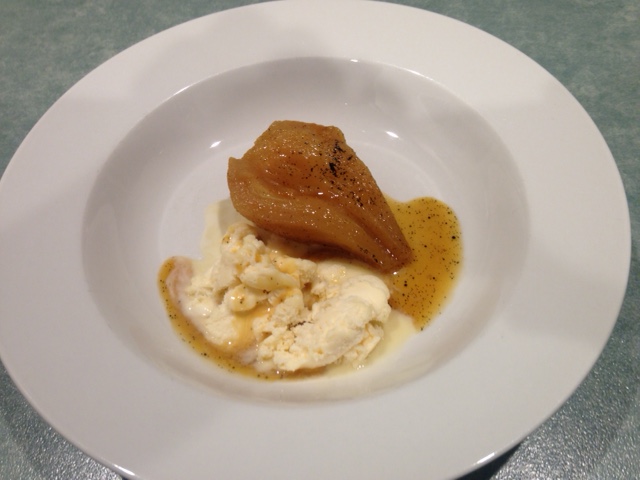
Pears baked

So, it’s the peak period for navel oranges, with freshly-squeezed juice going into those pears and, of a morning, a pre-work glass for Maggie; and the whole fruit being used for our Middle Eastern orange cake. And it’s also the time when our lemon tree becomes laden with ripe fruit, to be zested and juiced for such winter treats as lemon delicious pudding, a lemon & yoghurt cake and Maggie’s lovely crepes.

Not such a surprise then that all this intake of citrus triggered an old light bulb in my head, which sent me rummaging through cyber space for a recipe for ‘crepes suzette’. Here is the one we decided to use, word for word, at least for the sauce; we already have the crepes pegged.

Sweet Suzette

So retro. So delicious!

The final digest entry for this week is an alternative filling for the silver beet turnovers we made last month.

In a typical year, we buy just one packet of ten sheets of puff pastry. This year, four were used to prepare beef wellingtons for a friend’s 60th birthday; two to make lids for chicken pot pies; and two for those aforementioned turnovers.

For the last two sheets, I made a turnover filling according to my long-established recipe for a spinach or silver beet ‘flan’, known to my best friend as ‘Rick’s spinach pie’.

This option suited Maggie better; she is not a big fan of feta cheese. For me, this recipe, designed to fill a shortcrust pastry-case, was a better match, texturally, for the puff pastry than the previous filling, which is used with (lightly-oiled) sheets of filo pastry.

Ingredients

1 brown onion
25-30g butter, for cooking the onion
1 bunch silver beet, stalks trimmed and leaves rinsed
170g ricotta cheese
100g cheddar cheese, grated
2 eggs
generous pinch nutmeg

Method

  1. Coarsely chop the silver beet and cook in simmering, salted water for 6 minutes. When cool, squeeze to remove excess liquid.
  2. Dice onion finely and sauté in the butter until very soft.
  3. In a mixing bowl, combine, onion, silver beet, ricotta, cheddar, eggs and nutmeg.

And then proceed as for the previous batch of turnovers.

Posted in Cooking | Tagged , , , | Leave a comment

French fish frolic

Our latest foray into the recipes from Mastering the art of French cooking took us into unfamiliar territory – poached fish. Not that I’ve never eaten fish that has been poached, I’ve just never thought to try it at home. And bear in mind that Maggie’s appetite for fish is small, by volume, and narrow, by range.

Nevertheless, in the cause of making use of my Christmas present, and in the spirit of deference to Julia Child, we agreed that we would attempt to follow one of her recipes for poached fish, namely ‘filets de poisson Bercy aux champignons’. You can view the recipe at this address:

Julia Child’s Filets de Poisson Bercy aux Champignons (Fish Filets Poached in White Wine with Mushrooms)

We followed the recipe closely, although we took some opportunities to reduce the amount of butter a little. We used ‘green’ onions, which are known as ‘spring’ onions in Melbourne but ‘shallots’ in Sydney. Go figure! The ‘green’ onions softened readily, so contributing to a soft texture dish by the time the dish was ready to serve and eat; shallots – aka as ‘French’ or ‘brown’ shallots – have a lovely flavour but would have been chewy, IMHO!

For fish, we took our fishmonger’s advice and chose a fillet of what is known here as ‘King Dory’. It was firm to the touch, not too thick, it held together through the two stages of the cooking and was delightful to eat, with a mild flavour that melded perfectly with the mushrooms and the sauce.

Some people might think it unusual to cook mushrooms with fish. By way of encouragement, I would point them in the direction of Coquilles St Jacques, one of the classic dishes of French cuisine.

We will definitely cook this again and we would be very pleased to serve it to dinner guests. We accompanied the dish with some small potatoes and a simple, fresh pea & lettuce salad.

Fish poached 1 Fish poached 2

Posted in Cooking | Tagged , , | Leave a comment

Election Night triumph for novice Pizza Party candidate

Here in Australia, we’ve just had an election for our national parliament. Despite my best efforts – one vote in each of the two assemblies – it became clear yesterday that the incumbent conservative government has been returned, albeit with a very small majority.

The actual voting took place two Saturdays ago, following a campaign which was protracted, by Australian standards, and which aroused a low-level of enthusiasm, both generally and in our home. However, Maggie and I decided that we would follow the count on television, maintaining our energy-and-tolerance-levels with a smorgasbord of pizzas.

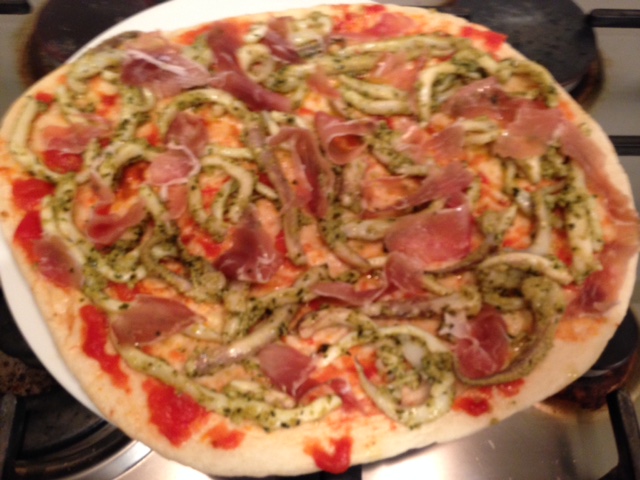
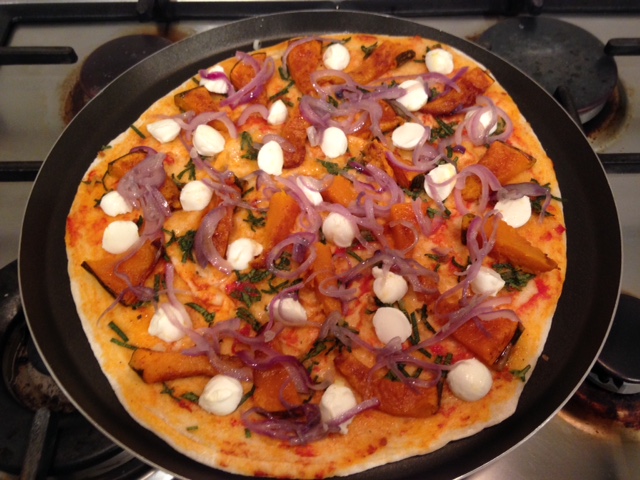
The photos show the pizzas just before they went in the oven. Commencing from the top left, we made four different pizzas: passata topped with seared calamari, basil pesto and prosciutto; (plenty of) passata topped with poached chicken, basil pesto, black olives, anchovies and wilted onion (think, chicken cacciatore); a ‘margherita’ style with chopped basil, bocconcini and prosciutto over passata; and a mere smear of passata topped with roasted pumpkin, shredded sage, bocconcini and some of the wilted onion.

Pizza calamari    Pizza chicken

Pizza Margherita    Pizza pumpkin

The result of this election-night pizza run-off? The calamari candidate suffered from the absence of its usual running mate – pieces of prawn – and was exposed as being one-dimensional; it came in last. The ‘chicken cacciatore’ was like one of those wannabes that sound good but lack the ability to punch through with verve and flavour; nice enough, but it deserved no better than third.

The modified ‘margherita’ was the pre-election favourite; a reliable and solid performer, with a good balance of simplicity and palate-appeal. However, it was overwhelmed by a late swing to the roast pumpkin, a novice pizza party candidate but one blessed with a popular past-a heritage.

So, a happy result and one of the few highlights of the election count. When the result was confirmed a few days later, the roast pumpkin team returned for a victory lap, substituting ricotta for the bocconcini and adding some thin slices of garlic to the wilted onion.

(For the wilted onion, Maggie takes a purple/red onion, halves it lengthways and cuts thin slices, which are tossed and steeped with olive oil, salt and pepper. Then we cook them in a pan (skillet) over moderate heat – say, midway between sauteing and frying – for about 5 minutes.)

Posted in Cooking | Tagged | Leave a comment

Dietary dialects: the English languages of cooking

George Bernard Shaw – critic, playwright and practising pedant – once wrote that “England and America are two countries separated by a common language”. He could well have had cooking terminology in mind.

Add Australian English into the stock-pot and the soup becomes stranger still!

Think of the innocent-looking word “tablespoon”. It refers to a different quantity in each country. As I have to remember when I am using a recipe written for American or British cooks. Just to remind you, dear readers, an Australian tablespoon (tbsp) is 20 millilitres, which, at two thirds of a fluid ounce, is 33% bigger than a US tablespoon (Tb). Our ‘cup’ is also bigger than that of America, but only by 10%.

Next is utensils. Whenever I mention a ‘frying pan’, this is the equivalent of a ‘skillet’ in the US. Followed by cooking methods – Australians apply the word ‘grilling’ to cooking, say, a steak by direct radiant heat, from below OR above; the word ‘broiling’ is not in our culinary lexicon.

And then there is the onion family, with different monikers for at least three of its members: ‘green’ onions in America are ‘spring’ onions in Melbourne but ‘shallots’ in Sydney, only 960km away (‘shallots’ are called shallots in my recipes, just as they were for Julia Child); an onion that is ‘yellow’ stateside, is ‘brown’ in Australia; and our ‘purple’ onion is called ‘red’ in America (perhaps we should meet halfway, at magenta?)

So, if you happen to decide to follow one of my recipes, please be sure to allow for these differences and, hopefully, it will taste just as good, in any language!


Posted in Cooking | Tagged | Leave a comment

A very special cake

A couple of weeks ago, I mentioned that I was planning to make a ‘Middle Eastern’ orange cake. It goes by this name because this type of cake was brought to the attention of a wide audience in 1968, with the publication of A book of Middle Eastern food by Claudia Roden.

I have made several modifications to the original recipe: I add raw spices to the liquid in which I poach the oranges, which makes for a subtle spice infusion of the orange skin; the cooked orange is cut finely, rather than pureed; powdered spices are added to the cake mix; and, with the availability of non-stick cooking equipment, I don’t need to apply any butter and flour to the inside of the cake tins. On top of that, I have increased most of the quantities by one-sixth, to provide sufficient for two cakes.

The recipe produces a dessert-style cake, rich in flavour but light in the belly. This is how our latest batch turned out, with the small pieces of orange rind just visible.

Orange cake 5

Previously, we have made the cake using navel or blood oranges, in season. The latter produces a vibrant colour, as it did when we prepared it for our wedding feast in 2006.

Pictures1 027

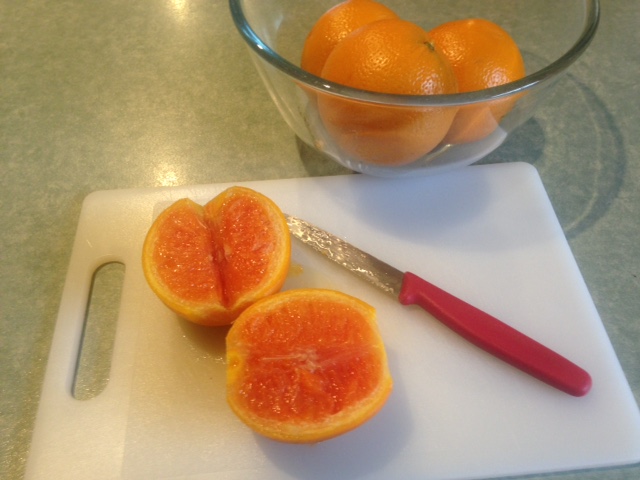
This time, we took advice from one of the team at our favourite greengrocer and used a variety of navel orange branded as ‘Cara Cara ruby navel’. The flesh of this navel can be similar in hue to that of a blood orange; in our case, it was more like a rich, orange ochre. The skin stayed intact throughout the simmering and, in the finished cake, its flavour had hints of candied orange.

We call the cake cooked when the egg has completely set, but it still emerges as very moist, (because we prefer to use more orange than in the original recipe). This means that you have to handle it carefully and, in warm weather or for extended storage, you should prevent the growth of fungus/mould by keeping it in your refrigerator, taking it out up to one hour before serving.

Overall, it is not an especially difficult cake to make, but the end result is complex and deeply satisfying.

Ingredients

4 medium oranges (total weight between 800g and 900g – no need to be precise)
3-4 cardamom pods, 4-6 cloves, 2 cinnamon sticks
3cm piece of fresh ginger, cut into batons
7 eggs, beaten
290g raw sugar
290g ground almonds
1 tsp mixed spice, ½ tsp ginger powder
1 tsp baking powder (optional)

Method

  1. Beginning with cold water, simmer oranges and whole spices in a covered saucepan until tender (about 1½ to 2 hours) (use a saucepan that holds the oranges snugly in one layer). Remove the oranges from the water and allow them to cool.
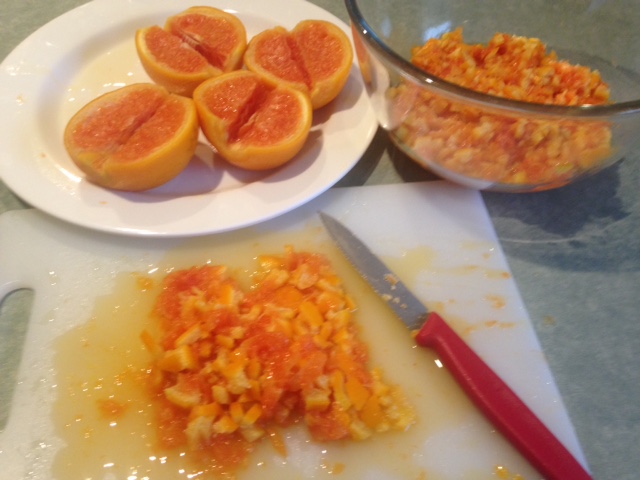
  2. Cut the oranges open, remove any pips and chop finely. (I use about 85% of the cooked orange in the actual cake and discard the rest. I introduced this practice because sometimes an orange splits while simmering. The texture and flavour around and under the split will be inferior, so cut out any split sections before chopping.) (Maggie also likes to remove the navel, the stem-join and, when halved, the white core of each orange.)
  3. Using a coarse sieve, strain the juices from the chopped orange over a bowl and reserve just half of the liquid to make the cake.
  4. Line the base of two 20cm non-stick springform tins with baking paper. (If you use a tin that is NOT non-stick, grease the sides with vegetable or olive oil just before you pour in the batter.)
  5. Preheat oven to 175C.
  6. Combine chopped oranges and other ingredients in a mixmaster, in a sequence of: eggs & sugar (beat for 4 minutes); oranges, strained juice and spices (beat for 2 minutes); almonds (& baking powder) (beat for 1 minute).
  7. Pour batter into tins and bake for 35-40 minutes. (With all that sugar, the cake will brown too quickly if the oven temperature is too high. Check and adjust after the first 10 minutes of baking.)
  8. Cool partly in tin (6 minutes) before gently turning out.

Orange cake 1   Orange cake 2

Orange cake 3   Orange cake 4

If you would prefer to make just one cake, as I sometimes do, use 4 eggs and measure the other quantities in a similar proportion, ie four sevenths or 57%. This sized cake will take 40-45 minutes to cook.

Posted in Cooking | Tagged , , , , , , | Leave a comment

Mastering the art of Julia Child’s boeuf bourguignon

I wonder how many hundreds of thousands of words have been written about the recipe for ‘boeuf bourguignon’ in Mastering the art of French cooking: many hundreds of articles in newspapers and magazines; cross-references or modified versions in numerous subsequent cookbooks; and, in more recent times, countless mentions in blogs and other online settings.

Is there anything left to say that warrants adding another 600 words to the pile? Well, yes, because two of the joys of cooking are that you have the opportunity to add your own twist to a recipe, and that the exercise of using a recipe for the first time will add something significant to your store of knowledge and skills. As was the case when we applied ourselves to this famously popular recipe last week.

Firstly, I can say that the dish we prepared had wonderful balance, texture and flavours. From just under half of the recommended beef, we served two generous dinners for ourselves, with sides of fresh green beans and mashed potatoes. The dish was noticeably richer than the result produced by the recipe we developed in the winter of 2014; perhaps a little too rich for my late-middle-age digestive system. Sigh!

Here are some observations, variations and lessons from our experience of Julia Child’s recipe.

Cut of beef: for braised beef dishes such as this, or beef goulash, we use what is called ‘gravy beef’ in Australia; I believe it is cut from the shin. Other popular options here are ‘chuck’ or ‘blade’. The quality of the gravy beef our butcher supplies is very high and we like the gelatinous texture it produces.

Bacon: for some years, we have been using what is known as ‘kaiserfleisch’ in place of bacon in French braises, including ‘coq au vin’; the difference is probably not great, but it works for us. For the step of browning, we cooked this together with the carrot and onion; cooked by itself, it splatters and spits its own fat all over the place. (We were a bit casual about the quantity of kaiserfleisch; see final note below.)

Vegetables: we used ‘dutch’ carrots, slender and sweet, halved lengthways then cut into segments

Browning the beef: we cut our beef into pieces averaging about 10% less than recommended and we browned them, in four batches of 150-200g, after we had browned the vegetables

Flour cooking technique: this was new to us and we quite enjoyed it

Liquids: Although we had just under 50% of the beef quantity, by the time we had added one-third of both the wine volume and the lesser volume of stock, our meat was well covered, so we didn’t use any more

Tomato paste: we replaced this with some of the tomato sauce we had made according to Julia Child’s recipe

Cooking time: in our case, just under two hours plus the final steps was sufficient to achieve tender meat and a delicious gravy

Small white onions: we used brown (French) shallots instead of onions; it’s an established personal preference. We enjoyed the technique of brown-braising the shallots, and expect that we will use it in other circumstances

Straining and skimming: we had used less liquid, so the cooked dish was quite thick, but not at all dry, and any fats were well integrated into the gravy; so, these steps were not applicable. Our own recipe adds flour just before the end, after straining and skimming; we think that works well, for us

Reducing the richness: if we used this recipe again, I would be strict in relation to the weight of kaiserfleisch and delete the rind. And I would use a tomato passata or puree – we don’t like to use tomato paste in such dishes but our homemade French tomato sauce was too rich for this dish

Posted in Cooking | Tagged | Leave a comment

Menu-ready index a recipe for excess?

I established this blog site about six years ago by copying & pasting a small collection of posts that I had written on a previous site which, vexingly, had a dysfunctional host. Most of those posts have been superseded, then deleted; just two remain.

For various reasons, I didn’t add any new posts until the beginning of 2014. Since then, I have written posts at a rate of about two each week, with a ratio of cooking stories to travel of about 5:2.

Towards the end of 2014, I created a page, now titled ‘Index of recipes”, which proudly listed all the recipes that I had published, and which, helpfully, provided a hypertext link from each recipe name to the relevant blog post. Not so helpful was my decision to list the recipes in order of posting, from most recent to the oldest. Why? Bone-laziness is the most plausible explanation.

Anyway, during this past week of wintry weather, I have used some of the hours of my confinement to reorganise the recipe index into eight groups, according to the categories that Maggie and I use for the collection of all our favourite recipes which we print out and keep in a folder in our kitchen. So, the Index of recipes is now much more user-friendly.

Most of the recipes are structured, ie Ingredients, followed by Method. Several others are presented as a piece of prose, so, looser, but still informative.

Bon appetit!

Posted in Cooking | 1 Comment

I’m puffing, but filling up-beet

We buy either spinach or silver beet about twice each month. We also grow it at home from time to time, although we usually struggle to keep it out of the reach of marauding possums!

I have cooked with these green leaves for nearly 40 years, mainly in the form of a silver beet flan, ie with a shortcrust pastry but bulkier than a quiche; a spinach souffle, tricky to achieve but worth the effort; and as the feature ingredient in an omelette. In recent years, I have replaced the flan with, first, the Greek dish spanakopita and, then, another filo pie, with a filling of silver beet, ricotta, feta and eggs, but no onion.

Maggie is as keen to buy the greens as I am, but she has just one destiny in mind for each of them: spinach, to be wilted with some butter, then finished with a teaspoon of Dijon mustard, seasoning and about 40ml of cooking cream; silver beet, to be trimmed, boiled in salted water, chopped and then tossed with some butter, say 20g for the average bunch. None of my other methods appeal to her all that much and, with no relatives-in-need close at hand to justify the effort and quantity, I have all but abandoned those dishes. Sigh!

Spinach was on the shopping list last week but the available bunches looked a bit ragged, so we came home with silver beet. By the following day, I had come up with a plan to entice Maggie to embrace a use for those leaves at variance with her preferred option.

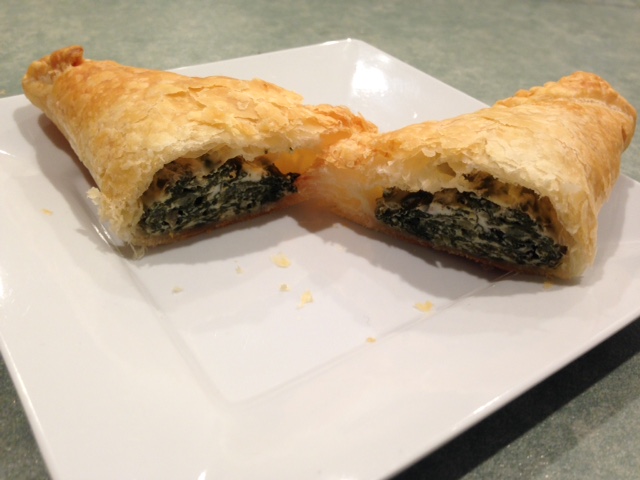
Here is the end result of my ploy – puff pastry turnovers filled with a simplified version of my filo pie recipe and with the tempting texture of the puff pastry. We made them on Sunday afternoon and Maggie took two to work for lunch on Monday. Mission accomplished!

The recipe below specifies ‘one bunch of sliver beet’, which is not very specific at all! Hence the quantity ranges for the two cheeses. Two eggs should be sufficient in most cases – we don’t want to have the filling set firm like a cake.

Silverbeet 1

Silverbeet 2

Ingredients

1 bunch silver beet, stalks trimmed and leaves rinsed
2 eggs
75-100g good quality feta cheese, crumbled
100-125g ricotta
¼  tsp grated nutmeg
¼  tsp dried oregano
2 to 3 sheets of puff pastry, just thawed

Method

  1. Coarsely chop the silver beet and cook in simmering, salted water for 6 minutes. When cool, squeeze to remove excess liquid.
  2. Separate one of the eggs into white and yolk.
  3. Beat the whole egg and the extra yolk in a large mixing bowl, add the feta and mix well. Add the silver beet, ricotta, nutmeg and oregano and mix well. Adjust seasoning.
  4. Preheat the oven to 180C.
  5. Line one or two baking trays with baking paper. (The recipe will produce enough filling for about 10 turnovers.)
  6. Whisk the extra egg white briefly.
  7. Cut each sheet of pastry into four squares.
  8. Divide the filling among the pastry squares. You can afford to be generous, as the filling will not expand unduly during the baking.
  9. Brush the edges of each square with the beaten egg white. Fold in half diagonally to enclose the filling. Pinch the edges to seal (Maggie uses a fork for this step).
  10. Place the turnovers on the prepared tray. Bake for 20-25 minutes or until puffed and golden.

To reheat any leftovers, I prefer to place them on a baking tray, put them into a cold oven and set the temperature to rise to about 150C. In about 12-15 minutes, this will reproduce a crisp pastry without cooking the filling any further. If you want to reheat them in a microwave oven, I suggest you cut each turnover in half beforehand, to let some steam escape and achieve even heating.

Posted in Cooking | Tagged , , , | Leave a comment

Without almonds, I’d go nuts!

Do you have a favourite nut? Yes, yes, very funny. Maggie says that too.

Or a nut that you can’t abide – say, brazil, or the leader of Brazil? No, seriously, I do NOT like brazil nuts. And I’m not all that enamoured of peanuts either; well, not since I stopped drinking beer on a regular basis.

However, I do enjoy several other varieties of nut: toasted pecans, in a superb dessert cake; walnuts, toasted or raw, in various sweet and savoury dishes; roasted and peeled hazelnuts, ditto, including a chocolate torte, Sara’s favourite cake; and macadamias, as the source of fat in an ‘Australian’ Christmas pudding.

Choc cake 5

But the king of the nut bowl in our kitchen is the almond, and I simply do not care to imagine what my life would be like without it.

How do I love thee? Let me count the ways.

We buy almonds in three forms: blanched – halves and flakes; and, very occasionally, raw almonds, which I dry roast to have on hand for a mid-afternoon snack.

I grind the blanched halves in our blender to make a coarse meal for at least three different cakes: the aforementioned chocolate torte, for special occasions; a plum cake, when ‘blood’ plums are in season; and my version of the well-known Middle Eastern orange and almond cake. The navel orange season has just begun, so I will make the last of these cakes soon and share my recipe.

Plum cake

I also grind some of the halves to small chunks. These go into the mixture when we make meringues, which we enjoy with fresh strawberries that have been macerated in a generous drizzle of Cointreau. Naughty but nice!

IMG_0633

And, as some of you would have noticed, we have begun to use almond halves that have been lightly browned in vegetable oil before we scatter them over a biryani-style dish.

The flakes? Raw, they form part of my homemade muesli. This is the first food I consume on the mornings of Maggie’s workdays, and the morning after the last day of her working ‘week’, when she gets a sleep-in.

But, when they are toasted, the almond flakes really come into their own.

By toasted, I mean cooked dry in a pan over low heat, and tossed every 30 seconds or so, until they have become lightly coloured and crunchy. In this form, I use almond flakes to add texture and flavour to an uncomplicated apple cake; and we like to sprinkle them over fresh strawberries or poached peaches for a simple yet satisfying summer dessert.

And that, in a nutshell, is our almond story.

Posted in Cooking | Tagged , , | Leave a comment

Naughty ‘nanas … nyum!

I quite enjoy a fresh banana, although I’m a bit choosy about where I buy them – not all bananas are created equal!

From time to time, quite regularly actually, I find myself with a surplus of ripe bananas. Perhaps, distracted by another option in our fruit bowl, I didn’t get around to eating them. Or, my favourite greengrocer was offering bags of bananas at a discount price – I’m easily led astray by a food bargain!

Too many bananas? No drama. I could probably make a banana, walnut and date cake in my sleep, I’ve done it so many times; between 250 and 400 times, to be approximate.

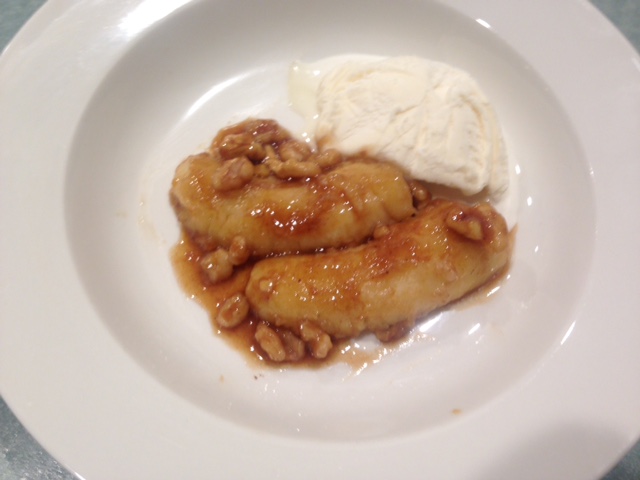
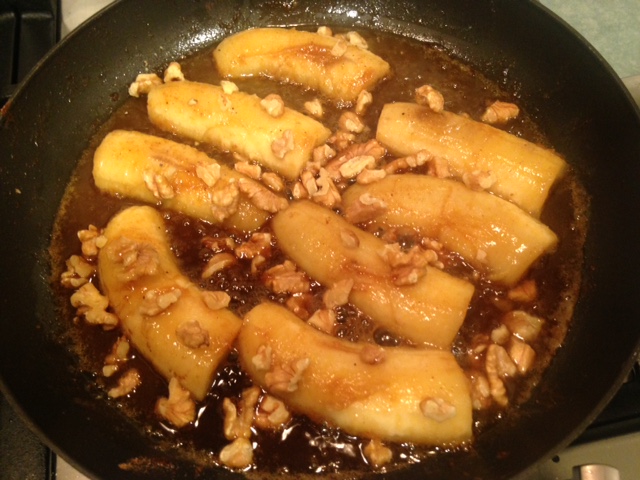
However, I had been thinking I should come up with a Plan B. Then, hey presto! The Sweet-tooth Fairy put a recipe for fried bananas in my newspaper, complete with a fancy name – ‘Bananas Foster’. How could I resist?

Bananas 6

The recipe worked well, although Maggie and I did modify it a little to suit our palates and the number of guests for dinner, as in zero.

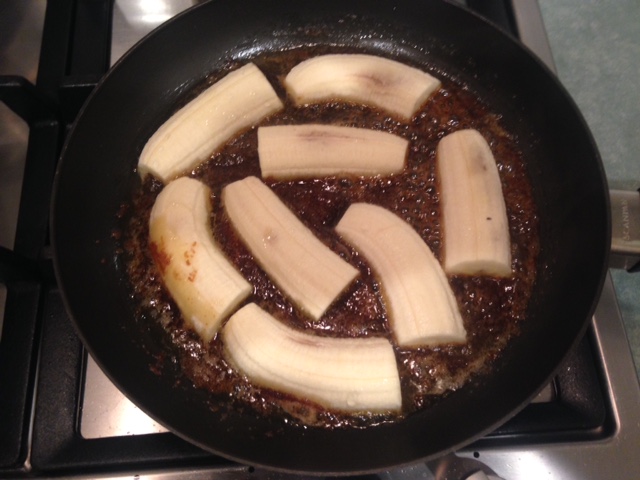
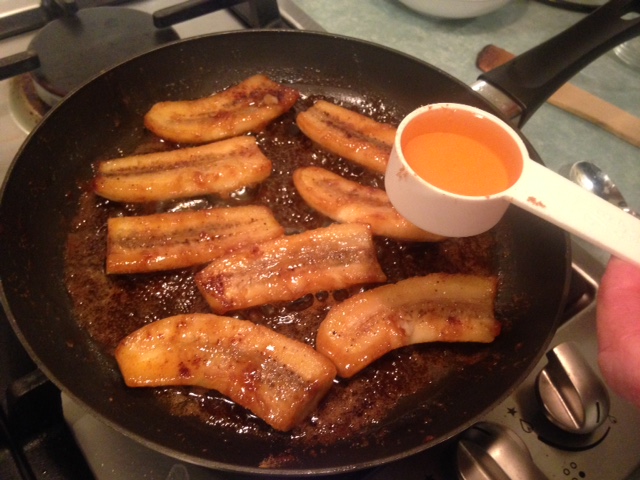
Our variations: two bananas and half the recipe quantities for everything else; cut the bananas in half both ways to make it easier to accommodate them in the pan; mixed spice in place of cinnamon; a generous squeeze of lemon juice just before the bananas are turned for the first time; and add the walnuts once the rum has bubbled for a minute or so. Oh, and we never ‘flambe’ alcohol spirits – it frightens the bejeezus out of Maggie and, well, I am more risk averse than in the first half of my life. (Note: if you want to flambe something, turn off your exhaust fan first!)

The recipe produces a delicious and well-balanced dessert, and Maggie is now taking more interest in our supply of bananas than ever before!

Bananas 1   Bananas 2

Bananas 4   Bananas 5

Posted in Cooking | Tagged , | 1 Comment