Visit to Canberra: a symphony in five monuments (day 1)

Maggie and I recently spent a few days in the region of Canberra, the capital of Australia. The next couple of posts will cover our visits to five national monuments, followed by some of the excellent food we ate in and around Canberra.

(I have used the word ‘symphony’ as a descriptor for this set of experiences. We do like to orchestrate our travels and, in a real way, the journey from monument to monument felt like a series of components of an integrated whole. Besides, it gave me the opportunity to apply the monument/movement pun!)

Australian War Memorial

The first item on our program was a visit to the nation’s principal war memorial, which also includes museum exhibits relating to all wars in which Australia has been involved, ie since 1901.

The memorial buildings are in a typically Australian setting – a variety of trees and shrubs in a semi-arid environment. From the front steps there is a striking view, across the artificial Lake Burley Griffin, to Parliament House. (You can admire that vista here, as well as a more detailed description of the site.)

10-war-mem   11-war-mem

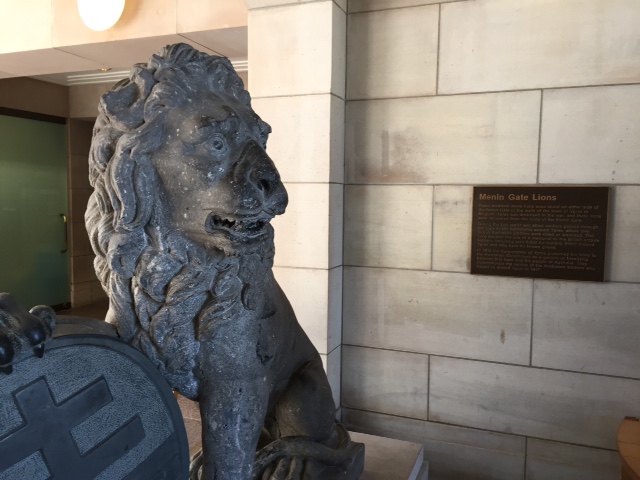
The entrance to the memorial is watched over by two stone lions, which originally formed part of the Menin Gate, in Ypres. (I recently wrote about our visit to Ypres.) The lions were donated to Australia by the Mayor of Ypres in 1936, as a gesture of friendship.
12-war-mem

The museum section also includes a copy of Menin Gate at Midnight by Australian artist Will Longstaff. He painted the work after attending the unveiling of the Gate, in July 1927. The foreground is dotted with steel-helmeted ‘spririts’, emerging from cornfields. You can find out more about this remarkable painting here.

13-war-mem

We then explored the museum exhibits associated with the First World War battlefields we had visited in Flanders and the Somme, including the astonishing collection of original Victoria Crosses awarded to Australian soldiers for gallantry. (The VC is the highest national award in each of Britain, Canada, Australia and New Zealand.)

As we made our way out of the museum section, we came across As of today, a remarkable sculptural monument to the 41 Australian soldiers who died while on duty in Afghanistan. This was especially poignant for Maggie – a close friend of her son is one of the 41 and her son was with him at the time. We attended his funeral, a deeply sorrowful event.

16-war-mem

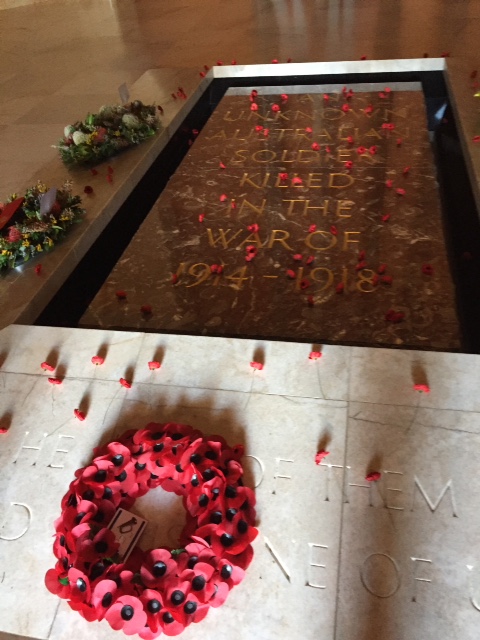
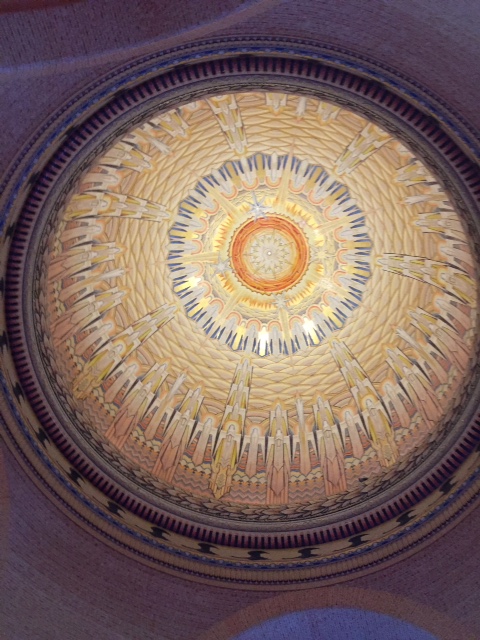
From the museum, we moved to the memorial courtyard, which leads to the Hall of Memory, an imposing chapel in which the body of an unknown soldier was interred in 1993. The soldier had served on the Western Front and his name would be recorded on one of the sites we visited in September.

18-war-mem

19-war-mem      20-war-mem

21-war-mem

The then Prime Minister, Paul Keating, made a powerful speech at the internment ceremony. You can find it here. The first I knew of this event, was when we visited the main Australian WW1 memorial outside Villers-Bretonneux; Keating’s words resonated very strongly with me.

From the chapel, we left the memorial via one of the two cloisters on the side of the courtyard. The walls of the cloisters contain the name of every Australian service man or woman who has been killed in war since 1901. The panels include provision for poppies to be attached next to a name, something we did for the friend of Maggie’s son.

22-war-mem

High Court of Australia

Our next visit was to the High Court, so it is probably time for me to insert some historical basics for the vast majority of my small band of followers that has never lived in Australia.

Until 1901, Australia was six separate colonies, which had been established from 1788 onwards through the presence of a mix of British troops, free settlers and convicts. On the first day of 1901, Australia became a single, unified nation and each of the former colonies became a state within the new federal system. The act of constitution which established Australia, and a national government and parliament, provided for the creation of a High Court, independent of government, with each new member being appointed by the government in a manner not unlike the US Supreme Court, for example.

The High Court has two main purposes: to resolve disputes about interpretation of the constitution, usually triggered by new legislation; and as the highest appeal court, determining matters that have arisen in a lesser state or federal court. The court comprises seven members or ‘justices’, one of whom is the Chief Justice, the most eminent judicial position in the country.

So, what did we see and learn by visiting the premises of the court?

Firstly, that the building is imposing. An in-house guide explained that this was an intention of the design brief, ie it should reflect the power and status of the court. He also pointed out that it was located off to the side of the central visual and planning axis of Canberra, which runs from the Australian War Memorial to Parliament House; this was to reflect the fact that the court is not subservient to the legislature. Interesting!

23-court

Inside the building, the walls and staircases are adorned with works of art that are also monumental, each one specifically commissioned. In Court No 1, which is used only for cases regarding the Australian Constitution, a large tapestry carries the symbolic badges of the six states and the crest of the Commonwealth.
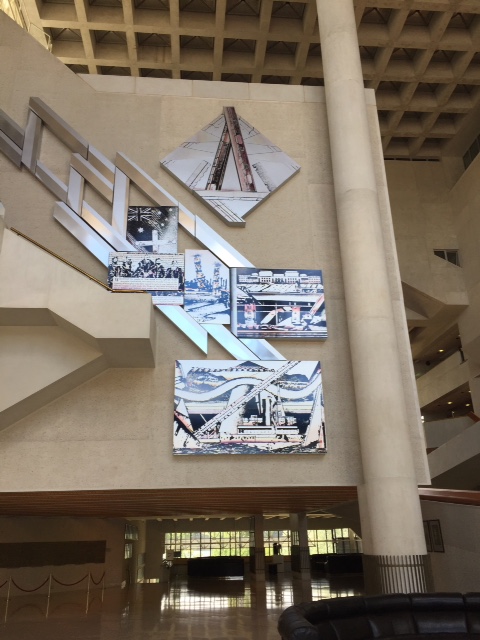
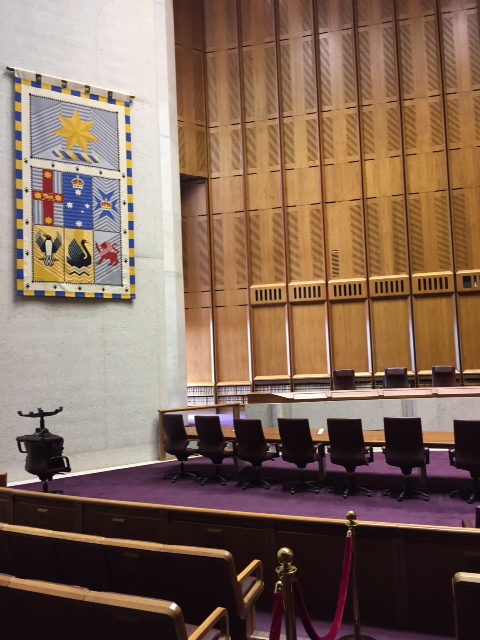
24-court      25-court

Two paintings in the foyer of the court used for matters of appeal, depict the court’s inaugural sitting in a Melbourne courtroom in 1903, and its centenary, in Canberra.

29-court   30-court

One artwork which I found particularly interesting and satisfying was Today now we all got to go by same laws, produced by Rosella Namok, an Australian aboriginal woman born in Queensland in 1979. I highly recommend that your read her description/explanation of the painting here; (you will also find that I missed two panels on the RH side when I took the photo).
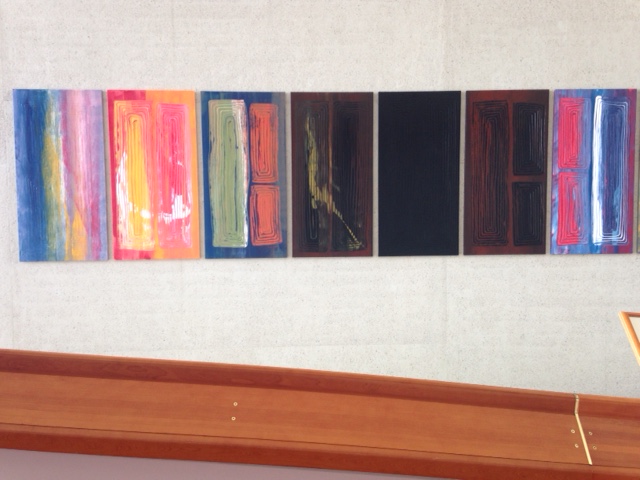
27-court

The next post will introduce you to the three national monuments that we visited on our second day in Canberra.

Until then, cheers!
Rick Grounds
Posted in Travel | Tagged , , | Leave a comment

Dutch treat

dutch-apple-cake-7

A temporary ceasefire has been declared in the war of words about our visit to WW1 battlefields. I have three more posts left to prepare and I want to take the time and care required to make them interesting and informative. Care, I have, but time is scarce. Our garden is requiring more maintenance than I would like and, tomorrow morning, we are heading to our national capital, Canberra, for a few days.

The main purpose of this, our third visit to Canberra in the last five years, is to see an exhibition called ‘A history of the world in 100 objects from the British Museum’, which is being held at the Australian National Museum. While we are in Canberra, we plan to visit some other important national buildings, including the High Court, the National Library, the Australian War Memorial and, if we can squeeze it in, a second visit to the National Portrait Gallery. Fifteen-hour round trip, three nights, accommodation in a heritage-listed hotel and a couple of well-regarded eating establishments. Mad if we don’t, really!

But before I start packing a suitcase, here is an apple cake story for you to bite into.

Until recently, there were three apple cake recipes in our repertoire. (All of them can be found in earlier posts via links on the Index of Recipes page.) Now there is a fourth, my ‘Dutch’ apple cake.

When we spent a few days in Amsterdam in August, a modest culinary highlight was a slice of apple cake I enjoyed in one of that city’s numerous excellent cafes. As well as being delicious, it revived a long-ago palate memory and left me yearning to find a recipe with which I could attempt to reproduce the essence of these two pleasurable events.

After we came home, I did find a recipe and we gave it a whirl, but it fell short of expectations. The diagnosis? Too much cake, overwhelming the apple; and not enough spice, to complement the apple. So, modifications have been designed and implemented and my palate is VERY happy. Our recipe, which will, henceforth, be our preferred one for making an apple cake, follows.

IF you can discipline yourself to leave the cake largely intact for a day or two, it will reach peak condition on the third day, when some of the moisture from the fruit has infused the surrounding cake.

Ingredients

200g plain flour
2 tsp baking powder
rounded ¼ tsp grated nutmeg
rounded ¼ tsp cinnamon powder
2 apples (I use Golden Delicious), peeled, halved and cored
90g unsalted butter, softened
180g caster sugar
50ml milk
2 eggs
110ml milk, extra
20ml raw sugar or demerara sugar, combined with < ¼ tsp each of grated nutmeg and cinnamon powder

Method

  1. Line the base of a 20cm non-stick cake tin with baking paper.
  2. Preheat oven to 170C
  3. Combine flour, baking powder and spices in a small bowl.
  4. Cut apple halves into thin slices, about 3mm.
  5. In a mixing bowl, cream the butter, caster sugar and as much of the 50ml of milk as it takes to enable the creaming process. Reserve any leftover milk.
  6. Beat in the eggs, one at a time.
  7. Add half of the milk (including the reserved portion of the 50ml) and half of the flour mixture and fold in. Repeat with the balance of the milk and flour.
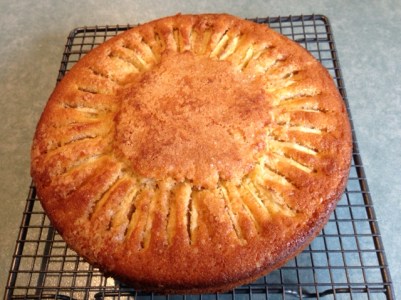
  8. Pour the batter into the cake tin. Press the slices, closely side by side, into the batter to form a ring around the central portion – 7-8cm across – of the batter (see photo below). (Tip: the slices from each half-apple should fit into one-quarter of the surface of the batter.)
  9. Sprinkle with the sugar and spice mix.
  10. Bake for about 35 minutes, until it tests clean.

dutch-apple-cake-8

Posted in Cooking | Tagged , , , | Leave a comment

Visit to WW1 battlefields: day 1, part 2

The final item on the itinerary for the first day of our tour was an extended visit to the small city of Ypres.

Ypres was briefly captured by German forces in the first months of the war, but they were soon driven out by the Allies during ‘The First Battle of Ypres’. From late 1914 onwards, Ypres functioned as the main Belgian stronghold for Allied forces, with a secure passage westwards to the coast. However, it was surrounded by German forces on the other three sides and much of the town was destroyed by continuing artillery and aircraft bombardments. You can read more about the history of Ypres and what happened in the town during the war here.

From our tour coach, we entered the old heart of the city through what is called the Menin Gate. This structure – a triumphal arch opening to a passage through a vaulted mausoleum, serves as a memorial to nearly 55,000 Commonwealth troops who died in and around Ypres during the war and whose bodies were never identified. It stands on the site of one of the gates within the city’s old fortifications, through which many Allied troops would have passed on their way to front, some never to return.
I will tell you more about our experience of the Menin Gate below. A more detailed explanation of the site can be read here.

41

Ypres was once a bigger city and, based on a thriving and renowned textile industry, a very prosperous one. The grand building on the left, below, is the Cloth Hall, completed in 1304 and one of the largest commercial buildings of its time. It was severely damaged during WW1 and painstakingly restored over three decades. It now houses a museum and study centre about WW1.

The other large building in the photo was a cathedral for more than 200 years, until 1801, when Ypres ceased to be the seat of a diocese. It was reduced to ruins during the war and was completely rebuilt in the 1920s, largely according to the original plans.

48   42

The old heart of the city is quite compact, easily explored in less than an hour of gentle walking. We came upon a rather quaint restaurant, ‘De Ruyffelaer’. It offered a menu called ‘Old Ypres’, which you can find here with some images of the quirky interior. Our hosts were very welcoming, the food was delicious and the portions were generous. Maggie felt that all her Christmases had come at once when the creme caramel arrived in a dish that was a good 15cm wide!

03-ypres-food   04-ypres-food

05-ypres-food

We dined quite early, as we were due to return to the Menin Gate by no later than 7pm, to witness a famous ceremony, first held there in July 1928 and and held EVERY evening since 11 November 1929, other than when Belgium was occupied by Germany during the Second World War.

The key elements of the ceremony are contributions by visiting choirs or musical bands; the laying of wreaths; and the playing of the ‘Last Post’ by buglers from the local volunteer fire brigade. Ordinary citizens can apply to lay wreaths, it is not just for ‘officials’. You can learn more about this remarkable and poignant tradition here.

We really had little idea what to expect and, in a way, that made even more special.

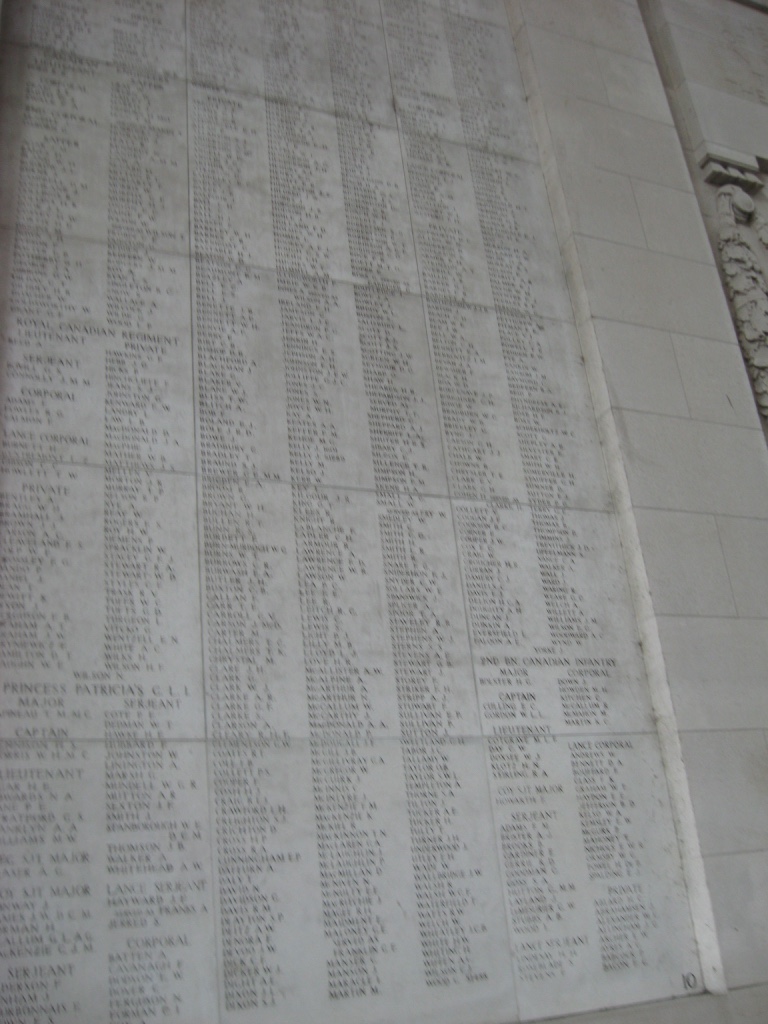
The first two photos were taken before the memorial was filled with a large crowd of viewers and participants. You can see examples of the panels that carry names of those thousands of personnel whose bodies were never identified.
44      45

On the evening of our attendance, the British Ambassador to Belgium was there to lay a wreath. Her participation also marked the presence in Ypres of the Grenadier Guards, one of the most famous army regiments in the English-speaking world. The entire regiment had spent several days in the region and, as we looked on, their brass band performed for an extended period to commence the evening’s program, concluding with some very solemn music as the many wreaths were laid.

57   55

56

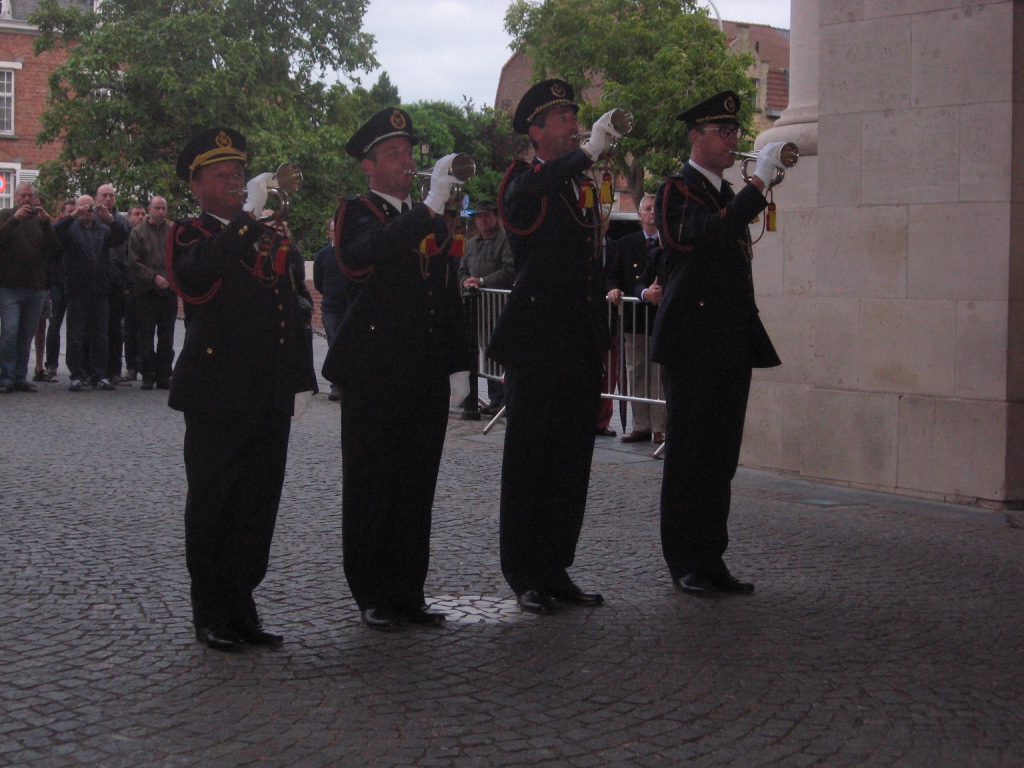
Then, at the appointed time of 8pm, four buglers arrived at the outer end of the memorial, to perform The Last Post; it was a powerfully poignant moment. It was also the beginning of our education as to the deep respect and gratitude felt, to this day, by citizens and communities in Belgium and France for those service personnel from other countries who fought and died here.

59

As you would appreciate, we did not have any plans to purchase ‘souvenirs’ associated with this catastrophe of a war. However, we did find a small ‘poppy’ brooch, which Maggie brought home to wear in the lead up to 11 November, known in Australia as ‘Remembrance Day’. She will maintain this tradition for the balance of her life, and it will always remind us of what we experienced at the Menin Gate in Ypres.

poppy-brooch

Posted in Travel | Tagged , | Leave a comment

Visit to WW1 battlefields: day 1, part 1

(I have found it quite challenging to prepare this first post about the sites we visited on our tour of First World War battlefields. Largely, this is because I knew only the most basic details of the war beforehand. Unfortunately, our guide added little in the way of information that helped to put the sites we visited in a strategic or temporal context; we weren’t even given a useful map.

I have spent some time trying to fill some of my knowledge gaps by reading articles on the internet, so that I might be able to give you an account that provides some real meaning for our itinerary and our photos. There will probably be a few errors of fact in this and the subsequent posts but, with any luck, they will not take us too far from the wider truths.

If you have sufficient interest, you might like to follow some of the links I have added to my account, starting with one that walks you through a list of all the key battlefield locations on the Western Front.)

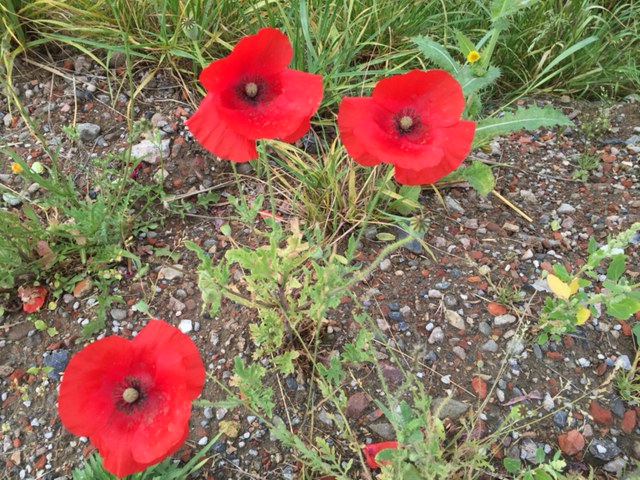
On the first day of the tour, a Sunday, we left Paris soon after 8am, bound for the Flanders region of Belgium. When we arrived at our first destination, we discovered that, yes, red poppies do grow in the fields and roadsides of Flanders.

img_1229

Tyne Cot Cemetery and Memorial to the Missing

Full details of this cemetery and its adjoining memorial may be found here.

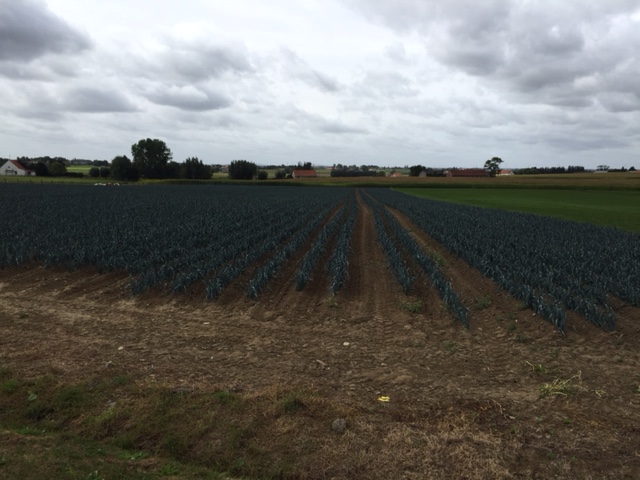
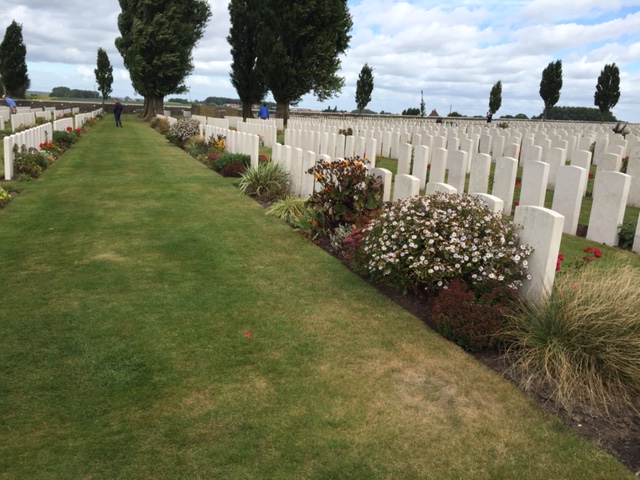
The first image, of a crop of leeks, gives you an idea of how flat and open the land is, much as it was at the time of the war. When, as often happened, groups of soldiers advanced across such spaces in the face of machine-gun fire, there was little to shield them from the deadly bullets, except for the occasional hole created by artillery fire. Death came quickly and multitudinously.

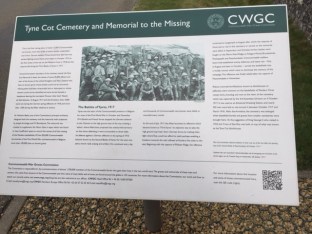
I don’t expect you to be able to read many of the words on the information board in the second photo. I’ve included it here to show you what the Commonwealth War Graves Commission (CWGC) provides at all of the numerous sites for which it is responsible. The quality and quantity of site-specific information was excellent.

img_1232   img_1237

7   img_1235

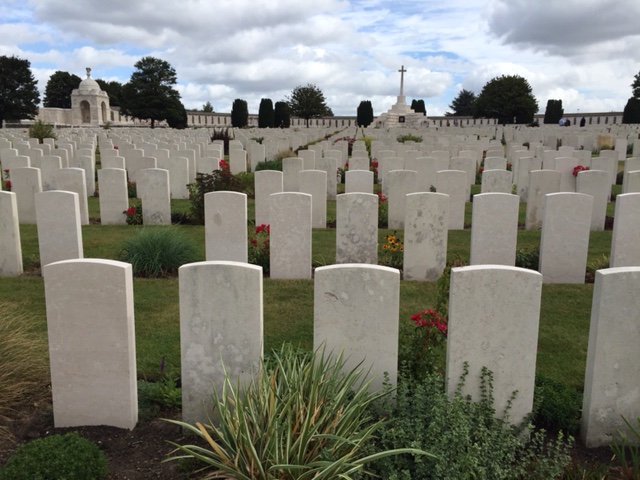
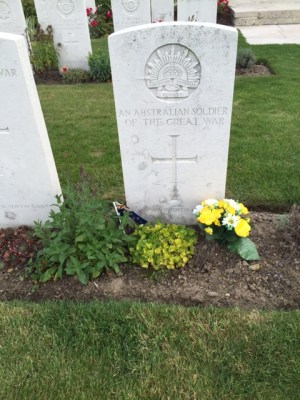
Nearly 12,000 Commonwealth servicemen – United Kingdom, Australia, etc – are buried at Tyne Cot, the largest number buried at a CWGC cemetery. More than two-thirds of them are unidentified.

(I have often made the 400km journey from the city of Perth in Western Australia to the city of Albany on the south coast. 12,000 is more than the sum of the entire populations of all the towns and farms between these two points.)

The Cross of Sacrifice – there is one at every one of the cemeteries – is located in the middle of the site, on the remains of what had been a reinforced concrete blockhouse, occupied by German machine-gunners.

img_1242   img_1243

img_1245      img_1250

The Memorial to the Missing is a long, sweeping wall of panels carrying the names of 35,000 United Kingdom and New Zealand soldiers whose bodies were never identified. (This is far from all such cases.)

14   15

The combined effect of the cemetery and memorial was close to overwhelming and the members of our tour group devoted an extended period to taking it all in and quietly processing the appalling reality represented here.

Passendale (Passchendaele)

The vast majority of the troops who are buried at Tyne Cot, or whose names are listed on its Memorial to the Missing, lost their lives is what is commonly known as the Battle of Passchendaele; to some military historians it is known technically as the Third Battle of Ypres (and by other names to Germans and French-speaking people, respectively).

The city of Ypres was one of the main bases and points of departure towards the front for the remnants of the Belgian army, some French forces and those British-led forces serving in Belgium. Germany had sought to capture Ypres and thence the coast to its west when it invaded Belgium in August 1914. However, the German advance had been held up by Allied troops. German forces then dug in along and behind ridge-lines generally to the east of Ypres, forming a bulge-like shape known as a ‘salient’.

For various reasons, the situation altered little through 1915 and 1916. The German army was able to strengthen its position slightly in the northern Spring of 1915 and there was continued significant loss of life on both sides from artillery fire and occasional skirmishes.

Through 1916 and the early months of 1917, the British command prepared plans for an offensive in Flanders, to take place in the northern Summer of 1917. The objectives were to drive the German forces back from their advantageous positions and then proceed to recapture the northern half of the Belgian coastline, including the ports from which German submarines posed a constant threat to British shipping.

You will find the Wikipedia account of this offensive here. Although it succeeded in gaining control of the higher ground east of Ypres, it came at a terrible toll of casualties on both sides and it did not deliver control of any additional coastline.

Crest Farm – Canadian Corps memorial

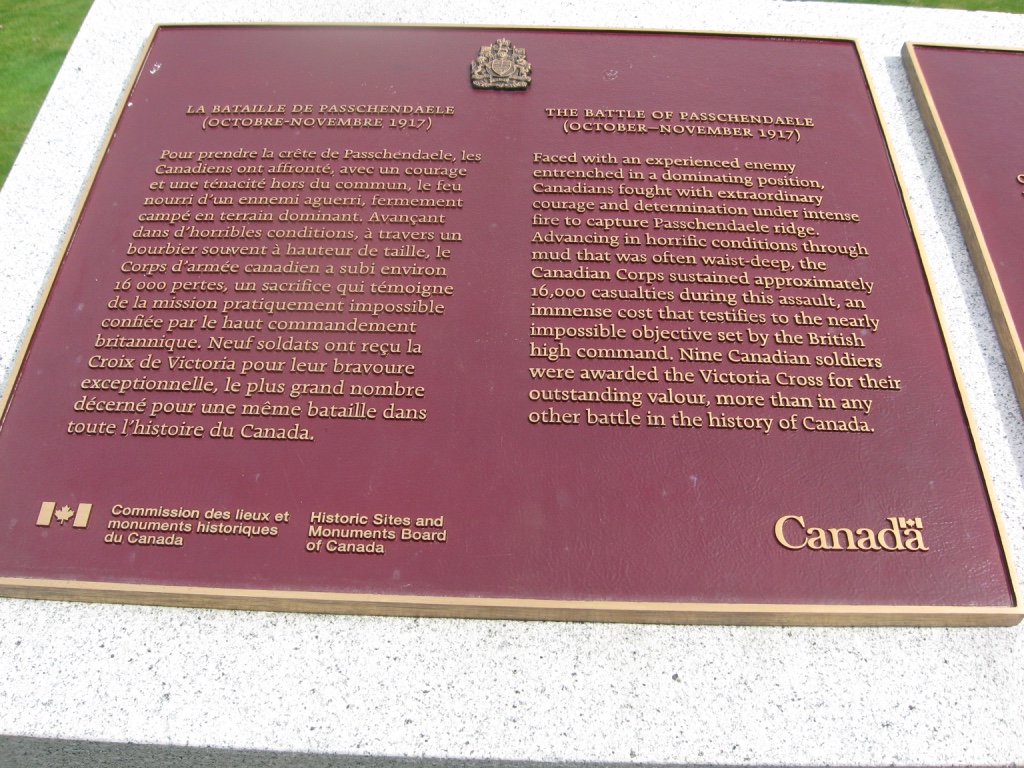
As well as Tyne Cot, we visited one of the many other significant sites connected with the 1917 battles. This was a memorial to the Canadian forces who captured the heart of the Passchendeale Ridge, a site known as Crest Farm, and then, in house to house fighting, the nearby town of Passchendeale itself. (If you visit the Wikipedia link above, you will see photographic evidence of the near-total destruction of the town.)

16   17

The words on the plaque read: “Faced with an experienced enemy, entrenched in a dominant position, Canadians fought with extraordinary courage and determination under intense fire to capture Passchendeale Ridge. Advancing in horrific conditions, through mud that was often waist-deep, the Canadian Corps sustained approximately 16,000 casualties during this assault, an immense cost that testifies to the almost impossible task set by the British high command. Nine Canadian soldiers were awarded the Victoria Cross for their outstanding valour, more than in any other battle in the history of Canada.”

Polygon Wood – Australian Fifth Division Memorial

The main 1917 Allied offensive in Flanders was preceded or accompanied by other attacks, which had the objectives of driving the German army from positions which threatened Ypres or which overlooked the intended direction of the main offensive.

The Battle of Polygon Wood was an example of the latter. The Allies’ aim was to expel German forces from high ground known as a ‘butte’, formed from excavations for a C19 railway line, adjacent to what was left of the original wood. You can read more about this battle here.

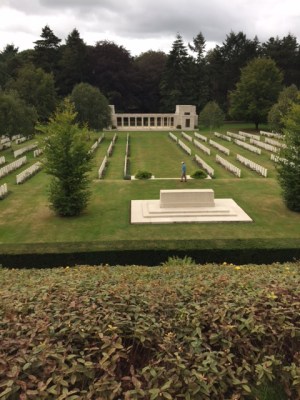
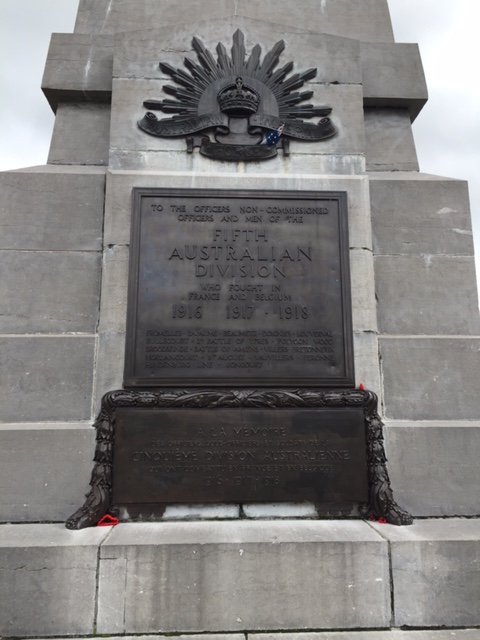
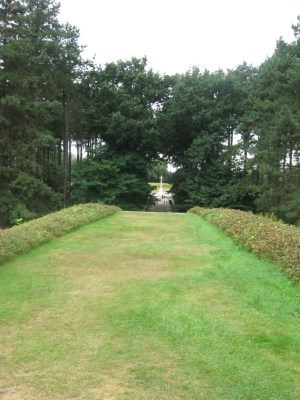
Our photos show, in order: the main cemetery, including a memorial to New Zealand soldiers who died in the vicinity in the 1917 battle or during the subsequent German offensive of 1918; the main WW1 memorial for the Australian Fifth Division, which sustained more than 5,000 casualties (dead or wounded) during the three days it took to capture the Polygon Wood site; the view from that memorial along the top of the butte in the direction of a smaller, original front-line cemetery below; and the Cross of Sacrifice at that cemetery.

img_1252      img_1251

28      21

Hill 60

The site known as Hill 60 has become more widely known in recent years as a result of a commercial movie, Beneath Hill 60, about what occurred there in 1916 to 1917.

The site is open to the public, but there is no properly formed walking track and many sections are fenced off for reasons of safety – unexploded mines or shells; and respect – numerous soldiers from both sides were buried underground and their bodies were never recovered.

33   38

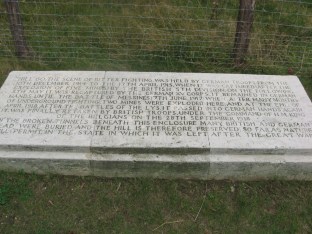
Near the entrance to the site, there is a simple concrete block, inscribed as follows:

“Hill 60, the scene of bitter fighting, was held by German troops from the 10th December 1914 to the 17th April 1915, when it was captured (after the explosion of five mines) by the British 5th Division. On the following 5th May it was recaptured by the German XV Corps. It remained in German hands until the Battle of Messines (7th June 1917) when, after many months of underground fighting, two mines were exploded here. And, at the end of April 1918, after the Battles of the Lys, it passed into German hands again. It was finally taken by British Troops under the command of H.M. King of the Belgians on the 28th September 1918. In the broken tunnels beneath this enclosure, many British and German dead were buried and the hill is therefore preserved, so far as nature will permit, in the state it was left after the Great War.”
There, in just 151 words, you have both the revolving-door character of the Western Front story and the profound futility of war in general!

More information on the site and the various battles which occurred there can be found here and here, respectively.

The main memorial at the site is a dedication to the 1st Australian Tunnelling Company, whose work is featured in Beneath Hill 60. There are two bullet holes in the memorial’s metal plaque from fighting that occurred in the area during the Second World War.

34

The other point of interest at the Hill 60 site is the presence of a concrete bunker, built by the German Army but also utilised by Allied troops when they had control of the hill. It is still largely intact, a century later!

31

Hill 60 wasn’t the last site we visited on this first day of our tour. From here we drove to the city of Ypres itself, arriving there late in the afternoon. We spent about four hours in Ypres, culminating in a remarkable experience which I will relate to you in my next post.

Posted in Travel | Tagged , , , , | 3 Comments

Visit to WW1 battlefields: introduction

img_1231

During our recent travels in Europe, Maggie and I went on a four-day guided tour of the First World War battlefields in the west of Belgium and the north-west of France. In Flanders and the Somme, some of the bloodiest and most pointless battles in human history took place, at the cost of hundreds of thousands of lives – British, French, German, Australian, Canadian and New Zealander, in the main. (One in every eighteen Australian men aged between 18 and 44 was killed during the war; many others were severely injured, mentally or physically.)

The tour, operated by Insight Vacations, took us to the sites of some of these battles and, more importantly, to several solemn cemeteries and memorials. For both of us, the tour presented us with the opportunity to honour those who died in the name of our country, as well as to learn a great deal about what took place. The four days amounted to a relentless but invaluable education in the horrors of war and, at times, the fact that many of our forebears displayed courage, skill and solidarity in the face of such horrors.

It is difficult to know the best way to share our experiences with you. There is a vast amount of accessible, published information about what took place on the ‘Western Front’, as the battleground in France and Belgium was known (the ‘Eastern Front’ was in Russia and Poland). So, I will try to avoid burdening you with too many statistics and other facts. However, I will try to describe, briefly, the significance of each site, share some images and tell you what we thought and felt. There will be four posts, one for each day of the tour.

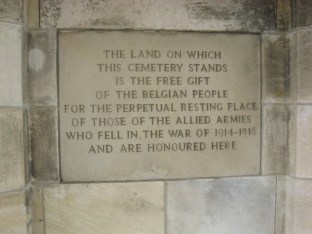
One last introductory item: from 1914 to 1917, Great Britain had command of all active troops who came from countries that had been or still were part of the British Empire. (In 1918, the five Australian army divisions were placed under their own command as the ‘Australian Corps’.) All the cemeteries and memorials associated with these countries are maintained by a body known as the Commonwealth War Graves Commission (CWGC). Other sites, including museums, are managed by individual nations. All of these sites occupy land that has been freely given by Belgium or France for the purpose.

Posted in Travel | Tagged , , , | Leave a comment

Cruising up the Rhine, part 4: trips ashore (days 6 and 7)

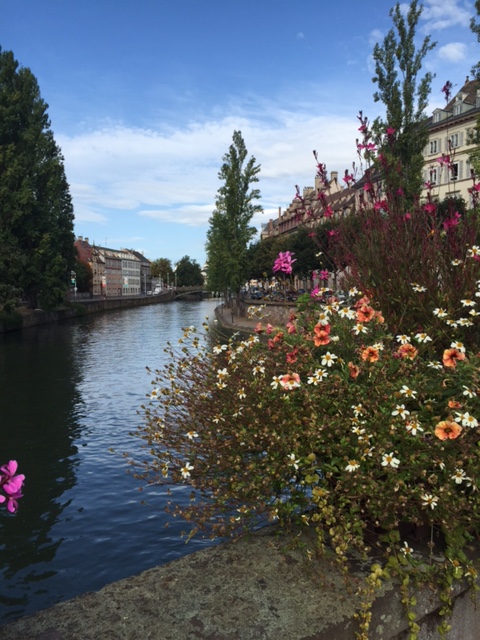
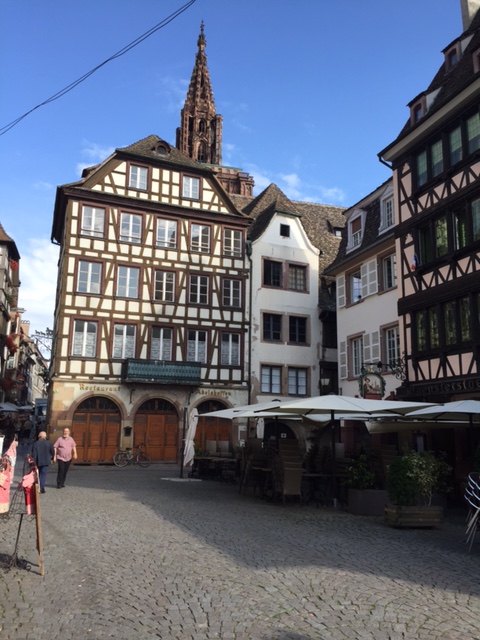
Day 6 (morning): Our ship berthed close to the German town of Kehl, on the opposite side of the Rhine to the French city of Strasbourg. The latter is best known these days as the seat of the European Parliament, which is reflected in a large number of modern public and commercial buildings. However, our excursion was all about the historical heart of the city, with its canals, medieval houses and gothic cathedral. Strasbourg is also the traditional home of the famous Schlupfkapp, the cap with the giant bow which has become a symbol of Alsace, mimicked in sculptures dotted around the old city.

img_0803      img_0817

img_0820      img_0856

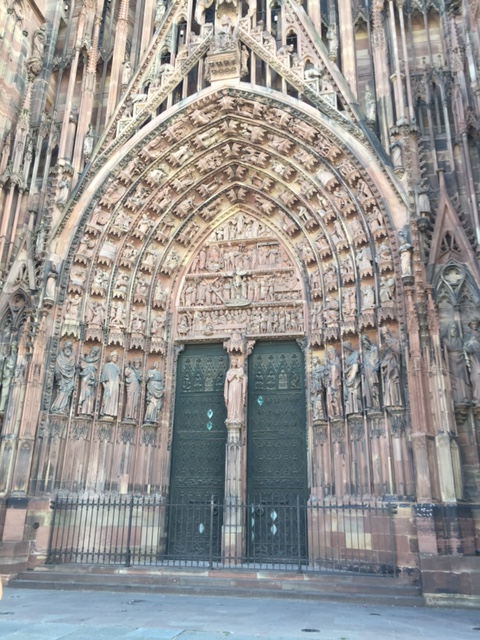
It was all very interesting and attractive but the undoubted highlight was the cathedral, predominantly Gothic in design but with a large Romanesque apse (I won’t repeat any more of the voluminous information that you can find readily online).

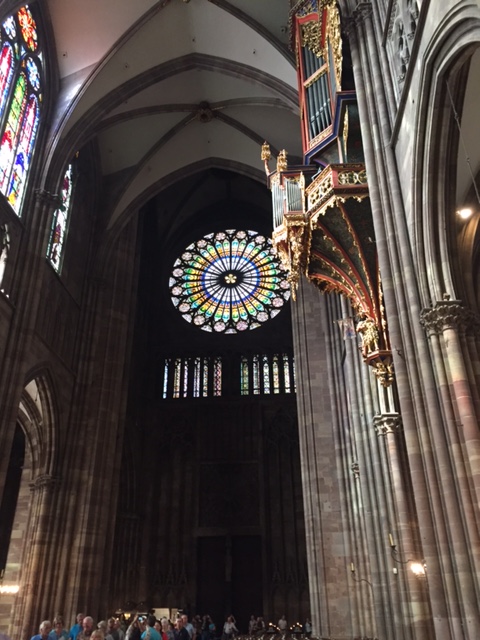
Compared to the Cologne cathedral, we found Strasbourg’s to be more attractive in both design and atmosphere, from the intricate front facade, to the organ and the astronomical clock which, conveniently, struck the hour just after we reached it.

Another striking feature was the stained glass rose window above the main entrance. As you might notice, the colours in this rose are decidedly atypical and there is no overt religious imagery. Our guide explained to us that the window had been commissioned some centuries ago by the business community to mark a denouement in their power struggle with the archbishop of the time; the colours were inspired by the agricultural base of the town’s economy. (Alas, I can find no confirmation of this online.)

img_0825

img_0831       img_0833

img_0836      img_0846

img_0852      img_0855

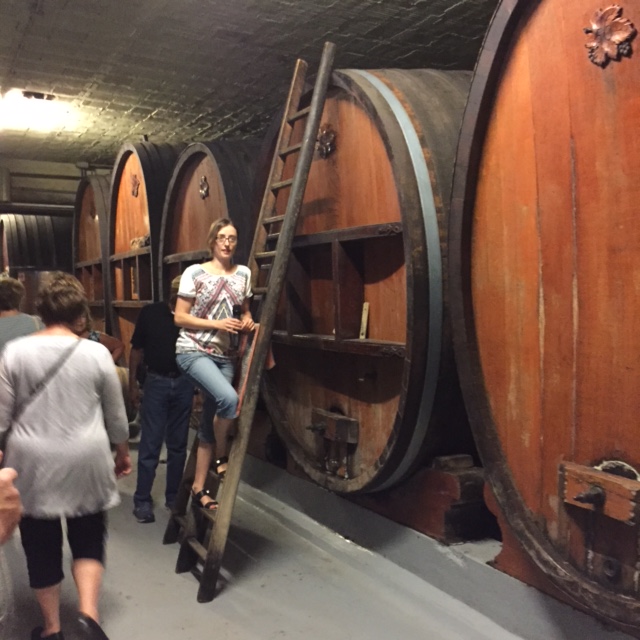
Day 6 (afternoon): The first of the optional excursions that we had booked was a drive into the heart of Alsace , including a visit to one of its numerous family-owned wineries. The youngish member of the family who hosted our visit was informative and hospitable, which helped to generate plenty of sales to our group! However, the rest of the outing was let down by the long drive through somewhat plain countryside and the fact that our guide seemed to lack the experience or presence of mind to bring the scenery to life with facts and insights.

img_0870   img_0871

img_0876

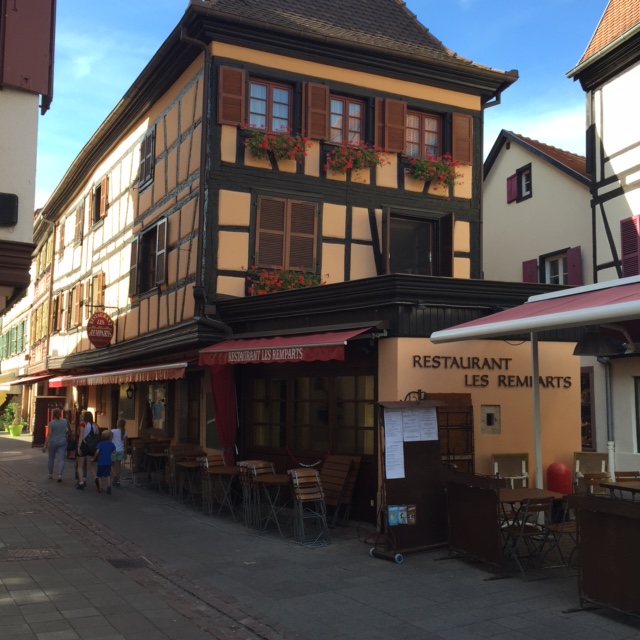
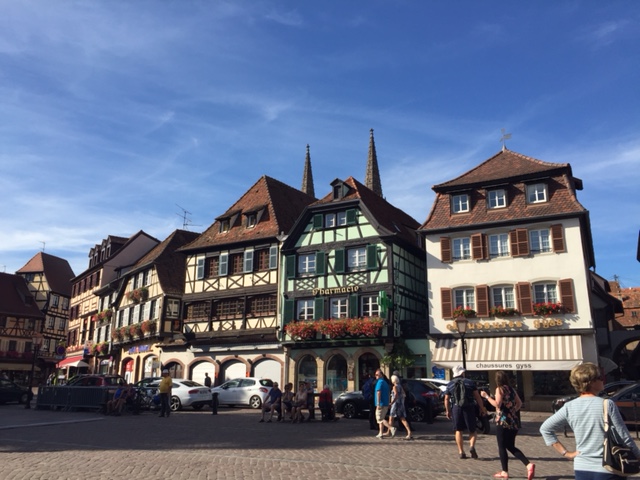
Before returning to our ship, we stopped for a pleasant exploration of the small town of Obernai, on the eastern slopes of the Vosges mountains

img_0879   img_0882

img_0887

Day 7 (morning): Like most of our fellow passengers, we had been counting down to the excursion into the Black Forest; not that we had any idea what it would be like!

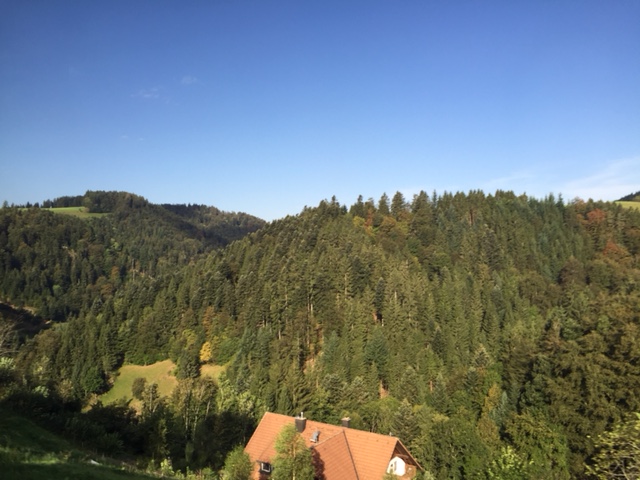
It didn’t disappoint. The trip took us through constantly changing scenes of dense forest (difficult to capture on camera while moving), farms and rolling green pastures, tiny villages, remote chapels and clear views to distant ranges. And the air was lovely and cool!

img_0892   img_0918

img_0897      img_0895

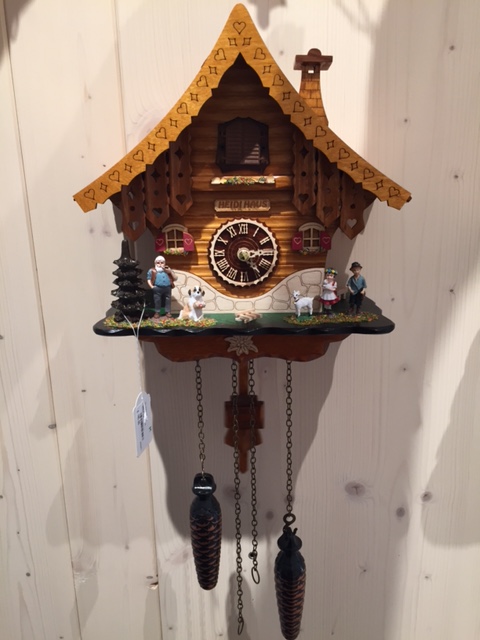
Just before 10am, we reached the small and mostly charming commercial and tourist complex of Hofgut Sternen, just in time to experience the clock chime and associated gadgetry. Here, we had several options: a guided walk into the forest; demonstrations of glass blowing and Black Forest Cake making; and a large shop specialising in cuckoo clocks. We headed to the last of these, where a brief demonstration of how the clocks are assembled put some of us in the mood for a purchase; I had not anticipated that this would include Maggie!

So, I took a deep breath and joined her in browsing, then chatting about what might suit, more browsing, comparing prices, etc, until we found a clock that had sufficient charm and practical features – battery powered and a light sensor to keep the cuckoo asleep at night – at an affordable price. That’s it, in the second line of photos. It arrived safely, just a couple of days before we returned to Melbourne and, I have to admit, it has proven to be a welcome addition to our home.

img_0928      img_0933

img_0942      img_0938

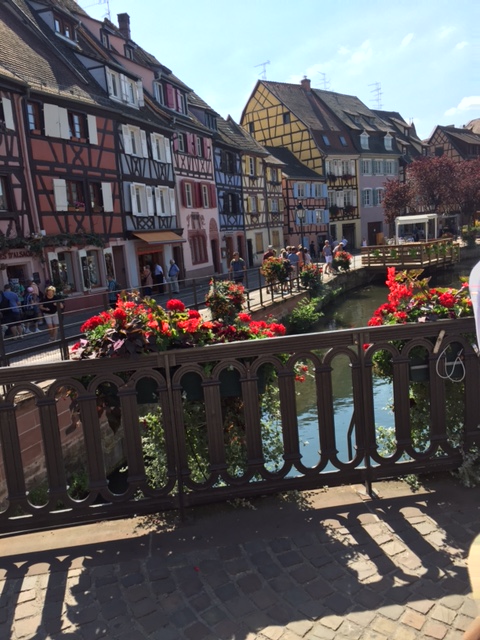
Day 7 (afternoon): Our final excursion was to the delightful and quaint town of Colmar. It is difficult to do justice, visually, to how attractive Colmar is, although it would have been easier if we had taken more photos. Unfortunately, I took the option of an extensive guided walking tour, while Maggie took a more limited option out of concern for her durability; and my tour was so engrossing and enjoyable that I didn’t stop to take any photos. So, here is a small collection that we gathered after we were reunited, as well as a link that will help you appreciate Colmar’s virtues as a place to visit.

img_0961      img_0964

img_0980      img_0988

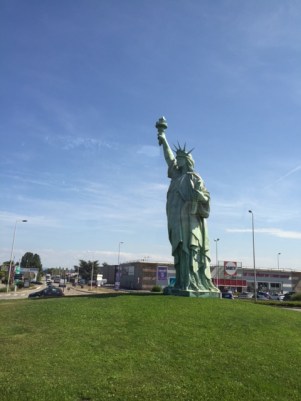
As well as Colmar’s medieval buildings and canals, it has the distinction of being the birthplace of Bartholdi, the sculptor responsible for New York’s Statue of Liberty. One of several genuine replicas of the original has been erected on the outskirts of the town and the house in which he lived as a young child is now a museum dedicated to his life and work.

The final photo is just a case of me indulging Maggie’s affection for dogs. This lucky dog spends its days accompanying its owner as he takes visitors around Colmar in his horse-drawn carriage. A magic wand in Maggie’s hand would have transported it to our place!

img_0959      img_0994


Posted in Travel | Tagged , , , , | Leave a comment

Cruising up the Rhine, part 3: trips ashore (days 1 to 5)

The top reason why Maggie and I chose to go on this cruise was the program of excursions to interesting places along the route, none of which we had visited before. There was one excursion every day covered by the cost of the cruise; in addition, we chose to pay for two of the ‘optional’ excursions that were offered.

Overall, the excursions proved to be very worthwhile, including a few that we will remember fondly for many years to come. Here, and in the following post, is a brief account of what we saw and did.

Day 1: We boarded the cruise ship in the port of Amsterdam in time for a light lunch, including some delicious smoked salmon; Norwegian, of course!

After lunch, we were invited to go on a walking tour of some of the old quarters of the city. Happily, the route didn’t duplicate any of the ground we had covered during the previous three days; besides, our experienced guide provided us with plenty of on-the-spot insights and information. (Photos from this excursion were incorporated into my previous post about our visit to Amsterdam.)

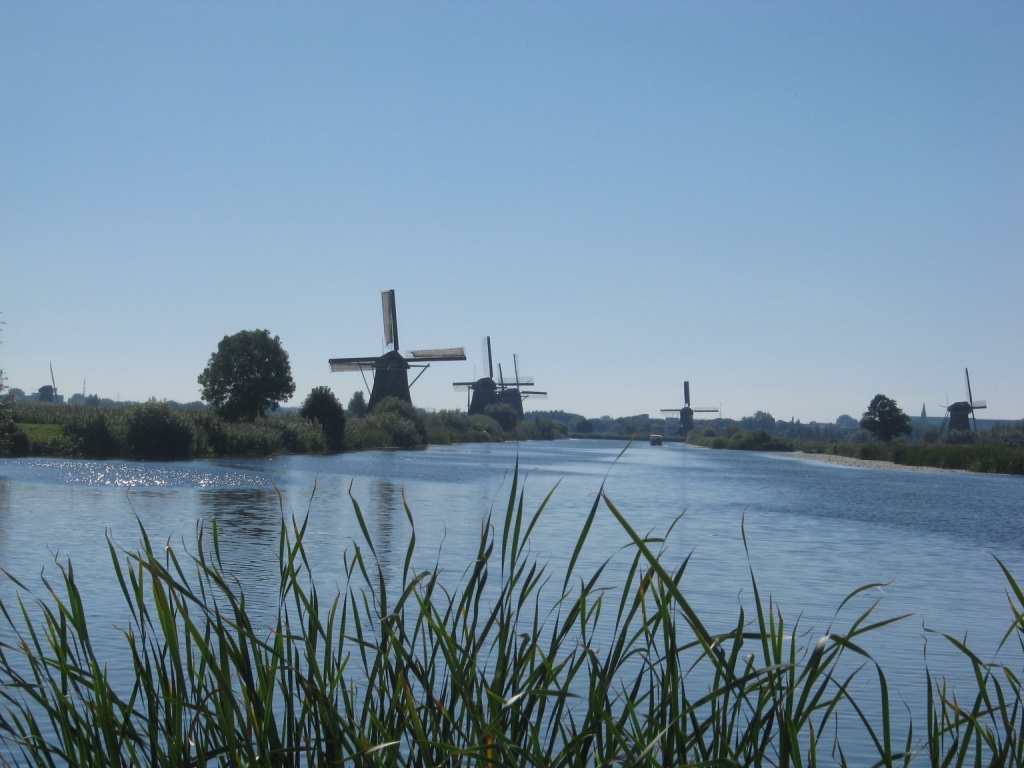
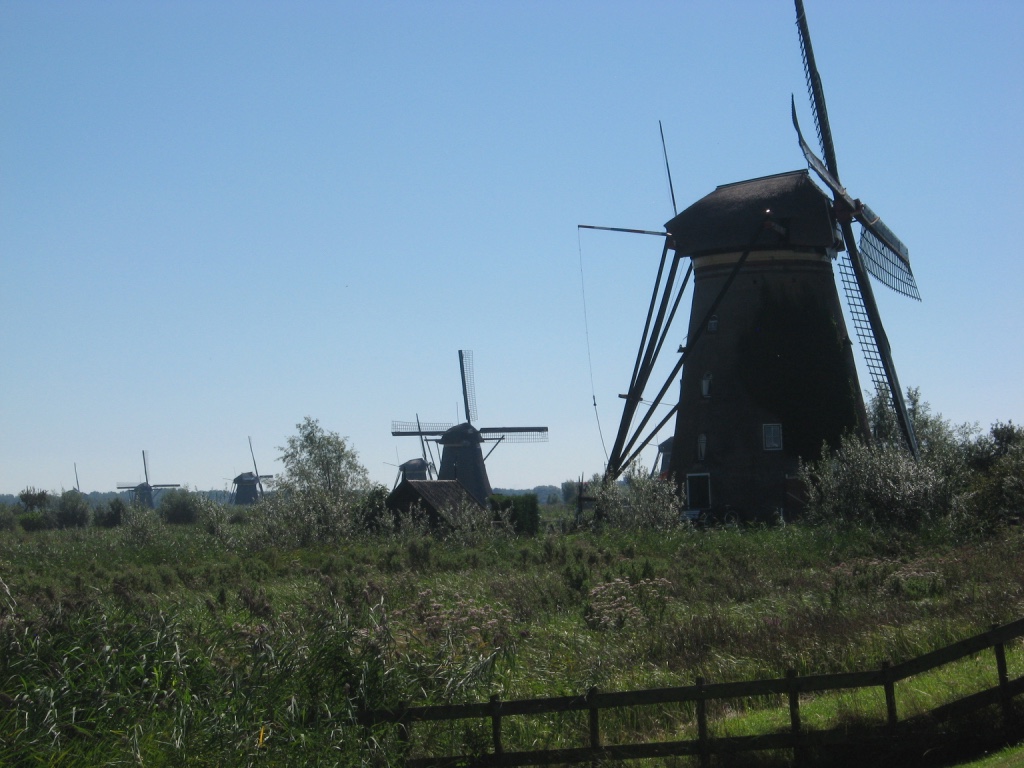
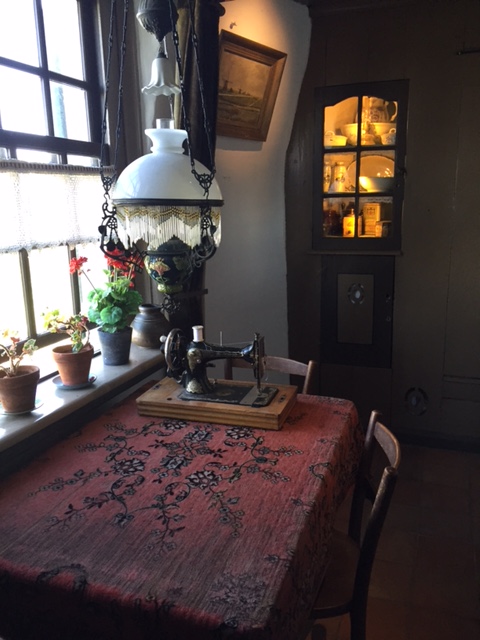
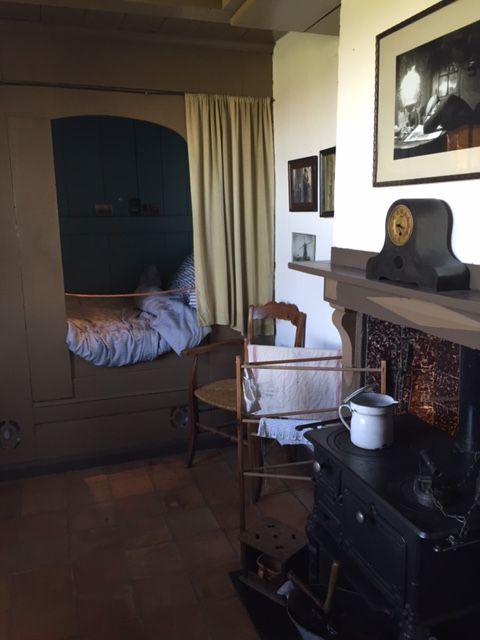
Day 2:  Next morning, we awoke to find ourselves tied up at a small dock in a canal surrounded by green countryside. After breakfast, we were arranged into half a dozen groups, each with a local guide who led us on a short walk to the World Heritage site of Kinderdijk. It is most famous for its 18th Century windmills, nineteen in all, which form part of the water management system that allows the adjoining land to be used for agriculture despite being well below sea level. The tour included a visit to one of the windmills and its cramped living quarters, as they might once have looked when occupied by a qualified mill operator’s family.

3   7

6      img_0621

img_0615      img_0617

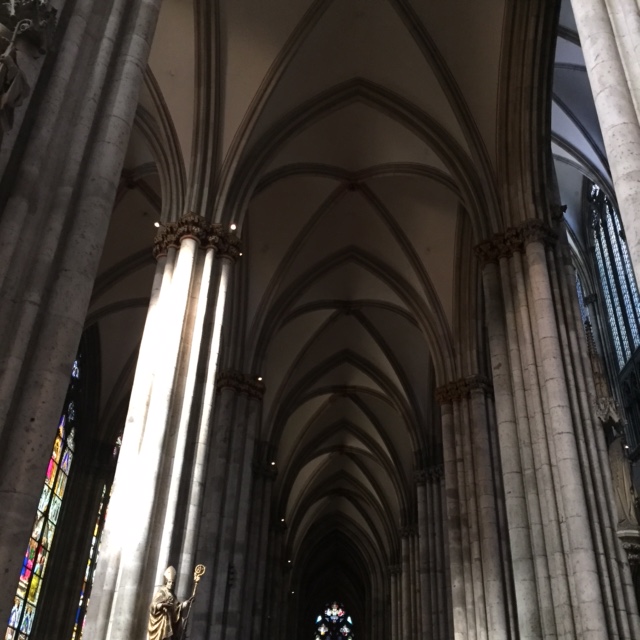
Day 3: By the next morning, we were advancing steadily up the Rhine. The ship pulled into a berth in the city of Cologne, famed for its vast Gothic cathedral. Our included tour took us to the cathedral and through sections of the attractive medieval heart of the city.

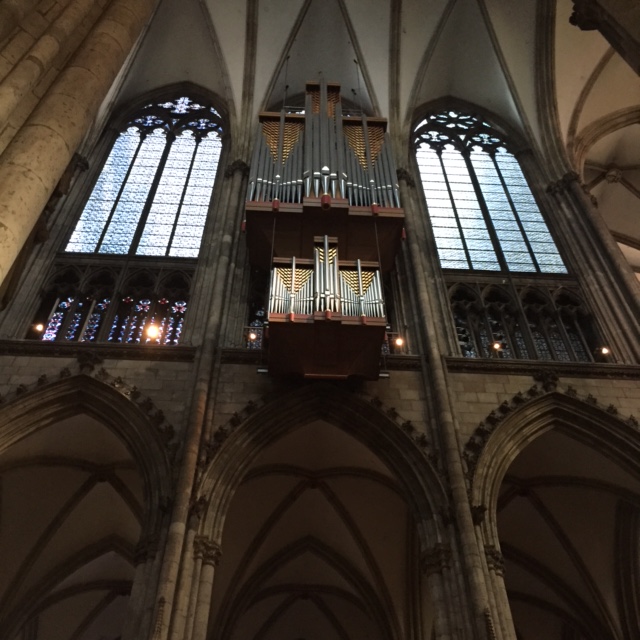
Personally, I found the scale of the cathedral to be disproportionate and unattractive; one might even say ‘intimidating’, which may well have been its design brief! However, I did appreciate two features of the inside spaces: the massive pipes of its organ, and a stained glass window which was designed by a renowned German artist, Gerhard Richter and installed in 2007.

Our photo (right, 3rd row) doesn’t even begin to do justice to Richter’s work but you can find it here, including background information. We both thought that it was intriguing and beautiful.

img_0657

img_0633   img_0634

img_0635   img_0642

img_0643   img_0645

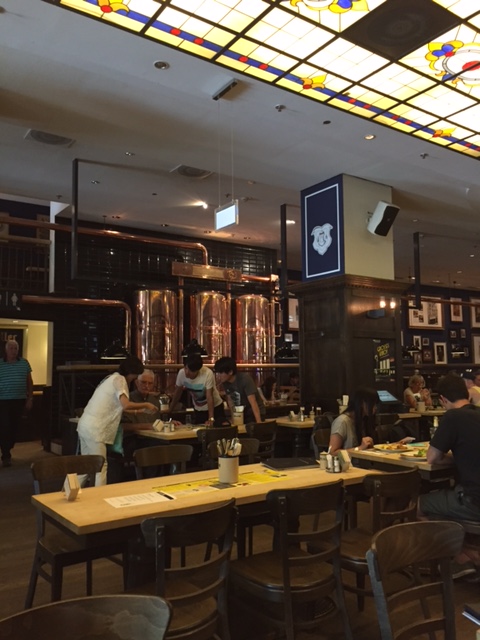
It was our third day of warm weather, pushing towards 30C. By the end of our guided tour, we were very pleased to make our way to the highly-regarded brewery and restaurant, Gaffel. After a couple of refreshing beers and a light lunch, we returned to our ship.

img_0669      img_0675

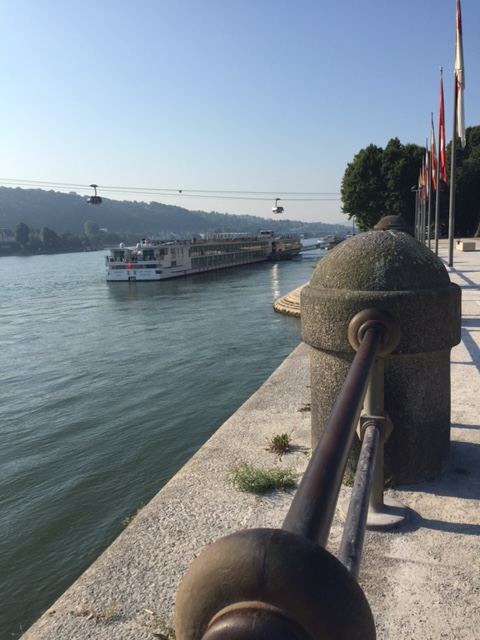
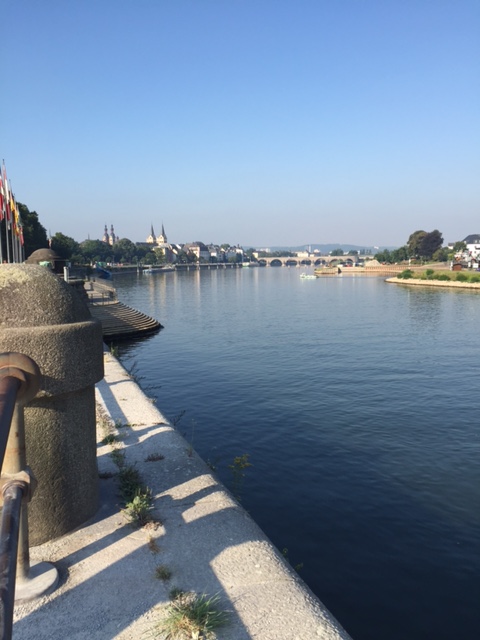
Day 4: Our ship docked at Koblenz, the German city at the junction of the Mosel and Rhine rivers; the second photo looks upstream along the Mosel, towards the steep slopes where vines produce grapes for the famous Riesling wines.

img_0686      img_0687

Most of our fellow passengers disembarked for a visit to the famous Marksburg Castle. Unfortunately, I was struggling with a lurgy, so we stayed behind, content to take a short stroll along the side of the Rhine before the ship headed on to meet our tour coaches further upstream.

img_0688      img_0692

We later learned that the excursion, while excellent, included a long walk up and down a steep path, which would have troubled Maggie’s ‘wonky’ knee, and that it had been a very warm morning, which might have been enough to finish me off!

After lunch, we enjoyed one of the advantages of touring by cruise, as our ship took us through the stretch of the river known as Rhine Gorge, famed for its castles, quaint villages and vineyards. Some photos from this ‘excursion’ appear in a previous post.

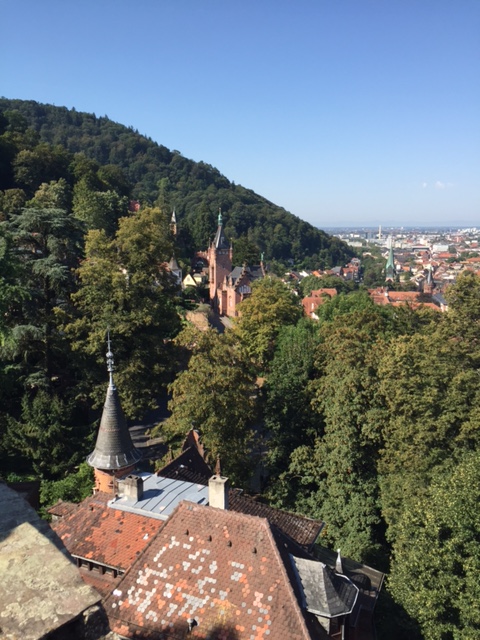
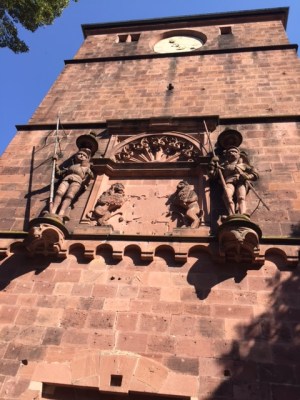
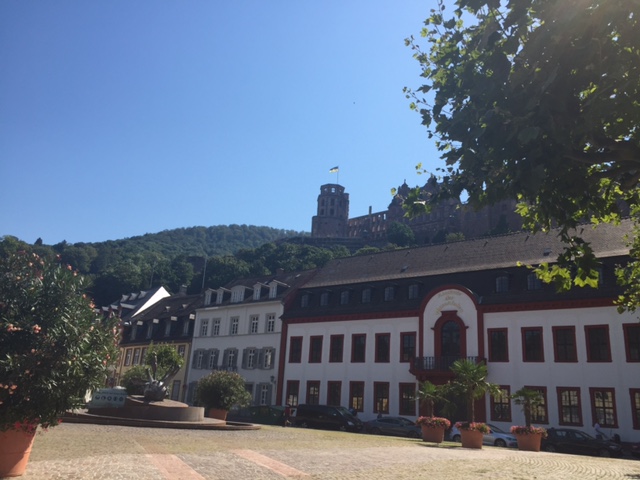
Day 5: Having missed out on the visit to Marksburg Castle, I was relieved that I was well enough to join the excursion to Heidelberg, including the spectacular ruins of Heidelberg Castle. Our guide did an excellent job of explaining the diverse elements of this massive edifice. The castle’s prominent location also yielded some delightful views of the old town below.

img_0718      img_0726

img_0730      img_0735

img_0748   img_0759

In the following post: Strasbourg, Black Forest, Colmar – all wonderful.

Posted in Travel | Tagged , , , , | Leave a comment

Fiddling produces one wonderful pot of food

pot-au-feu-2

Pot au feu – literally meaning pot on the fire – is a very traditional French dish made from beef, vegetables, a cartilaginous meat such as oxtail, water, herbs and seasoning. We’ve never made pot au feu per se, although it has some similarities to the French lamb dish that we make a few times each Spring.

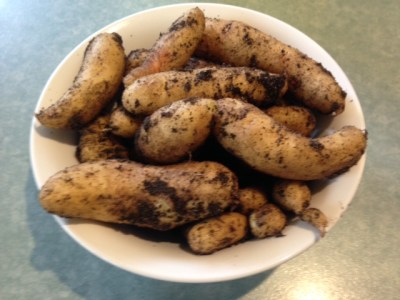
More recently, our newspaper published a recipe for what its author called ‘Spring pot au feu’. I’m not quite sure how ‘Spring’ earned a gig in the name of the dish, unless it was a nod to the small kipfler potatoes which are in season here. Here are some we grew earlier (harvested and washed just last week).

kipflers-2

kipflers-1

Anyway, semantics aside, we thought the recipe was sufficiently attractive to give it a go. You can find it here (I have no right to publish it). As we prepared the ingredients and cooked them, we made a few changes to the recipe, without losing its essence. So, for those who are interested enough to work from the original and this post, this is what we did.

  1. We used a ham hock which weighed about 1.1kg and was quite flavoursome. Some persons might have found the ham flavour in the resulting stock to be too pronounced. So, choose according to your own taste and the flavour of the hock.
  2. The type of oil is irrelevant; we used olive oil.
  3. We added 3.5 litres of water; 4 litres would have produced an insipid stock, even allowing for the fact that we simmered the hock and vegetables with the lid a little ajar.
  4. To remove the carrot and celery as stated in the recipe would be time-wasting and beyond tedious. We left them in to help build the stock’s flavour, then added fresh carrot and celery in the final stages (see step 7, below).
  5. We poached the pieces of chicken breast after we removed the hock but before we strained the cooking liquid. That saved us some further time and tedium.
  6. Once Maggie had separated all the ham meat from the hock, we placed the chicken breasts in a large bowl and covered them with the strained stock. After overnight refrigeration, we were able to remove the layer of fat from the surface of the stock and remove the breasts for Maggie to slice.
  7. After bringing the stock to a simmer, we added sections of small (Dutch) carrots, returned to the boil, added slices of celery, ditto, and finally some shredded silver beet and small kipflers, halved lengthways. (If the potatoes had not been so young and tender, we would have added them at the same time as the carrot.
  8. We didn’t need to use all of the stock to produce a dish with a pleasing balance of liquid and softish solids; there is 700ml of the stock in our freezer.
  9. We deleted the parsley and chervil. I honestly think that herbs added at the time of serving would have spoilt this delicate dish and had me reaching for more seasoning.

Here is another shot of our version of this ‘pot au feu’. To give you some idea of the size of the solids, the centre of this bowl is 18cm (7″) wide.

pot-au-feu-1

Pot au feu. Potpourri. Pretty plateful. Playful with food. Food in the belly. Pot on the fire.

Posted in Cooking | Tagged , | Leave a comment

Cruising up the Rhine, part 2: brushing through the locks

If the volume of commercial freight traffic that we passed on the Rhine River was an interesting novelty for Maggie and me, what words can I use to adequately characterise how we felt about passing through the locks on the great waterway? ‘Super novelty’?

In Australia, there is a small number of locks on a very small number of rivers, but their contemporary economic and social significance is inconsequential and few of my fellow countrymen know of their existence, let alone see any of them. And although I had some passing familiarity with the presence of locks in Europe as a result of long-ago school studies in geography and history, neither of us had envisaged actually meeting one face-to-face; and I mean literally!

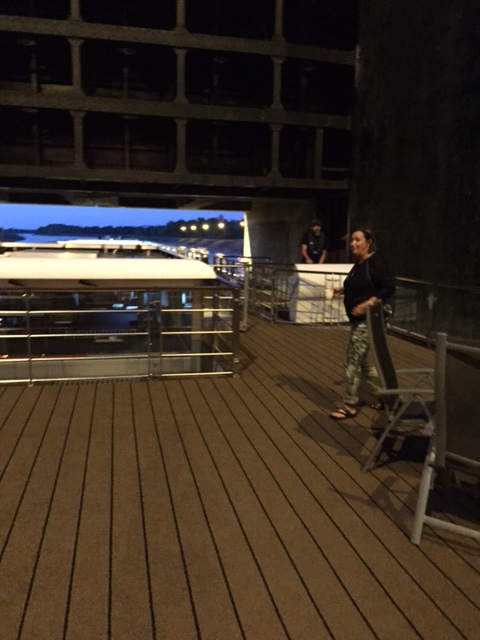
Our first encounter with a lock occurred in the middle of a night, about half way through the cruise. I woke up for a comfort stop and realised that it was very dark outside; ie no moonlight or riverside lighting. When I pulled back the curtain, I found what I slowly recognised to be a concrete wall, only a few centimetres beyond our balcony. When I roused Maggie to join me, she confirmed that, yes, the wall was within arm’s reach, it was damp, even slippery, and the ship was moving up the wall. We were in a lock!

In the following days, the cruise took us further up-river, towards our destination in Switzerland, and the sea-level of the surrounding terrain increased at a progressively faster rate. That meant we would be passing through locks more often. Usually this was scheduled to occur when most of us were fast asleep, so, when the ship’s captain let it be known that we would reach a lock at about 9.30 to 10.00pm on our second-last night, there was a buzz of excitement in the dining room.

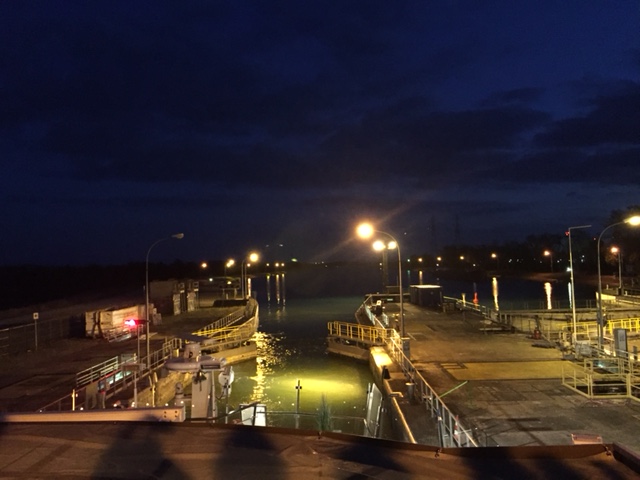
Having also been told that there would be an earlier opportunity on the final evening, Maggie and I  opted to go to bed. Which was just as well – there was a long delay and few, if any, passengers witnessed it. However, we were all on hand for the following evening’s event and that is the one captured in the following photos.

img_1021      img_1020

These three pairs of pics show the ship approaching the lock’s entrance and then within the lock, before the rear gates were shut. Note that the ship’s bridge has been lowered to allow the ship to enter the lock, that the ship is being controlled from a panel set up on the port side and that the captain is keeping an eye on proceedings from a secondary station on the starboard side.

img_1023      img_1024

img_1027      img_1026

The next two images show the height to be reached by the water as it fills the lock – the top of the dark grey section – and some of the mould growing on the wall as a result of being damp most of the time.

img_1030      img_1031

The next four pics capture the gradual rise in the water level, with the ship pointing towards the exit gates.

img_1028      img_1032

img_1034      img_1035

Finally, the water in the lock reaches the level of the next upstream section of the river and the gates to open to allow the ship to leave the lock.

img_1037

img_1038

The whole process took between about 40-to-45 minutes and, as you might gather, we we were very much in its thrall!

Posted in Travel | Tagged , , | Leave a comment

Cruising up the Rhine, part 1: on board

It is unlikely that Maggie and I will become ‘frequent cruisers’. Money, or the lack thereof, is one reason; ship-based touring is expensive! And we’re not the ‘boating’ type of person; not sure what that is but I do know that we’re prone to ‘cabin fever’.

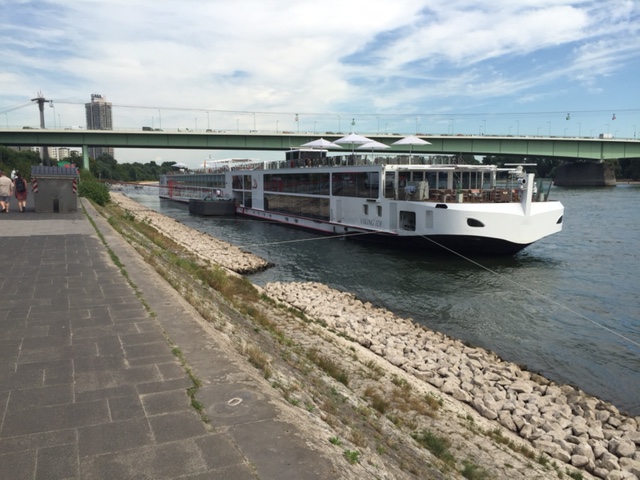
That said, we do match key elements of the profile for the majority of river-cruise customers – our age (not too young but not too old, yet); easily tempted by a copious supply of food and beverages; willingness to meet and converse with fellow travellers; and enthusiasm for a well-constructed itinerary of quality sights and experiences. So, we went ahead – twelve months ahead, in fact – and booked a 7-night voyage from Amsterdam to Basel with Viking Cruises.

For those who are interested, here is my account of what it was like, told over four short posts, including one post devoted to the unanticipated entertainment value of passing through the locks on the Rhine River.

img_0678   img_0682

The river-cruise ships are designed to be just slim enough to pass through the locks; more of that anon. That’s our cabin, top-right, with the deck, chairs and table. An unseasonal heatwave kept us from extended time hanging out on the deck most afternoons; ditto for the rear deck off the lounge and the sun deck on top of the ship.

(I’m kicking myself that I don’t have a photo of the inside of our cabin. It was attractive, comfortable and designed very cleverly to make a small space feel uncrowded.)

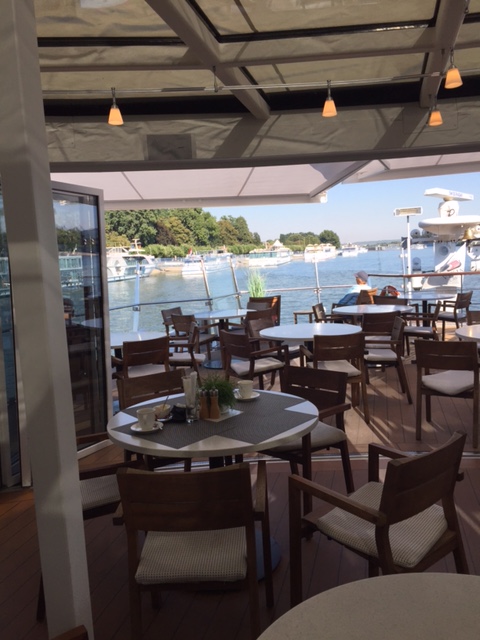
The team in the spotless kitchen did a good job but the reality is that, when catering for 186 passengers with a three-course menu, it is difficult to produce food to a consistently high standard, ie how it looks in the promotional bumf! However, we were well fed and the wines were excellent.

img_0711      img_0798

Here is Maggie with ‘JP’, a Texan who was the ship’s Program Director. He and his team delivered a very enjoyable program of on-board entertainment and shore-based sightseeing. At 186, the group of travellers was not at all overwhelming and it was usually easy to find a variety of people to chat with over lunch or a pre-dinner drink. We soon found four buddies – two couples from Florida – to make up a table of six for dinner each evening.

img_0788      img_0790

img_0792

One reason why we were attracted to this particular cruise was the opportunity to take in the sights along the banks of the Rhine River – pretty towns and villages, steep vineyards and castles. There were lots of castles, oh yes!

I am sorry that we didn’t capture any images of another sight which made an impression on us – the high volume of commercial freight using the river, both containerised and piled, eg raw materials. I guess that is a common enough item for residents of the northern hemisphere but it was quite a novelty for we Australians.

9   10

12   20

21   18

img_0704

Posted in Travel | Tagged , | Leave a comment