Our itinerary

At 9.30pm on Thursday night, Melbourne time, Maggie and I will hop into a private taxi and begin our latest travel adventure.  At around 9.30pm on Friday night, Paris time, we will arrive at our hotel in Le Marais district.

Here is a brief outline of what we will be doing over the following 31 days.

We will be in Paris for just three nights and two days.  We have had two previous extended visits to Paris but we have drawn up a short list of new experiences, as well as a repeat restaurant experience and a repeat visit to a Fragonard shop to replenish Maggie’s supply of her favourite perfume.

On the third morning, we will board a very fast train at Gare du Lyon, bound for Dijon, the capital of Bourgogne (Burgundy).  We have booked a rental car and will spend five days exploring this famous region, spending three nights in Beaune and two in Dijon.

Another train journey will take us to Salzburg, via Zurich.  After three nights in this beautiful city, famed as the childhood home of Mozart, we will hire another car and drive slowly to Vienna through some of the beautiful Austrian countryside, including the Vienna Woods.

We will devote the next four evenings and three days to exploring the many and varied delights of Vienna before we make our way to Vienna Airport to connect with our land transfer to Budapest for the beginning of the Insight Vacations Tour “Highlights of Central & Eastern Europe”

The tours itinerary is built around two nights in each of Budapest, Krakow, Warsaw, Berlin and Prague, one night in Cesky Krumlov and two nights in Vienna.  (Our independent time in Vienna will take account of what we will visit and experience on the Insight tour.)

I won’t take up time and space now with the details of the tour of Central & Eastern Europe, as I will be posting regular stories and some photos as we go.  I trust that you will enjoy them.

When the tour is completed, we will spend a further day in Vienna before flying to Dubai for a 48 hour stopover, before flying home to Melbourne, arriving early on the morning of 27 May.

← Back

Thank you for your response. ✨

Posted in Travel | Tagged , , , , , , | 2 Comments

Poulterer’s Pie

For this dish, we have overhauled an on-line recipe for chicken pot pies with puff pastry lids, ditched the pastry and added a layer of mashed potato as in the well-known Shepherd’s Pie. The result is very tasty and reheats well. You could also drop the mashed potato and serve it as a casserole with a medley of steamed or boiled vegetables.

Ingredients

50g butter
200g small Swiss Brown mushrooms, thinly sliced (2-3mm)
3 long rashers bacon, trimmed and coarsely chopped
600g chicken thigh fillets, chopped
1-2 leeks, white part only, halved lengthways and thinly sliced (vary quantity of leek depending on size and your own taste)
30ml plain flour
250-300ml chicken stock
60ml cooking cream
2 tsp Dijon mustard
2 tsp fresh thyme leaves OR 1 tsp chopped fresh tarragon leaves
freshly ground black pepper
400g mashing potatoes, eg Dutch Cream
extra butter, milk and sour cream

Method

  1. Melt 30g of the butter in a non-stick pan over medium heat. Add the mushroom slices and sauté for 6-8 minutes until they have just begun to caramelise. (To start, I put a lid loosely on the pan for a couple of minutes to help soften the mushrooms using their own steam; otherwise, it seems that you need to add more butter to the pan.) Remove mushroom slices and set aside in a large bowl or deep plate.
  2. Add bacon to the pan and cook, stirring, for 3-4 minutes until cooked through but not browned. Add to the mushrooms. Add 10g of butter to the pan and cook the chopped chicken in 2 or 3 batches – to prevent stewing the meat – until lightly browned all over. Add to the mushrooms and bacon.
  3. Melt remaining butter, add leek and sauté for 5 minutes until leek softens; add resting juices from other ingredients if pan is a little dry. As the leek cooks, it will loosen and incorporate the caramelised bits from the base of the pan.
  4. Return bacon, mushroom and chicken to the pan over medium heat, add flour and cook for 1 minute. Add 250ml of the stock, bring to the boil then simmer for 5 minutes until the sauce thickens. Add cream, mustard, thyme and a generous grind of pepper then cook for a further two minutes, adding extra stock if the sauce is too thick. Remove from the heat and tip into a ceramic or glass baking dish no smaller than 20cm x 20cm (or an equivalent rectangular dish).
  5. Preheat oven to 150C.
  6. Prepare potato mash by peeling the potatoes and cutting them into chunks. Add potato chunks to a saucepan, cover with plenty of salted cold water, bring to the boil and simmer for about 15 minutes or just tender. Drain well and mash with a little butter, sour cream and milk, sufficient to produce a smooth but firm consistency.
  7. Spread mash over chicken mixture, gently furrow the surface with a fork and bake in the oven for about 25 minutes until the chicken mix is heated through and bubbling around the edges.
  8. We served the pie with some fresh peas and some Dutch carrots.

← Back

Thank you for your response. ✨

Posted in Cooking | Tagged , , | Leave a comment

A fresh apple cake

A few posts back, I mentioned that I would be baking an apple cake; this would provide morning tea for Maggie at work, including some pieces for her immediate colleagues, and for me to snack on in the days leading up to our departure for Paris.

There are three cakes in our repertoire which feature apple.  One is the dessert-style apple torte which was part of the dinner at which we celebrated my 60th birthday.  Another is a lunch-box cake full of apple, walnuts and dried apricots, with olive oil replacing butter; the recipe is provided in an old post “A delicious apple cake”.

Here is recipe for the third cake, similar in style to a tea-cake.  We made it on Sunday afternoon – very moreish!

Ingredients

3 medium-sized cooking apples (Golden Delicious preferred when in season)
2 tbsp brandy
1 tsp caster sugar
¼-½ cup dried fruit, roughly chopped, eg sultanas, currants, raisins (optional)
140g butter
120g raw sugar
3 eggs
160g plain flour
1 tsp baking powder
2 tsp ground cinnamon/mixed spice/ginger (vary according to taste)
50g almond flakes, lightly toasted

Method

  1. Core, peel and chop apple (approx 1-2cm cubes), mix with caster sugar, dried fruit and brandy and steep for 30 minutes, stirring two or three times.
  2. Grease a 21-28cm round springform cake tin and line base with baking paper.
  3. Melt butter over low heat and allow to cool partly. Preheat oven to 170C.
  4. Beat eggs and raw sugar in a large bowl until thick (5 minutes on medium speed).
  5. Mix flour, baking powder and spices and fold into mixture.
  6. Drizzle in melted butter then fold it in.
  7. Use a spoon to fold in the almond flakes, then the apple mix, including any juice.
  8. Spoon into tin and bake for about 35 minutes or until cake is golden brown and tests clean.

← Back

Thank you for your response. ✨

Posted in Cooking | Tagged , , , | Leave a comment

Love that duck!

We are a little obsessed about duck, forever tracking down suppliers of quality fresh duck, looking for new duck recipes, reflecting on our palate experiences and tweaking our established duck repertoire.

However, one particular duck recipe has met our exacting standards for over four years and become our favourite dish.  Period!  Despite Maggie’s addiction to red meat. Surviving the year we cooked our way through a calf.  Beyond even the greatest that can be achieved on our Weber Q.

It began as a Terry Durack recipe from the Good Weekend section of The Age, was promptly modified to suit our pantry and palates and has since undergone further changes to generate maximum satisfaction.

We appreciate that many people who like to eat duck are a bit tentative about cooking with it.  So, in the recipe that follows, I will try give you enough information to help you achieve a delicious result. The recipe should be sufficient to be divided between four dinner plates; we cook two breasts and have enough food for dinner each plus a workday-lunch for Maggie.

Duck breasts with piquant sauce and brown rice

Before you begin, put a richly-flavoured chardonnay in the fridge so it is ready to be the companion wine at dinner time.  (If you would prefer a red, you could turn to some pinot noir but this is one duck dish that goes better with a well-chosen chardonnay.)

Ingredients

200g uncooked brown rice
1 tbsp butter
2 tbsp finely chopped herbs (chives plus some parsley, thyme and sage)
salt and pepper
3 duck breasts (see note below)
1 tbsp each of brandy and Cointreau or 2 tbsp cumquat-infused brandy (see note below)
200-250ml chicken stock
3 tsp green peppercorns (see note below)
3 tsp Dijon mustard
60-80ml cream

Notes: Some suppliers leave the wing attached to the breast; this needs to be removed. We make our own cumquat-infused brandy by making brandied cumquats then discarding the fruit.  We use green peppercorns that come from France preserved in a brine in a small tin; you must drain the peppercorns on some paper towel before use.

Method

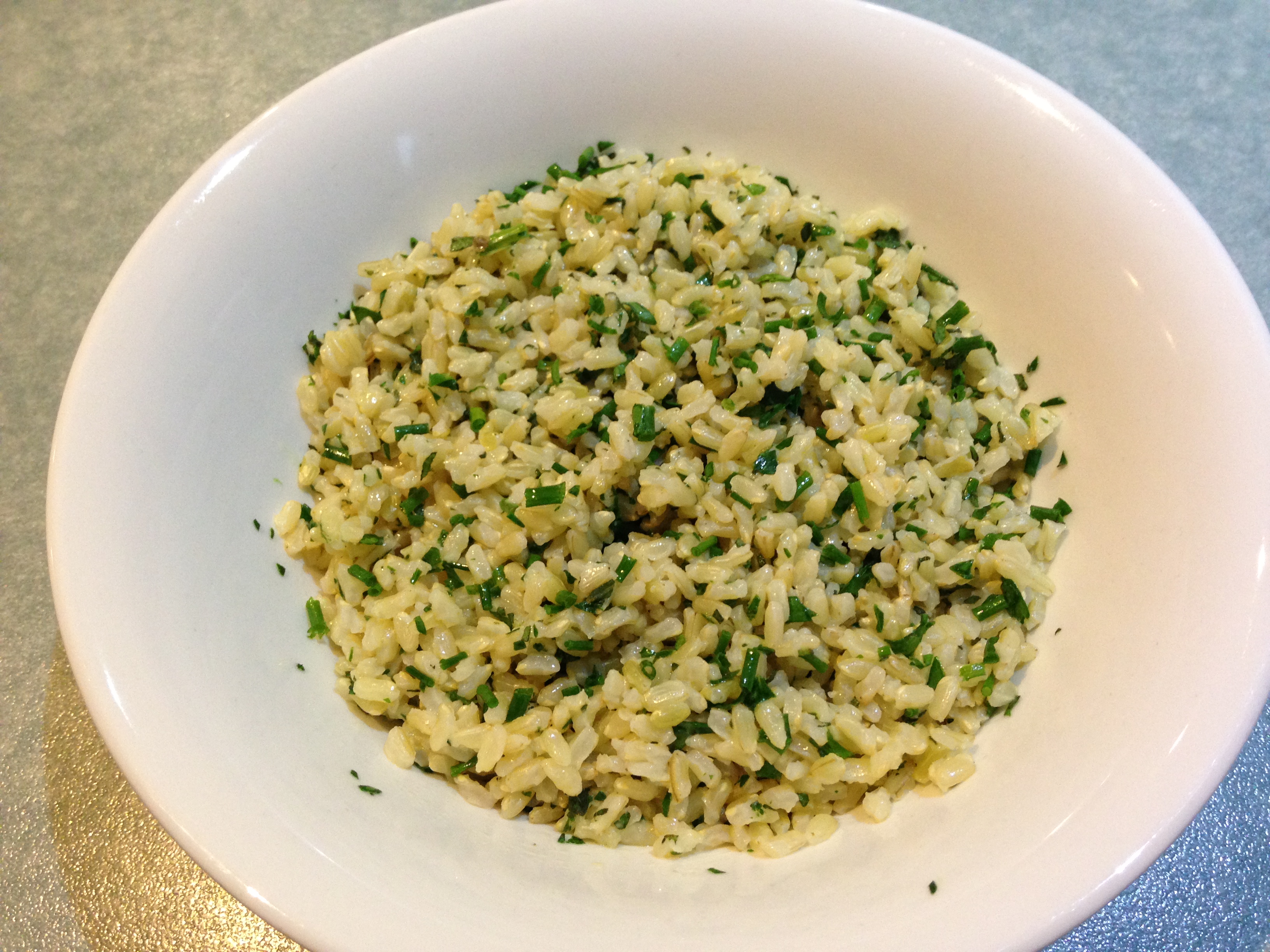
  1. Cook the rice in plenty of simmering, well-salted water until very tender (about 32 minutes) (we also add 2 tsp of chicken stock powder to enhance the flavour). Drain the rice and toss with butter, herbs and some freshly-ground black pepper; adjust seasoning and set aside to be served warm but not hot.
  2. Meanwhile, score the skin of the duck breast lightly in a 1cm criss-cross pattern on the diagonal.  Warm a large, heavy-based non-stick pan over medium-high heat.  When the pan is hot, place the breasts skin-side down and cook for 8 minutes or until the skin is crisp and golden.  (You might need to use a non-metallic egg-lifter to separate the skin from the pan surface and you will need a spatter mat to stem the spread of duck fat over your cooktop!)
  3. Turn and cook the breasts on the skin side for 3 minutes, leaving the duck still pink in the middle.
  4. Remove the duck breasts and allow to rest on a dish in a 75C oven.  If the breasts are especially thick (I can’t be more specific than that, sorry), have the oven at 100C.
  5. To make a sauce, tip the rendered duck fat out of the pan then use a fork or spoon to return any caramelised goodies to the pan.  (The excess duck fat can be stored in the freezer for use when roasting potatoes, etc.)
  6. Add the brandy and 200ml of stock to the pan and simmer to reduce until syrupy. Reduce the heat to low, add the peppercorns, mustard and 60ml of cream and gently stir until smooth and thick.  Add the resting juices from the duck then add extra stock or cream to suit your palate.
  7. To serve, slice the duck on an angle, divide the rice between three or four plates and form it into low mounds, place duck slices on top of the rice and spoon over the sauce.(We end up with a main meal to suit each of our appetites, a leftover lunch for Maggie and a snack for me.)

Duck breast 1   Duck breast 3

Duck breast 4   Duck breast 2

Duck breast 5   Duck breast 6

Posted in Cooking | Tagged , , , | Leave a comment

A peach of a dish

Since May 2013, we have been making extensive use of My Umbrian Kitchen by Patrizia Simone.  (Patrizia is famous in Victoria for the restaurant she and her husband established in the country town of Bright, in the north-east of our state; they had migrated from the Italian region of Umbria early in their married life.)

We purchased this lovely book at a Mothers Day luncheon that featured three courses of food prepared according to some of Patrizia’s recipes. To date, we have used more than a dozen of the recipes in the book, including three dishes which featured rabbit, trout and quail, respectively, all boned by Maggie.

As a cookbook, My Umbrian Kitchen is the best match for our tastes and cooking ambitions that we have ever discovered.  It is also beautifully presented.

Many of Patrizia’s recipes are overtly seasonal – she is renowned for using local produce in season – so we had to be patient as the year passed from autumn, through winter and spring and then, towards the end of summer, arriving at the best time for peaches.  All for the sake of using her recipe for grilled spatchcock and peaches.

We have modified the recipe twice – to the marinade, judging by our palates, and to the cooking process, based on experience.  Our version follows.  The recipe assumes that you have access to a barbecue that can also function effectively as an oven.  If not, use a grill pan then your kitchen oven.

Ingredients

2 spatchcocks (aka poussin) weighing 500-600g
1 red chilli, finely chopped (or a generous pinch of chilli flakes)
2 cloves garlic, finely chopped
6 sage leaves, finely chopped
2 tsp finely chopped parsley
1/2 tsp fennel seeds
1/2 tsp sugar
juice of half a lemon
up to 1 tbsp olive oil
3 ripe freestone yellow peaches, pitted and halved
a vinaigrette dressing, to serve

Method

  1. Using kitchen scissors, split each spatchcock down the backbone and flatten it open.  Cut away the tips from the wings, then use a sharp knife to slash each leg at its thickest part to allow the heat to penetrate when cooking.
  2. Make a marinade by combining the chilli, garlic, sage, parsley, fennel seeds, sugar, lemon juice and some of the olive oil; add extra sugar, lemon juice or oil to balance the marinade to your taste.
  3. Rub the spatchcocks with the marinade and refrigerate, covered, for a few hours, turning them occasionally.  Remove from the fridge at least 45 minutes before cooking.
  4. Heat the barbecue grill plate until hot.To grill the peaches, cook them for 3 minutes on their skins then four minutes on their flesh; remove and reserve for step 6 below.   To grill the spatchcock, cook them for 10 minutes on the underside then 7 minutes on their skins.
  5. Are you with me?
  6. Reduce the heat to roast at about 180C.  Roast the spatchcock and peaches for about 20 minutes or until the juices run clear when you pierce the thickest part of the leg with a skewer.
  7. To serve, divide the spatchcock and peaches between two plates (or four as an entree) and drizzle with some dressing.  A simple green salad, eg mesclun leaves and cucumber, would go well, especially if you mix them on the plate with all the juices.

We made this twice more while peaches were in season and we can hardly wait for the next season (which we did and made it the main course of Christmas Day lunch 2014).

Spatchcock marinating - herb it up!

Spatchcock marinating – herb it up!

Roasting completed

Roasting completed

A mouth-watering platter

A mouth-watering platter

Posted in Cooking | Tagged , , , | Leave a comment

At last, a visual!

To date, this blog has comprised words, words and more words – thousands of them!

In my defence, it used to be possible to follow a link from one of my old posts to several photo albums relating to our first two trips to Europe – Italy in September 2008 and France, for  our first white Christmas, in December 2009.  However, by the time I revived my blog earlier this year, that link was no longer functional, ie the photos are lost in cyber space!

So, by way of restoring the balance, here are two images for the Parisian restaurant at which we will be dining on the evening of 27 April.  Suddenly, I feel hungry!

image001 image002

← Back

Thank you for your response. ✨

Posted in Cooking, Eating out, Travel | Leave a comment

Another Saturday afternoon in the kitchen

We were supposed to be going to a 21st birthday party last Saturday night.  However, we are not party animals, unless it is a party involving three or four courses of delicious food, up to six guests and several bottles of wine and San Pellegrino!  Besides, I had been through a tough week of looking after family members, so we chose to stay home.

In lieu of attending the party, Maggie called in mid-morning to catch up with Nicole, a daughter of one of her cousins, admire her party finery, enjoy a chat and giver her a hug and a kiss from both us.  On her way home, Maggie dropped in to our butcher and came out with the pieces of pork belly and Scotch fillet of beef foreshadowed in the previous post, as well as some bacon for the chicken pies we plan to make later in the week.

The beef was set aside for Sunday and the pork was placed flesh-side down in a marinade with Chinese flavourings to be roasted in the Weber on Monday evening.  (Let me know if you would like the recipe for the marinade.)

Meanwhile, we had thawed some pieces of raw Atlantic salmon and some escallops of veal.  The salmon was destined for a pie that would do me for lunch and general grazing over the following days; the veal would be the basis of some veal parmigiana.

Before we prepared these savoury items, we cooked a batch of toasted muesli (or granola, depending on where you live). The recipe for the toasted muesli is nothing special – there are any number of recipes at least as adequate as the dated one I use – so I won’t take up time and space adding it to this post.  I also make a raw muesli, including dried fruit; for breakfast, I combine equal quantities of the two with some milk and, occasionally, some yoghurt.  Yes, I should include the latter more often!

Next it was time to prepare the savoury items.  (In truth, we first took a break to watch some of the highlights of Day 2 of the US Masters at Augusta, accompanied by a glass each of a Chardonnay from Chile.)

Much as fresh Atlantic salmon provides high-value nutrition, it can become a tad boring if you only have one or two ways of preparing it. This recipe began as one for salmon croquettes (rissoles) published many years ago by a Tasmanian salmon producer.  By reducing the quantity of  breadcrumbs by half and adding an extra egg, we converted it into the filling for a very tasty pie made using fillo pastry.

Atlantic salmon pie

Ingredients

20g butter
½ cup chopped spring onions
1-2 sticks celery, finely chopped
500g of salmon fillet (no skin or bone), coarsely chopped into ½cm cubes
3 tbsp finely chopped parsley (a small amount of dill could be included)
3/4 cup fresh breadcrumbs
2 large eggs
3/4 tsp sea salt flakes
½ tsp black pepper
1 tbsp Dijon mustard
½ tsp Tabasco sauce
zest of a whole lemon or 2 tsp finely chopped rind of preserved lemon
packet of fillo pastry sheets
olive oil

Method

  1. Melt butter in a medium-sized pan, add spring onions and celery and sauté gently for about 8 minutes or until softened. Transfer to a large mixing bowl and allow to cool briefly.
  2. Add salmon, breadcrumbs, parsley and lemon and mix well.
  3. Place the eggs, salt, pepper, mustard and Tabasco in a small bowl and beat to combine. Add to salmon mix, stir and then use a spoon to combine thoroughly.
  4. The baking dish will need to be at least 20cm x 20cm in size and 8cm deep.  Lay a sheet of fillo over the bottom and up the two longer or opposite sides. If the sheet is too big, you can either fold it to fit or trim it roughly with kitchen scissors. Using a pastry brush, lightly grease the sheet with some olive oil. Repeat until you have 6 to 8 layers.  (You can use a spray can of olive oil rather than a brush.)
  5. Spread the salmon mixture evenly over the fillo. Top with another 4 to 6 layers of fillo, oiling each sheet lightly. Oil the top sheet a bit more generously.
  6. Place the baking dish in a cold oven, bring the heat up to 150-160C and bake for a further 25-30 minutes or until the top sheet fillo is honey brown.  (This technique ensures that the filling cooks through without overcooking the pastry.)

Veal parmigiana

Sometime early in 2012, we were browsing The Australian Women’s Weekly Great Cooking Classics cookbook. One of several recipes that caught our attention was for Veal parmigiana. The recipe included the somewhat elaborate preparation of a tomato sauce. We decided to replace this with Maggie’s homemade sauce (see below), to which we added some of the basil-in-olive-oil that we store in our freezer. We have made other modifications but we are indebted to the original recipe.

The quality of the veal is critical to how much you will enjoy it.  If not satisfied, shop around until you find a butcher who can help deliver a good result consistently.  I’ve just had some leftovers from what we prepared on Saturday and I’m already looking forward to coming home from Europe and making it again!

Ingredients

We use enough veal to yield dinner for a middle-aged couple plus lunch for a middle-aged woman. Younger adults will need a good deal more!

1 cup tomato sauce
250g veal escallops
salt and black pepper
plain flour
1 egg, beaten
breadcrumbs, 50:50 fresh and packet
olive oil
100g grated mozzarella
a few basil leaves, chopped
50g grated pecorino

Method

  1. To make the tomato sauce, Maggie peels some ripe tomatoes, chops them coarsely and adds them to a saucepan with a little butter, salt, pepper and sugar (quantities determined by trial and error, apologies for the imprecision).  She brings the tomatoes to the boil and then simmers them until the volume is reduced by at least one third.
  2. Cover veal with cling wrap and use a rolling pin or similar to pound it thin. Cut veal into pieces about 12-15cm long. Season pieces of veal well on both sides then toss them in a some flour and shake off the excess.
  3. Dip veal in egg then coat with breadcrumbs. Refrigerate for about 15 minutes.
  4. Heat some olive oil in a non-stick pan over medium heat. Cook veal in pan until just golden on both sides. Drain on paper towel to remove excess oil.
  5. Place the veal in an ovenproof dish, sprinkle mozzarella evenly over the meat. Stir basil leaves in tomato sauce and pour over veal, then sprinkle evenly with pecorino.
  6. Place dish in an oven pre-heated to 170C and bake for 20-25 minutes or until pecorino is golden brown.

We serve the veal with wilted green leaves or a green salad.

Posted in Cooking | Tagged , , , | Leave a comment

Pre-flight victuals

We spent some happy hours in the kitchen yesterday, producing a chicken, leek and noodle soup; some cooked down tomatoes; a bowl of creamy spinach; and, for the first time in many years, some strawberry jam.

As were cleaning up, Maggie suggested we needed to buy various meat ingredients for main meals between now and our early-morning departure on 25 April.  First, we did a finger-count of the number of meals.  We got to eleven (we ate out at a vegetarian Indian restaurant last night, we are going to a 21st birthday party tonight and we won’t be cooking on the evening of the 24th!)

Next, we did a body-count in the freezer compartments of our two fridges.  There were the makings of eight main meals for each of us.  So, much to Maggie’s surprise and disappointment, only a small amount of meat to be bought in.

The menu plan?

In no particular order: veal parmigiana, Atlantic salmon pie (using filo pastry), two meals of chicken bacon & mushroom pies (ditto), barbecued beef rissoles, an 8cm piece of Scotch fillet chargrilled on the BBQ, lamb chump chops (ditto but less char), duck breasts with a piquant sauce, pork belly marinated in chinese flavours then roasted in the Weber, beef stir-fried with black pepper and celery, one meal yet-to-be determined and various salads, rice, cooked vegetables and fruit salads.  And for morning teas – date and spice scones and an apple teacake.

That should see us through!

Posted in Cooking | 1 Comment

Travel plan Ins and Outs

So, here we are, a fortnight out from being on a plane not long before our descent into Dubai en route to Paris.

In the last 24 hours we have confirmed a culinary appointment and discovered a cultural disappointment.  Such is travel!

Our friends at Hotel Paris France, in the Marais district, have followed up an email we sent to Pramil Restaurant and secured us a table for 27 April, our last evening in Paris before we set off for 5 days in Burgundy.  Pramil cooks for Parisian palates – lucky us!

The disappointment?  More than four years after it began, the restoration and refurbishment of Musee Picasso is not yet complete.  This is the third time our wish to visit this important museum has been frustrated.  Oh well, we’ll just have to visit Paris again.  Merde!

Posted in Travel | Tagged , | Leave a comment

What we cooked on Sunday

A careful reading of my previous post would reveal a mystery – what did we eat on Sunday?  And did it involve any meat, as everything we bought at the butcher on Saturday has been accounted for?

Well, I forgot to mention that we visited a second butcher that morning in order to purchase a whole Bannockburn chicken.  Ashburton Meats can order them in but we are happy to spread our favours.

After we returned to our home, we decided on a four-day sequence of meals that allocated the chicken to Sunday, to be roasted in the Weber Q.

Either side of a light lunch, our Sunday comprised a medley of activities to do with preparing our garden for both our forthcoming absence and the much-awaited still-not-arrived change of season.  We were also busy ticking some of the boxes on the long getting-ready-to-travel list.  By mid-afternoon, we were ready to turn our attention to the chicken.

We decided to make a stuffing using well-cooked brown rice.  We first did this when my daughter-in-law, Sara was in hospital waiting to give birth – to my granddaughter Iris – and was in need of premium quality sustenance.  Sara is gluten-intolerant, hence the rice.  We have substituted the rice for breadcrumbs in some other dishes, eg stuffed mushrooms, and they sometimes work better.  (By well-cooked, I mean boiled in plenty of salted water for 33-35 minutes.)

To the rice, we added chopped shallot (French or golden) sauteed in butter until quite soft; Dijon mustard; chopped parsley, sage, rosemary and thyme; a little piece of homemade preserved lemon, rinsed and finely chopped; some trimmed and chopped prosciutto remnants; salt and pepper; a drizzle of olive oil; and an egg yolk.  (The egg yolk provides richness – you don’t need the white, all it does is inflate and, needlessly, bind the stuffing.)

By the time we put the chicken in the Weber – pre-heated to 200C – the chicken had been out of the fridge for about one hour.  This is our usual practice for cooking whole pieces of meat; we give a large piece of beef 90 minutes or so.  The aim is to have the meat at about room temperature when it begins to cook; this makes it much easier both to predict the outcome and produce meat that is well-cooked on the outside but not raw in the middle or around bone joints.

We roasted the Size 15 chicken for about 70 minutes – even at 200C the bird cooked gently, a feature of the Weber.  For sides, we prepared spinach and potatoes as for the Birthday Dinner post, as well as herbed, halved tomatoes cooked in the Weber.

The chicken was perfectly cooked – golden brown skin, no undercooked spots on the inside and oh-so-moist breasts.  The leftovers provided a work-day lunch for Maggie and a filling for four generous sandwiches.  Yum!

Posted in Cooking | Tagged , | Leave a comment